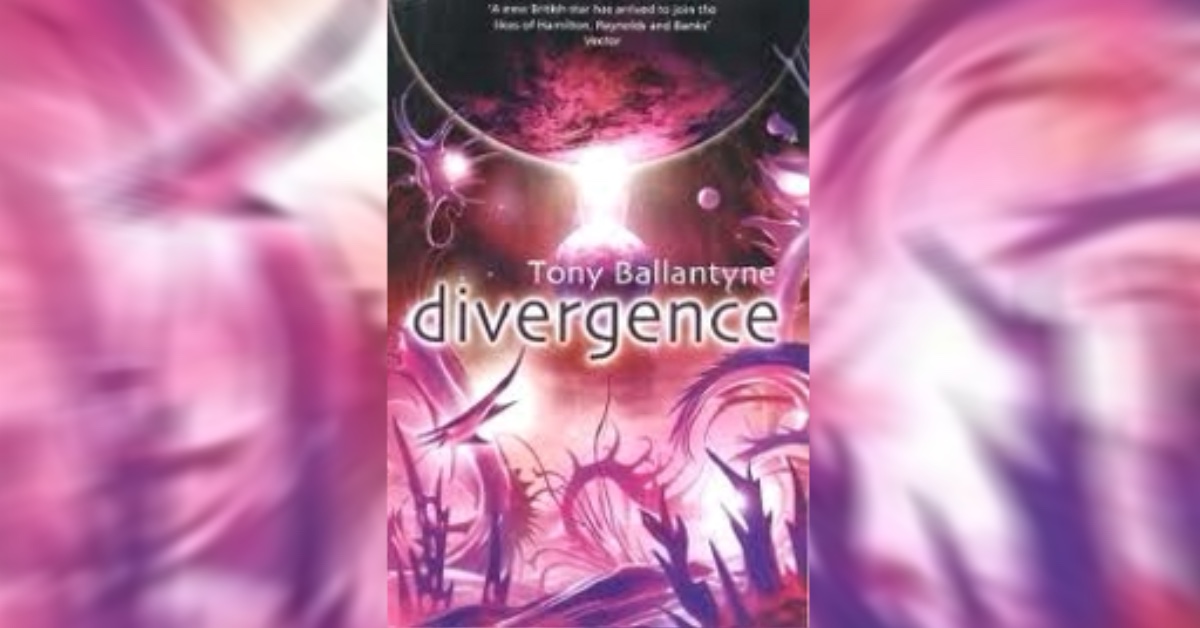
Divergence

“Full of invention and ideas, guaranteed to revive a sense of wonder.”

– The Times

“Ballantyne handles an intricate future skillfully and oddly hopefully … maintaining a fine balance between good characterization and a fast-paced plot.”

– Booklist

The robot Constantine notices an Artificial Intelligence spontaneously coming into being on a distant planet…and watches helplessly as it is destroyed.

In deep space, far from Earth, Judy senses a change of mood aboard the passenger ship she travels on…and a quick investigation reveals that the craft is succumbing to a mysterious alien infestation.  Just as hope seems lost, a group of combat drones appears to rescue all the passengers, except Judy – who is told she is the property of a forgotten mega-corporation based on Earth.

Returned against her wishes to an Earth under constant assault from the same alien infestation, Judy begins to learn her place in a conspiracy billions of years old.  But is she ready to take on the benign, omnipotent, all-seeing Watcher who guides human destiny?

And destroy it?

Buy Divergence on Amazon UK | Buy Divergence on Amazon US

Extract

Edward sat in the conference room, his hands covering his face, his feet on his chair so that his knees were drawn up to his chest.

“I don’t like them,” he said.

“Don’t be silly,” snapped Saskia, striding into the room.

“That’s not going to calm him down, is it?” said Judy, quite reasonably. She placed a reassuring hand on the big man’s shoulder, and said something softly that Maurice couldn’t hear.

The cause of Edward’s distress could be seen floating in a viewing field above the black shiny table.

“What are they?” asked Maurice.

“We don’t know,” admitted Judy. “Nor does Aleph.”

She pointed to a viewing field, where the system-repair robot they had picked up from the Petersburg could be seen clinging to the hull of their ship. Aleph gave Maurice a cheery wave.

Maurice gave a half-hearted wave in return as he moved closer to the images. They reminded him of flowers: they were all the same size and shape, roughly spherical. Their surfaces were spectacularly coloured, bursts of yellow and red and orange tangled around each other in fractally entwined patterns that deepened to a dark rose at a focus. Maurice understood why Edward seemed so frightened. The patterns on those flowers were unnerving: they gave the impression that they were looking straight at you.

To conceal his uneasiness, Maurice pulled out his console and brought up a scale reading. The flowers registered as just over thirty centimetres in diameter. He called up a topographical mapping.

“The readings suggest that they are not completely spherical,” he announced. “There is an indentation at the other side of these objects. They’re hollow. So what’s inside?”

“We don’t know,” said Saskia. “They’re turning so as to face us as we travel. It’s like they are always keeping their back to us, not letting us see what they’re hiding.”

Maurice rubbed his chin. “Oh. I’ve never heard of anything like this before.”

“Nor has Aleph,” said Judy.

“I don’t like them,” repeated Edward. He noted Saskia’s glare. “They’re not right,” he whined. “They’re alien!”

Judy rubbed his arm gently and spoke to him in a voice learned from Social Care.

“Edward, they’re not alien. Aleph says so.”

“Aleph is an alien himself! Why should we believe him?”

“There are no such things as aliens,” snapped Saskia, looking painfully thin and bristling with nerves. “I already told you that. We have never found aliens on any of the planets we’ve visited, and humans have travelled a very long way. Aleph is just a system-repair robot.”

“Easy, Saskia,” said Maurice. “Hmm, has there been any sign of the Bailero yet?”

“Of course not.” Saskia was scathing. “We got stiffed again.”

Maurice tapped at his console. “We’re in the middle of empty space,” he said thoughtfully. “The closest star is over three parsecs away. Hmmm, if I were an AI escaping from Earth on a warp ship, this would be just the place I would choose to hide. Right where no one ever comes.”

“Hide maybe,” said Saskia irritably, “but not a very good place to build an empire from. There are no raw materials out here. The Free Enterprise said it was manufactured by the Bailero. Out of what, though?”

“I don’t know,” said Maurice. He gestured at the orange-red eyes of the flowers. “Maybe out of those things. Are there any more of them around?”

“Not that we know of.”

Maurice concentrated on his console. The space flowers- or whatever they were- were about 200 kilometres distant. The Eva Rye was currently at rest relative to them. He checked back on the search pattern that he had programmed: a three-dimensional spiral that swept out a path through a volume of space that was covered by the limits of the ship’s senses. Long-distance senses had picked up the flowers from nine hundred kilometres back, and had watched them closely as the ship slowed to a halt. And the flowers had turned to watch the Eva Rye right back.

“Odd,” said Maurice. “I wonder what they are hiding inside? Let’s try and catch them out. Aleph?”

“Hi, Maurice.”

“I’m going to take the Eva Rye up and over to the other side of those things. Why don’t you let go of our hull and just stay floating here? If they turn to follow us, you might then get a look at what they’re concealing.”

“Maurice,” said reprovingly, “that wasn’t part of our contract.”

“Aleph, there should be an antique Warp Ship waiting here for us, payment for taking Judy to Earth. Instead we have found space flowers. Look at it this way, Aleph, if there is no ship, there is no contract, so we will not be going to Earth.”

“There’ll be a ship,” said Judy resignedly.

Saskia glared at her. Maurice ignored them.

“Help us, Aleph, and we’ll soon be on our way.”

“Oh, very well,” said Aleph. “I’m letting go of your hull. Off you go now.”

Maurice’s fingers danced across his console. “Where’s Miss Rose?” he asked, casually.

“In her room, of course,” said Saskia. “This is just wasting fuel, you know.”

“Well, what do you suggest?” asked Maurice. “Should we just ignore those things and sit here waiting for the Bailero to turn up of its own accord?”

Saskia said nothing to that.

“Fuel?” said Judy suddenly, her head tilted to the side. “The Eva Rye uses fuel?”

“Oh yes,” said Saskia bitterly. “That’s part of the FE deal. Apparently use of such things as AIs and VNMs and unlimited engine range only gives us the idea that we can get something for nothing. That’s contrary to the FE philosophy. Though, of course, in our case we seem to get nothing for something every time we do a deal…”

Saskia sensed that she had lost her audience’s interest. She took a green apple from the white bowl in the centre of the table, and bit into it. She crunched on it noisily as the Eva Rye began to move.

“I don’t like this,” moaned Edward. “I don’t like this!”

“Shh,” said Judy.

“The Petersburg did warn us,” complained Saskia, but Maurice tuned her out.

They watched the flowers intently. The red and yellow and orange blooms hung there, apparently motionless.

“…which means they are turning to follow us,” said Maurice. “They are still trying to conceal their contents. Aleph, what can you see?”

“Nothing as yet,” said Aleph. “Keep going. I can see them turning. They are… Oh damn!”

The crew of the Eva Rye saw it happening at the same time. The flowers seemed to move together, their hidden mouths joining together to kiss and conceal.

“Now what?” said Saskia.
Buy Divergence on Amazon UK | Buy Divergence on Amazon US

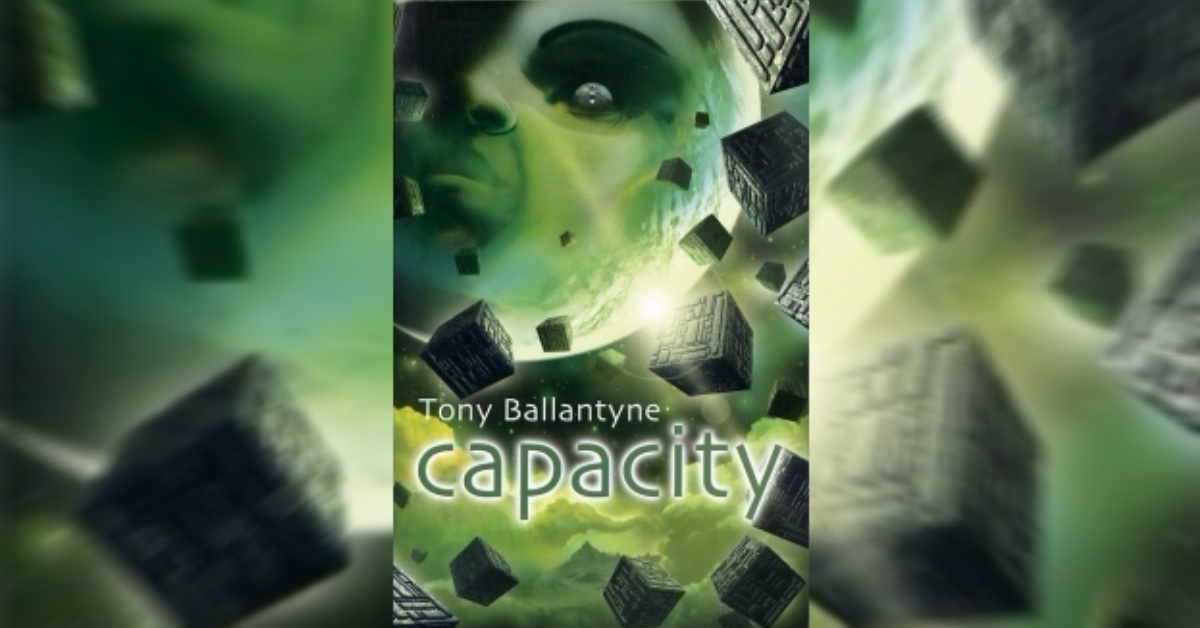
Capacity

“A techno-thriller that aspires to be more than just detective fiction with gadgetry, Capacity successfully tackles themes like free will, accountability, and the nature of human consciousness… It’s to Ballantyne’s credit that these weighty issues never threaten to occlude the individual characters, or to overshadow the sometimes painful attachment you feel for them.”

-Strange Horizons

“Tony Ballantyne lets seasoned hard SF and fans of cyberpunk have it with both barrels in a zero compromise, take no prisoners, novel. Richly plotted and drawing upon many SF tropes, Capacity is so epic in ambition and scope that the unprepared reader might be excused a passing sense of vertigo…”

-Concatenation

Welcome to the year 2252—and congratulations! You’re now a personality construct. We know that can be a daunting stage of personal development,especially if you don’t remember making this life-changing decision. But we’re here to help….

Helen is waking to a dark new reality—one that she’s certain she didn’t choose. In this borrowed existence, she finds an unexpected guide in Judy, a geisha-faced virgin who’s on a mission of her own. Together, the two of them begin a dangerous run through dozens of imagined worlds in an attempt to trap a psychopath haunting the shadowed areas of virtual space—a killer who brutally murdered an earlier version of Helen and who plans to kill again. Meanwhile, Justinian is investigating a peculiar rash of AI suicides on far-off planets—and finds that not only is there more to these “deaths” than he thought, but that they may be linked to his wife Anya’s mysterious coma.

In a future where AIs have taken over human life and the Environment Agency runs everything for our own good, the fact that we can live on after physical death as sentient digital beings should have been a good thing. Instead, as Helen and Justinian are about to discover, it just means there are more ways to die.

Buy Capacity on Amazon UK | Buy Capacity on Amazon US

Extract

The AI pod rested in a little indentation in the bank. It seemed almost unchanged from its dormant state: a smooth fluorescent green kidney bean the size of Justinian, had he taken it into his head to curl up in the foetus position there in the stinking mud. Three BVBs had wrapped themselves around its surface, a few Schrödinger boxes were scattered across the mud before it.

“Hello,” said the pod.

“Hello, I’m Justinian.”

“Hello, Justinian.” The pod’s voice was eager, like a child, fascinated by the world.

“Have you seen these little boxes? As soon as you take your eye off any of them, they jump to another position. But as long as you are looking at them, they stay put.”

“I’ve seen them,” said Justinian, feeling fed up with this pod already. He had been conducting interviews all over the planet, asking the same questions over and over again, and each time receiving exactly the same answers. It was getting tedious beyond belief. For this pod, of course, it was all new.

“Do you know what they are?” it asked. “They’re amazing!”

“They’re called Schrödinger boxes,” said Justinian, carefully. The pod wasn’t fooled.

“Ah! So you don’t actually know what they are either. Maybe you can tell me about these bands wrapped around my shell. Do you know what they are, or do you simply have a name for them?”

Justinian was too tired to be insulted. Besides, it was all part of the script.

“We call them BVBs,” he replied. “Look, I’ve got one in here.”

He pulled the plastic rod from the thigh pocket of his passive suit, and waited a moment for the pod to scan it.

“Very interesting,” it said. “Where did you find it?”

“The plastic rod is a table leg. One of the other colonists found the BVB wrapped around it as they were sitting down to breakfast one morning.”

“One of the other colonists? How many are there now on Gateway?”

“Still just a hundred. And me, of course.”

Justinian gave an involuntary shiver as he said these words. It reminded him how far he was from home, and Justinian felt doubly alone. Here he was, standing on a remote mud slick, lost on a planet that floated between galaxies, and yet he felt himself an outsider to the only group of humans for millions of light years. The bright blue belt of M32 rose into the dark sky behind the pod. The Milky Way was a monochrome rainbow in the other direction.

Justinian rubbed a finger across the fuzzy surface of the BVB and wondered at the strangeness of this place. As far as he was concerned, reality was a force that diminished the further one travelled from home: the hundred colonists were treading in a place of dreams where nothing worked as it should. Nor should it be expected to.

The pod spoke in a thoughtful tone.

“I don’t remember anything about BVBs. I wonder why that is?”

“Probably because they weren’t known about when you were conceived. They were only discovered on this planet.”

Justinian crouched down before the pod, looking for external sense cluster formations. There seemed to be nothing. That implied the pod was still operating on internals. Just like all the other pods, in fact.

“BVBs are similar to the Schrödinger boxes,” he continued, his hands glowing fluorescent green as he felt the rubbery surface of the pod. Red mud squelched under his feet and he grabbed onto the pod to maintain his balance. “BVBs only form in spaces that are not being observed, and then they immediately begin to contract.”

“How do you know?” interrupted the pod.

“How do I know what?”

“How do you know that they begin to contract immediately if the space in which they form is not being observed?”

Justinian gave a tired smile

“Good point,” he said. “I hadn’t thought of that before.” He was struck by how much like children the AIs here on Gateway had become. Innocent, but with a sharp eye for detail.

“Someone probably did, they just didn’t explain that part to you.”

Justinian gazed coolly at the pod. And like a child, he thought, they could be incredibly tactless. They quickly figured out that Justinian wasn’t part of the scientific survey team, and then equally quickly lost all respect for him.

His legs were getting tired from crouching, so he straightened up and began to circle the pod, treading carefully on the slippery mud. One careless step and he could end up rolling down the slope into the dark water below.

“Anyway,” he said. “BVBs form in empty spaces. We believe they begin to contract immediately. Sometimes they get tangled around an object; like a pipe or a tree branch. The slightest touch on their inside surface stops them contracting; nothing can make them expand again. And they’re unbreakable. Nothing can cut through them.”

“Oh…” the pod’s voice was almost wistful. “What does BVB stand for?”

“Black Velvet Band. Named after an old song, apparently.”

Justinian rested a hand on the warm surface of the pod. He looked at the three BVBs that had formed on its supple skin. “If you rearrange your external structure to make your skin frictionless they’ll slip right off.”

There was a moment’s pause before the pod spoke.

“…I can’t,”

“You can,” said Justinian. “All AI pods have multiform integuments. Yours is just set to dormant mode at the moment. Wake it up.”

“I can’t,” said the pod. It sounded embarrassed. “I don’t understand how to work the mechanism. I can see the potentials arranged before me, but I don’t understand how to achieve them.”

Justinian yawned again; looking out across the water. A pale glow had appeared over there as dawn approached. He wondered if he could make out the shape of another mud bank, slowly materialising from the blackness.

“You’ve heard all this before, haven’t you?” said the pod shrewdly. “Who are you? Why are you here? You’re obviously not one of the regular surveyors.”

There it was again: all the pods so far had figured this out. They might be acting like children, but they still had intelligence at least equal to his own. And, stripped down though their intelligences were, they still had access to vast libraries of data. Data that covered many, many subjects. How to read body language would be just one of them.

Justinian played it straight. “My name is Justinian. I’m a counsellor. I’ve been brought to Gateway to try and figure out why AIs aren’t thriving here.”

“A counsellor?” said the pod. “What sort of a counsellor? MTPH?”

“Originally. I work mainly with personality constructs nowadays.”

“Personality constructs? Does that make a difference?”

“It shouldn’t do. You have to retrain in the use of MTPH….”

“I suppose that’s one reason for sending you here to speak to me,” said the pod thoughtfully. “Still, I would have thought the reasons for my failure would be beyond human intelligence. I would have thought the investigation would be a job for an AI.”

Justinian spoke in his most sarcastic voice.

“You’d think so, wouldn’t you? The trouble is, AIs don’t seem to want to work on Gateway. So far I’ve interviewed fourteen of the thirty two pods that were seeded here. All of them have been exactly like you: drastically reduced versions of their former selves. Virtual suicides.”

The pod seemed unbothered by his tone.

“Really? So it wasn’t just me, then…”

The pod was silent for a moment. When it spoke, Justinian thought that there was an edge of fear to its voice. That was silly, of course. The pod could make its voice sound however it wanted it to sound.

“So that’s why they sent a human. But why you, I wonder? There’s more, isn’t there, Justinian? There’s a reason why they chose you in particular.”

Buy Capacity on Amazon UK | Buy Capacity on Amazon US