Guest Post: Stephen Palmer

I suppose Brian Eno is best known for his contribution to music; and a lot of it is great music. I always think of him though for a particular piece of advice: Use your accidents. As a producer, Eno encouraged bands to moderate or even ignore their instinct to produce polished music, in favour of that with the vitality of accidental input.

How does this fit with writing?

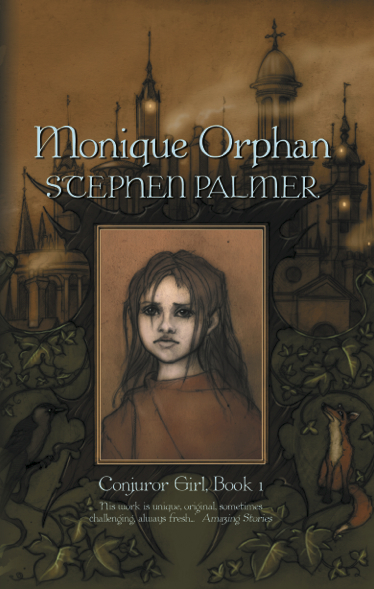
When I was putting together the scenario for my new Conjuror Girl trilogy – a steampunk work set in an alternate late Victorian version of my home town of Shrewsbury – I thought everything would be steam, carriages and horse power. Then, reading one day a book about carbon-based fuel, I was struck by a reference to the fractionating column, used by chemists to separate different compounds existing in the same solution. Such a contraption I’d not seen since my school days. I looked up from the book, wondering if I could use the thing for Conjuror Girl, but I thought… nah. Too modern.

Then I reconsidered. The mental image persisted. Chemists did all sorts of things in the late nineteenth century, so was there really a reason to ignore this accidental image? I jotted the idea down, then was suddenly struck with another idea. The dark side of these novels comes in the form of the Reifiers, men with the ability to make real – reify – the contents of their minds. As it is put early on, they can make real their whims and fancies. But to do this they have to impose their minds upon the world, an act of deep selfishness. The consequence of Reification is a black fluid which, lore has it, is composed of pure selfishness; and even Reifiers dare not come into contact with this stuff.

Now I was getting to the kernel of the idea. What if this oily black liquid was composed of different fractions which could be separated in a fractionating column? What if there was a character who did this – a madcap scientist, a petit-Reifier in fact. Suddenly I had a whole new part of the plot, previously blank.

It’s accidents like this which make sub-creation such fun. I usually leave many of a novel’s details vague so that, when I’m writing in the white heat of composition, I can use my imagination for fuel.

And there was another accident which I took advantage of. When I was at school I did history before taking other O-levels, and the first thing we studied was the Danelaw. While talking about school teachers to a friend one day I suddenly remembered history lessons, and the naïve, poorly drawn map I did in my history book of the border between England and the Danelaw, which my teacher wrote poor next to in red pen. Thinking on this, I wondered if I could perpetuate that border and have part of Britain inhabited by Danes…

A final accident, then. When looking at a map of south-east England one time I noticed Sussex, Middlesex and Essex, and their origins in Saxon regions. There was also a Wessex of course. At once I asked myself: why no Nossex? Well, there were no north Saxons to leave such a name. I knew at once that I had to invent the region. So I did. My fictitious Shrewsbury is in Nossex.

Buy Monique Orphan from Amazon

http://www.stephenpalmer.co.uk/
The Food Bin

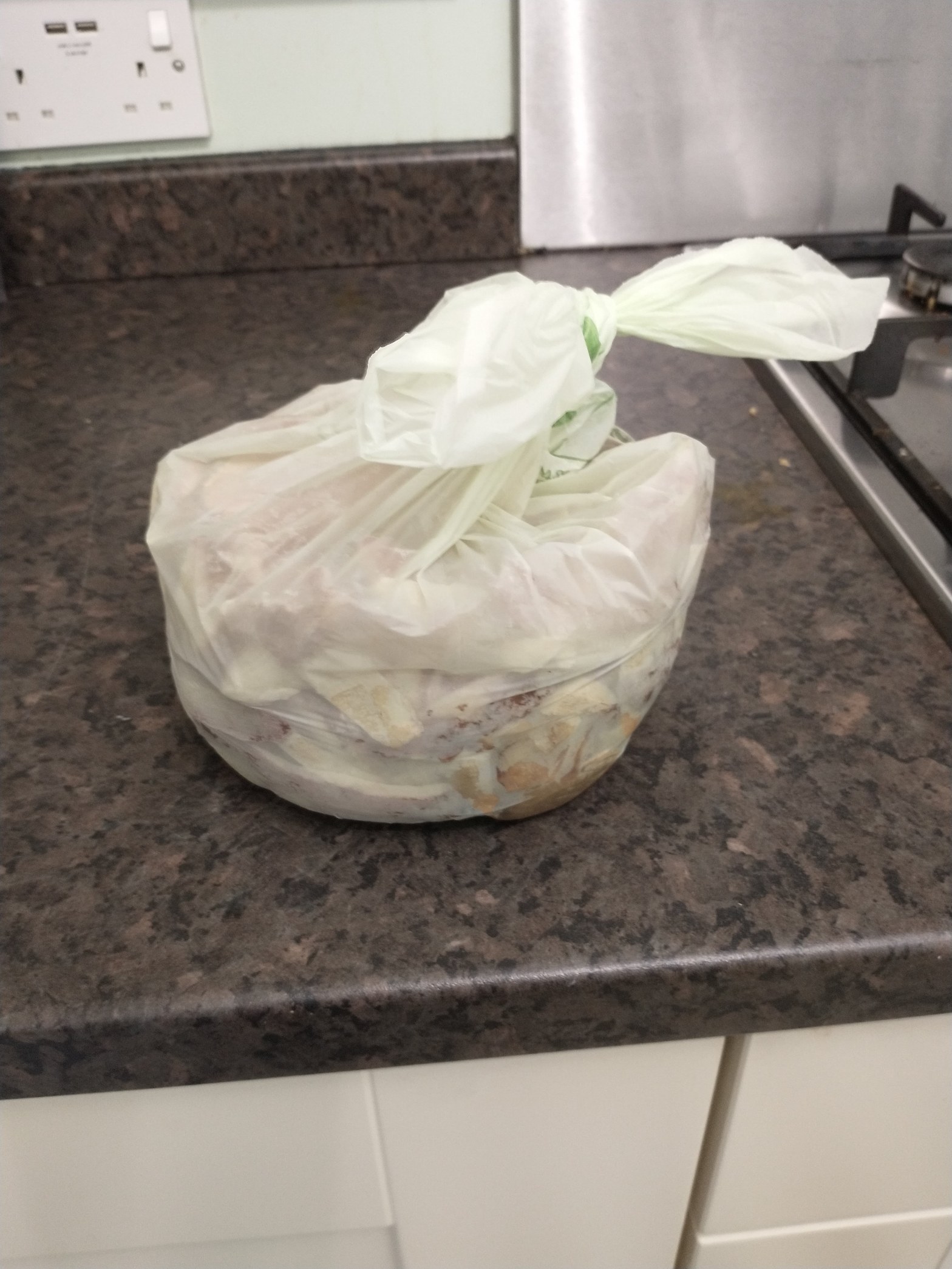
This is a green bag. A green bag of food waste.

The green bag contains things like potato peelings and leftover scraps: the sort of things that can’t go on the compost heap. The green bag normally lives in a container. When the bag is full, it’s taken out to the green bin. Here, someone has taken it from the container and left it on the kitchen counter.

This is very much the COP26 solution to the problem of keeping the house tidy. It has the appearance of doing something to help the housing environment, but it achieves nothing. It’s actually offloading the real problem (taking the green bag out to the green bin) onto someone else, all the while giving the culprit the chance to boast about their green bag credentials.

Who was it? Investigations are ongoing, but I’m pretty confident it will turn out to be the dog. The dog seems to be behind most of the crimes committed in our house, including drinking the last of the milk, not putting the butter back in the fridge and failing to turn on the dishwasher.

Genesis

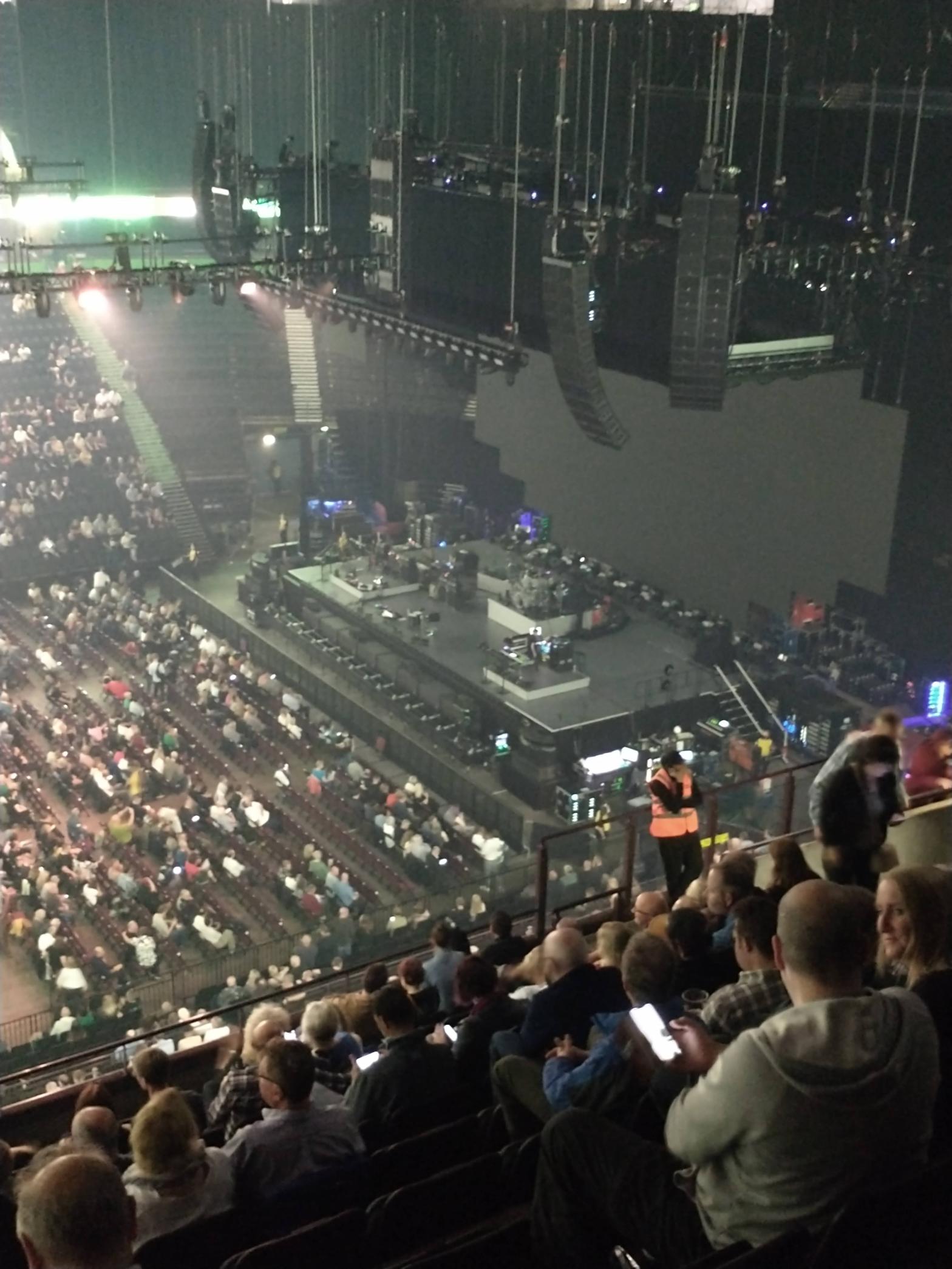
On Friday night I saw Genesis for what will probably be the last time. It was was an excellent, though flawed, gig. Excellent because of the warmth of the crowd, the good humour of the band and the body of work they played. Flawed because they are getting too old for performing. Much comment has been made in the media about how Phil Collins performs seated (as does Mike Rutherford for part of the performance). What’s not really been mentioned is how often Phil Collins is off key and out of time. If I’m to brutally honest, the other original band members weren’t at the top of their game either in terms of their playing.

But this isn’t a problem. Phil Collins still has great stage presence and charisma, he controls the audience with a wave of his hand. And there is is something rather magnificent about seeing him refusing to give up, walking onto stage using a stick. Unlike some other groups still touring, I don’t imagine that Genesis need the money. They were performing because they wanted to. 

I’ve written before about Second Rate Entertainment and how much I enjoy it. This was hardly a second rate entertainment. The light show was of typically high standard, a lot of time had clearly been spent on arranging and rehearsing. I’ve seen a number of older bands in the past few years using backing vocalists and musicians to support ageing singers and players. It’s usually done thoughtfully and honestly, the audience is under no illusions about what they’re hearing.

This was a gig aware of mortality. The song Fading Lights, the last song on Genesis’ last album together was used to introduce a medley of old hits.  The most poignant moment was in the middle of I Know What I Like. Many of us remember how Phil Collins would perform a lively dance with the tambourine. Now all he could do was rather wryly hit it on his head.

I  don’t know what non fans would make of the event. I saw a lot of history in this performance a certain  bravery and quiet resolution not to gentle into that dark night.  I was very moved.

And I knew that’s not just because of the gig.  I’ve been a Genesis fan since I was a teenager. That concert felt like an end bracket on part of my life, one reflected in the fact that I was taking my son to university the following day. The end of another era.  But another built on a solid body of work that I will certainly remember.

Genesis AO Arena Manchester 24/9/21

Educational Research

Why not do your own educational research? It’s easier than you might think. Just follow the steps below.

1: Choose a hypothesis.

This is the hardest bit. You could try something obvious such as you get better with practice. You could also try to demonstrate something that is patently ridiculous, for example, sniffing oranges improves grades. To be honest, it makes no difference what you decide on, someone will believe it.

I’m going to choose an obvious hypothesis as it will make it harder for someone to disagree with my conclusions.

Hypothesis: students get better at something when they practice it.

2: Find some Citations

Use this random name generator https://www.behindthename.com/random/ to find some authors to cite. Here are three I generated as an example

Bradford Jamison Elliott, Geoffrey Maitland Roach, Teresa Dorean Robbins

3: Graphs and Charts

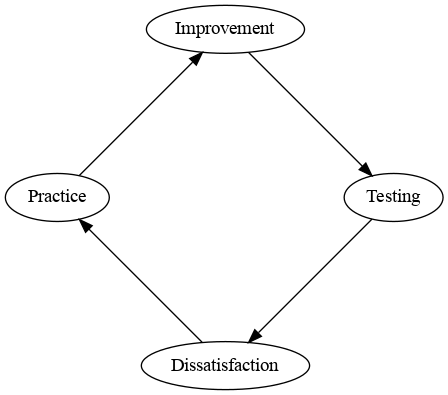
Research looks more convincing with a graph or chart. I’m going to create a cycle chart. Educational researchers love cycle charts. Here’s one I knocked up using Graphviz.

Dissatisfaction -> practice -> improvement -> testing

4: Test your Hypothesis

Split one of your classes in two halves. Test your hypothesis on one half, leave the other as a control group. If you don’t get the results you want, just ignore some of the students or swap them around between groups.

5: You’re going to need an Acronym

Think of a word. Some good words to use the basis for your acronym are VECTOR, INSPIRE and RAISE

I chose ERIC, as my friend is called Eric. Eric could stand for

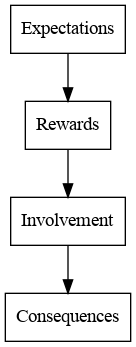
Expectations, Rewards, Involvement and Consequences.

That looks a bit boring, so here it is rewritten as a flowchart:

6: It must be true, I read it on a blog

Publish your research on your blog and then tweet what you’ve done. Retweet other people’s research in the hope that they return the favour.

bliss

I ripped my CD’s in the noughties.  Now they’re sat in the attic awaiting the collapse of civilisation. When the electricity stops working I can at least look at the covers and remember what music used to sound like.

In the meantime I can enjoy listening to my music wherever I like. Since I digitised my collection, however, I’ve never managed to keep it tidy.  I’ve tried various software to sort out my folders, eventually settling on Picard and Emacs. The trouble is, the collection always seems to grow faster than my attempts to tidy it.  

This weekend I gave up trying to manage it myself and installed bliss.  bliss audits your music collection according to a set of rules that you choose and then fixes any problems it finds.

By way of introduction, bliss fixes your cover artwork.  The software is very flexible, you can choose whether to embed the art into the individual music files, keep it separate or both, for example.

Here’s a picture of it in action:

Scanning Albums

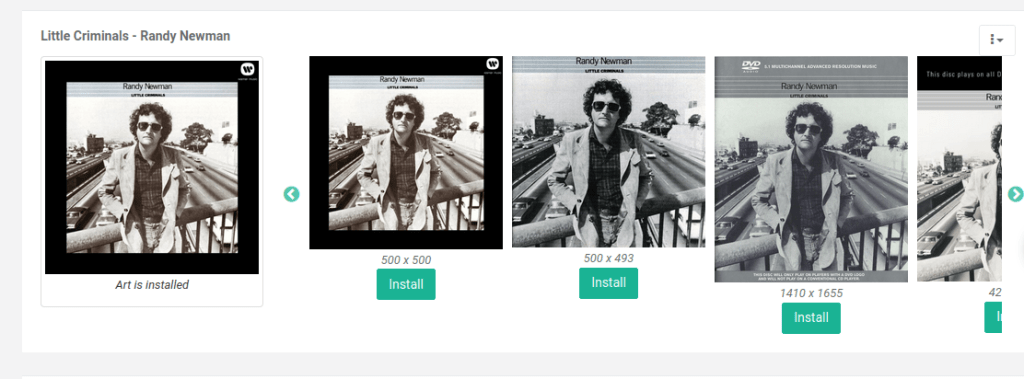
You can choose from alternate covers if you want to match the art in your original collection.

Alertnate covers

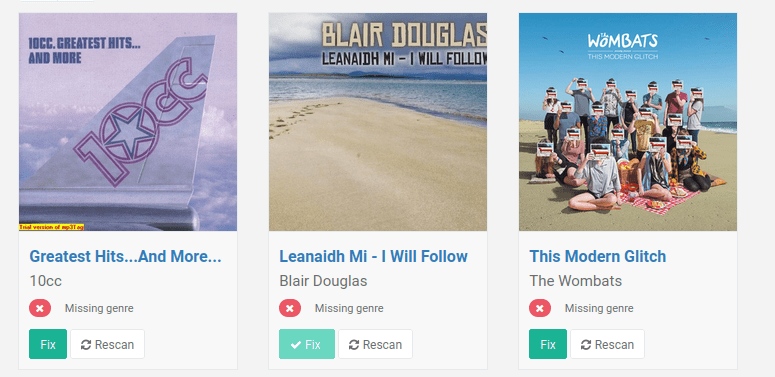
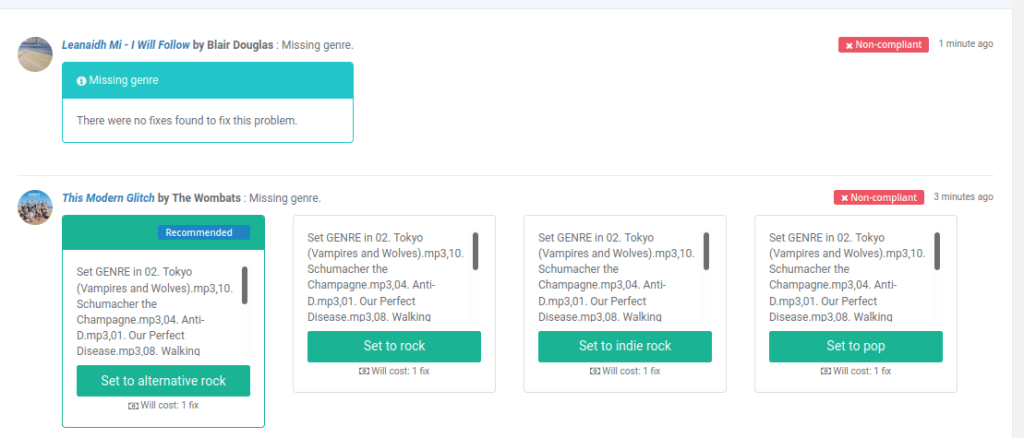
Finding lost artwork is only the beginning. You can apply rules to do such things as fix genre or sort out your folder structure. Fixes can be applied manually or automatically, as below:

Fixing Genres

I’ve wasted a lot of time over the past few days just watching it work:

Scanning in action

What’s the catch? Well, not a catch as such, but you have to pay for bliss. It comes with 100 fixes, so that’s a 100 pieces of cover art installed for example.

11 Fixes left

You can buy more fixes but for a large collection you’re going to end up spending £59 or equivalent for unlimited fixes, and let’s face it, if you don’t have a large collection, you’re not going to need the software.

Is it worth it?  As a writer I believe that people should be paid for their creative endeavours however, full disclosure, bliss offer a the license free to people who blog about the software. But even if they didn’t, I’d pay the money.

Fifteen years of trying and failing to tidy my collection have proven to me it’s not going to happen any other way.

Find out more here: https://www.blisshq.com

12 Mince Pies

I’m not a superstitious person.  I walk under ladders and on the cracks in pavements.  I don’t knock on wood, I don’t throw salt over my shoulder and I can never remember whether black cats are good or bad luck.

About the only superstition I follow is one my mother told me when I was a child: that if you eat a mince pie on each of the twelve days of Christmas you’ll have good luck for the following year.  I only follow that superstition because I like mince pies and I’ve been pretty conscientious about maintaining it for that reason. In fact, I think the only time I’ve ever not eaten 12 mince pies over the Christmas season was last year, when I had the flu and I didn’t really feel like eating anything.

You may be pleased to know I made damn sure that I ate 12 mince pies this year.

You’re welcome.

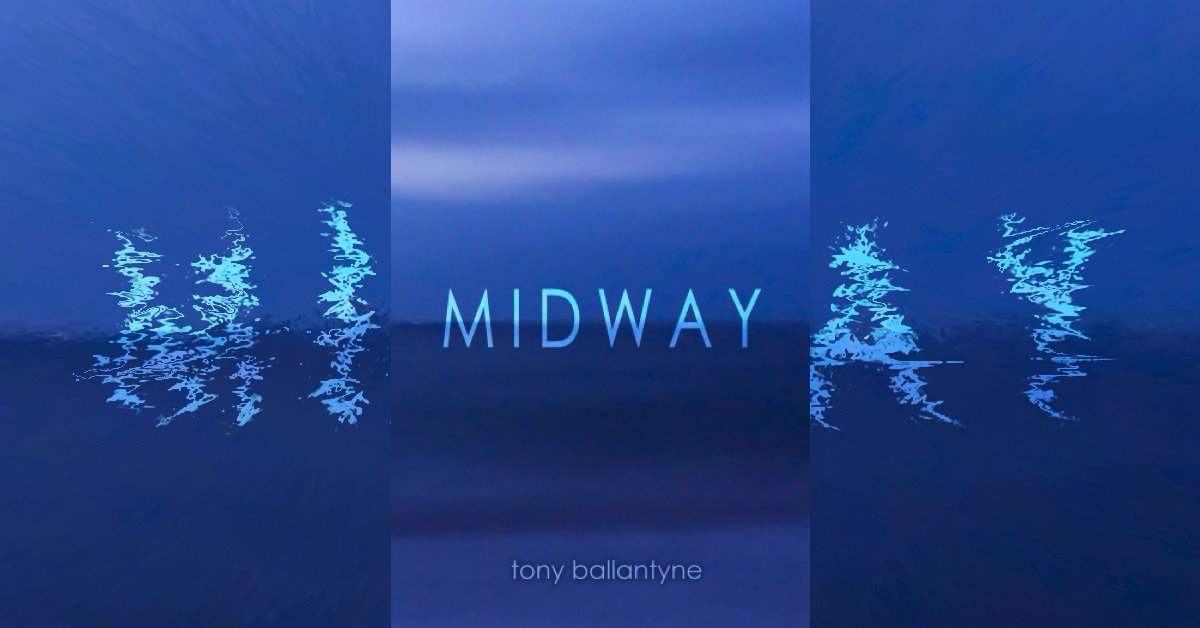
Midway

Written on the road between the past and the future, a writer explores his relationship with his dying father.

Literature, fantasy and science fiction come together in this unique and very personal piece.

Buy on Amazon (paid link)| Apple Books

| Barnes and Noble | Buy on Kobo

Ballantyne’s moving, quietly profound stories present flawed human beings confronting the vicissitudes of life with varying degrees of success. Superb.

The Guardian 16/10/2020

‘Sharp, touching, and very original, this collection uses stories of different genres to explore aspects of the same emotional landscape, creating a very personal and very satisfying whole.’

Chris Beckett, winner of the Arthur C Clarke Award

My New Writing Regime

I have a new writing regime.

For years I used to head in Manchester city centre to write in coffee shops and the Portico Library. Nothing unusual about that, many writers do the same.

But then lock down came and I found myself sat at my computer doing the day job for hours on end. Writing took a back seat: the last thing I wanted to do in the evening was to go back to the keyboard. I needed to find a new way to work.

I think I’ve found it.

Now, when it’s a writing day, I put my notebook and iPad into my backpack and set off walking. If I get an idea I record it on my phone using Speechnotes. When I’m ready to write I find somewhere to sit, be it a cafe, bench, pub or a convenient rock, and begin to write on my iPad. I repeat the process until I’ve done at least 500 words and then I go home.  The system seems to be working.

Not only that, it’s made me realise something.

I’ve now been a professional writer for twenty something years. During that time I was always in a hurry to get somewhere to write a story. It’s only recently occurred to me that when I read other people’s stories I stop and look at the scenery.

So that’s my new regime. I find I’m spending less time on the writing and more time on enjoying the scenery. Does it make me a better writer? I don’t know. I’m certainly a more relaxed one.

Forks

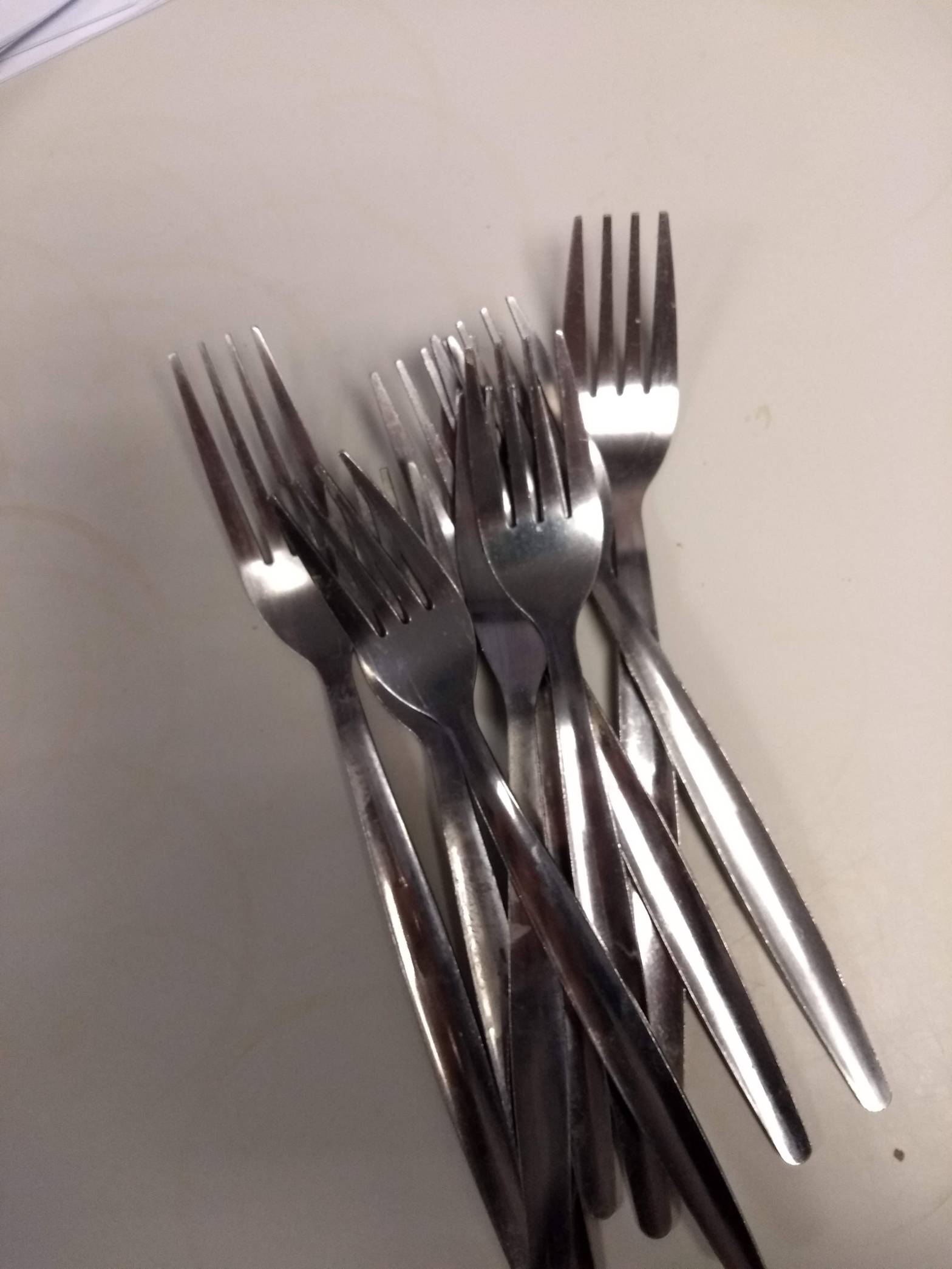
Here is my pile of forks. The forks live on a shelf above my desk at work.

Every time I get a take away meal from the restaurant I take a metal fork with me. 

I always used to take my metal fork back to the restaurant when I finished my meal. This is because I am the sort of person who likes to keep things tidy. A place for everything and everything in its place. But it was also partly because it just seemed the right thing to do.

And then there was a notice in the staff bulletin saying that staff must return their cutlery to the canteen after their meals.  It listed the number of knives and forks in the canteen on a day to day basis and pointed out that the number was falling.  Staff were instructed to return their cutlery immediately.

Quite naturally, I began to hoard forks.

I know that not returning the forks is childish. I’m also aware that the pile of forks is upsetting me. I’d much prefer them to be back in their natural environment: basking in the cutlery tray. 

But most of all I’m really irritated at being instructed to do something I was planning to do anyway.

That’s why I have a pile of forks.