My short story The Scooped Out Man appeared as the Tuesday 14th June edition of Daily Science Fiction.
Author Archives: Tony Ballantyne
Writer and Tech blogger
Map AltGr to Alt on Linux
All I wanted was to make my AltGr key to work the same as my Alt key…
As my poor hands continue to struggle with RSI, I’ve been looking at ways to make my typing more efficient. One thing that occurred to me was to fix something that had bugged me for ages: the fact that I never use AltGr on my keyboard. Things would be easier if it acted like Alt. It would certainly make it more comfortable to hit M-x and M-g in Emacs
And so I searched and searched for ways to do this. The simplest way I found was to type the following command into the terminal:
setxkbmap -option altwin:meta_alt
But how to run that at startup?
My Arch Linux setup uses the i3 window manager, which is called from ~/.xinitrc. Adding setxkbmap -option altwin:meta_alt to the beginning of ~/.xinitrc did the trick.
That doesn’t work on Ubuntu 16.04, however. The easiest way there is to use dconf editor.
sudo apt-get install dconf-editor if you’ve not already got it, then navigate to org|gnome|desktop|input-sources and choose xkb-options.
Insert the following in the value box: ['altwin:meta_alt']
… and that’s it.
How Writers Write: Eric Brown
How Writers Write is a monthly series of guest posts where established writers invite you into their workspaces, reveal their work habits and share their experience.
Follow this link for a full list of previous posts
Eric Brown is my oldest SF writer friend. When I met him in the year 2000 he was still coming to grips with the twentieth century. Let’s find out how he’s dealing with the twenty first…
What tools do you use?
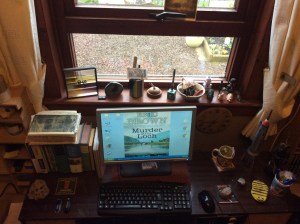
I work on Word on a Dell computer, a twelve year old machine that Keith Brooke gave me. It serves its purpose as a word processor. I’m not into technology: I’m not interested in tech and gadgets. I don’t have a mobile phone or whatever they’re called now. I don’t even have a watch. I carry a sundial around in my backpack.
I plot a novel – in as much as I plot anything – and make random notes freehand in an old jotter. These days I don’t do much planning, just some notes on characters and an idea or two, then I get going. It works for me. In my notebook, which I keep to the left of me when I’m writing, I scribble down anything from a list of phrases that people spoke in the nineteen-fifties (for the series of crime novels I’m writing set then), to a line of dialogue, to a detailed day-by-day breakdown of how may words I’ve written. (I’m anal like that).
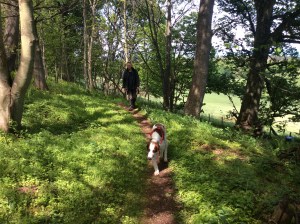

When I’m working on a project, novels, stories or whatever, I work five days a week, from Monday to Friday. Occasionally I might work on a Saturday and Sunday if my wife and daughter are off doing things. I walk the hound in the morning at eight-thirty, and get to my desk at nine-fifteen, work for two and a half hours. In that time I write two thousand words, or a couple of hundred under or over. Around eleven forty-five I knock off, take the dog for another gallop, have a green tea and a sandwich for lunch (yeast extract, peanut butter and beetroot, since you asked, or less occasionally Stilton cheese, lettuce and mayonnaise, or sometimes Vegemite, tahini and cucumber, or probably once a month cheddar and hot lime pickle), then get to the desk again around one and work till around three-thirty, knocking out another couple of thousand words. Before I married, fifteen years ago, I’d work in the evening too, so that I could produce over six thousand words a day – and I worked at the weekends.

This meant that my early novels (From Meridian Days to New York Dreams) were written in around a fortnight, or just over. I’d stagger from my study a gibbering wreck and demand pints and pints of Timothy Taylor’s best bitter. Then, when I’d sobered up, I began the laborious task of rewriting the things.

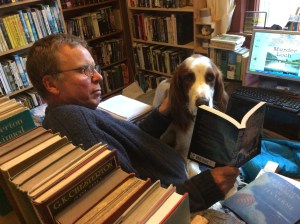
(I walk the dog for two hours a day. He’s called Uther and he’s a red and white setter. He’s our first dog, and a life-changer. Having children is easy, a joy, compared to owning a dog. That said, he does exercise me. I wouldn’t get out otherwise, and while out walking the beautiful countryside of Berwickshire, around the village of Cockburnspath, I get lots of day-dreaming done. Uther was immortalised in Tony Ballantyne’s fine novel Dream Paris, in a scene which brilliantly encapsulates my relationship with the hound).
I write in my study surrounded by over three thousand tomes and air that smells of dog. I love books. I collect them. I collect SF, old and new, and fiction from the thirties, forties, fifties, sixties. I collect autobiographical books and biographies of writers. I collect the works of Rupert Croft-Cooke, G. K. Chesterton, Peter de Polnay, Miles Tripp, Elizabeth Ferrars, Michael Coney, Charles Bukowski, and many more. I don’t read on a Kindle, onscreen, or anything else like that. I detest Kindles etc. They’re just text, shorn of much of what a book is. A book is a beautiful object with its own history and associations. The abomination of Kindle renders every single book as a homogenised, soulless product – perfect for the homogenised, soulless world in which multinational companies and capitalist moguls would like us to exist.
Where do you write?
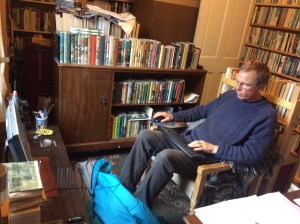
My computer sits on my ‘desk’, a nineteen-fifties Baird radiogram. I sit back in a armchair with the keyboard on my lap and tap away. My wife says that’s why I have backache. On my desk are bits and bobs I’ve picked up over the years. Pens I love. A broken Wallace and Grommit mug. A tin rocket. A rock. A clay bee and a hippo my daughter Freya made. A hole-filled rock I found on Eastbourne beach while visiting James Lovegrove, which I use as a pen holder. Some reference books I hardly ever refer to. A statue of the Hindu monkey God Hanuman. A Timothy Taylor beer mat. A clock. On the window sill behind my computer are some plastic dinosaurs, a couple of pigs, a robot salt- and pepper-pot (thanks, Becky), a BSFA award for a short tale, an ancient metal statue, probably worth hundreds of thousands of pounds, of a man holding his head in one hand and his penis in the other. He looks like how I often feel.
When do you write?
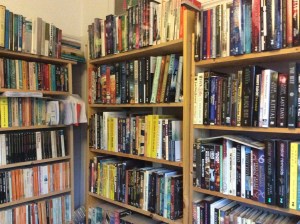
I only ever write in my study, but think about story all the time.
I like peace and quiet while I’m scribbling. I don’t like music when I’m writing. I don’t wait for inspiration. That way I’d never write a word.
I write by the seat of my pants. In the early days, forty years ago when I began writing, I didn’t know how to write, so I had to have detailed notes and plans and plots and lists of characters to shore up my under-confidence. Now I know how to write and I have no fear of writing. I have technique, and trust in that and in my subconscious. They get the job done. I often start with little knowledge of what I’ll be writing , but the old sub-con kicks in and dictates the words.
Questions of style
A novel or story dictates style, narrative viewpoint etc. I don’t much think about things like that beforehand, or about the actual prose style I’ll be using. I follow both characters and plot, whatever is dictated by my subconscious.
When the first draft is done I’m unutterably depressed for a while. Life seems pointless. The rush of creation is over, the endorphins run dry. Now comes the hard and dispiriting work of rewriting. While writing the first draft, I convince myself that the book or story is great, even exceptional. Then I finish and realise it isn’t – but it has to be made better. That’s bloody hard work. And I make lots of continuity errors and other ballsups which need fixing. Hey-ho.
How many redrafts?
Many.
How many readers?
Half a dozen. And I value them immensely.
How easy is it to let go?
It’s bloody fantastic to say au revoir to something I’ve been working on for months. I’m delighted to see the back of it.
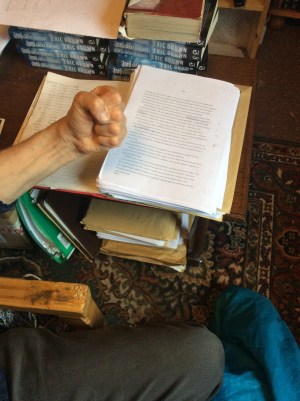
At the moment I’ve just finished the first draft of Murder Take Three, the fourth book in the Langham and Dupré series of crime novels set in the fifties. So I’m at that depressed stage of creativity, the rush over. Plus my wife and daughter are away in Haworth visiting my mother-in-law so I’m rattling round the house with the dog, eating curry and sandwiches and feeling sorry for myself and staring balefully at the mound of the ms I’ve just printed out and shaking my fist at the bloody thing and threatening to rip into it with a red pen and cut it by nine thousand words and turn it from a sow’s lughole into a silken purse.

Also, the damned thing isn’t contracted for. I wrote it on spec, which I don’t normally do, as the idea came to me and I like the characters of Donald Langham and Maria Dupré and Ralph Ryland, the Cockney detective. I just hope Severn House want it.
Next, I’ll be rewriting the second half of Binary System, an action-adventure novel about a woman stranded on a very alien planet, and how she survives. The two halves of the novel will come out later this year from Solaris as e-books, and next year as a real paperback book which you can hold, fondle, smell, read and slip onto the shelf. Then I’ll be writing the fourth Telemass novella for PS Publishing, then a play for Big Finish, a few shorts stories, and later this year a big SF novel I’ve just sold to Solaris.
How would I describe myself?
Writer, curry addict, secularist, liberal, Leeds United fan, a man who increasingly finds the world a bewildering hell-hole, bracketed as we are by the bigoted Trump on one side and the religious fascists of Daesh on the other. No wonder I escape into my writing whenever possible.
My website is at: https://ericbrown.co.uk/
Cheers!
RSI, Tendonitis, Carpal Tunnel Syndrome…
I suppose it was inevitable that after so much time spent writing stories and articles and programming, I would suffer from Repetitive Strain Injury.
I’ve taken care of myself over the years: making sure I set up my work station properly, doing exercises, buying a suitable chair, using an ergonomic keyboard. Even so, things are getting more uncomfortable…
So now I’ve taken three further steps, as follows:
i3wm
I’ve installed the i3 tiling window manager on my Ubuntu setup. (Here’s an article on why you should use a tiling window manager)
I’ve used i3 for some time on my Arch Linux setup, mainly for speed and simplicity. As it has become apparent that using the mouse gives me the greatest amount of pain, it seems sensible to do anything to reduce its use. The i3 desktop is the perfect solution. It allows you to do nearly everything using the keyboard, which has the added bonus of increasing productivity.
I now deliberately push the mouse away from the keyboard so as to lead me not into temptation whilst I work. Doing this has encouraged me to learn the shortcut keys for applications such as Chrome and even things like VLC and Spotify. If I’m honest, it’s only laziness that’s stopped me learning them in the past: I could have searched for the Chrome shortcuts at any time, but it was easier just to use the mouse.
i3wm sits nicely on top of Ubuntu. Installing on Ubuntu is a great way to get used to using it, as you have the fallback of logging into Unity when you need it.
Evil Mode
If you read my blog, you’ll know I’m an Emacs user. However, as I said in this blog entry, you have to admit that vi has a great set of key bindings. I do my planning and structural editing in Emacs – there’s nothing faster – but When it comes down to plain text editing I find the vi commands easier on my poor hands. That’s why I use evil-mode.
I’ve set up my .emacs file (see below) so that I can turn evil-mode on or off by pressing F6. I’ve also added code which I found on Stack Overflow that causes evil-mode to go to Emacs mode when I press any insert command. Switching between modes allows me to get the best of both editors. For example, I much prefer vi’s ma and `a to set a mark and jump to it, rather than Emacs’s rather cumbersome C-x r SPC a. Points marked in vi are remembered no matter how often you turn on and off evil-mode in a session.
Dictation Software
Lastly, I’ve taken the plunge and bought voice recognition software, the software used to dictate this blog entry, as a matter of fact. On the plus side, it saves using my hands, on the minus side, Dragon Naturally Speaking only comes in a Windows version. I suppose I should have a look at installing it on Linux using Wine.
I’m finding using Windows 10 extremely depressing experience. Still, I’m only there long enough to dictate notes. After that it’s back onto Linux and Emacs where I use my precious hands to do the editing. I’m currently clocking myself on Emacs, comparing my typing rate with my dictation rate. It will be interesting to see which is faster. I’m having to get used to thinking my thoughts then speaking them rather than just typing and thinking at the same time. I wonder if it will have an effect the creative process? More on that another time…
.emacs and evil-mode
(require 'evil) ;; installed using Elpa

;;  The following ensures j,k for up and down follow visual-line-mode
(define-key evil-normal-state-map (kbd "<remap> <evil-next-line>") 'evil-next-visual-line)
(define-key evil-normal-state-map (kbd "<remap> <evil-previous-line>") 'evil-previous-visual-line)
(setq-default evil-cross-lines t)

;; i a o etc go to emacs mode
(defalias 'evil-insert-state 'evil-emacs-state)

;; Turn on and off evil-mode
(global-set-key (kbd "<f6>") 'evil-mode)
(global-set-key (kbd "C-M-z") 'evil-mode)How Writers Write: Chris Beckett
How Writers Write is a monthly series of guest posts where established writers invite you into their workspaces, reveal their work habits and share their experience.
Follow this link for a full list of previous posts
I introduced myself to Chris Beckett at an Eastercon in Blackpool: I wanted to tell him how much I’d enjoyed his short stories. Here he tells us how they are written…
What tools do you use?
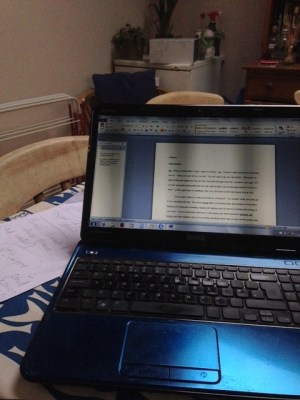
I write on my fairly aged laptop, using word. There was a time, long ago, when I found it hard to write directly onto a keyboard – which would then have been a typewriter– and liked to write by hand first, but now it’s the opposite. I’ve pretty much lost the knack of writing by hand, for anything other than short notes, and my handwriting is bad to the point of illegibility, even to me.
I do not plan things out in detail in advance. I just don’t know how to do that. I start with only the vaguest idea of a plot, and slowly batter it into shape, as characters start to come to life, and my fictional world starts to generate interesting possibilities. I do sometimes take notes on scraps of paper, usually just a list of things I don’t want to forget in that day’s writing. I also from time to time compile things like lists of minor characters as word files, so I can refer to them if I need to remind myself. When writing Dark Eden, I also used Paint to draw a couple of maps. (I had a pretty clear map in mind for the other Eden novels but found I was able to hold it in my mind.) A few times with short stories I have plotted the whole thing out, but even then they change in the writing.
I’ve just started using my phone to make voice memos when I’m walking, so as to stop myself having to endlessly rehearse ideas to prevent myself from forgetting them. That said, I am fairly relaxed about forgetting things. My son told me that Tom Waits (I think) said that he never worried about forgetting ideas because if any idea was any good it would reoccur. I agree with that.
When do you write?
I no longer have a ‘day job’, and it’s six years since I had a full-time day job. I try and write every day, for at least four or five hours, assuming that I haven’t got something else on. When something is really bubbling, and also when I am at the copyediting stage (work which is easy to pick up and put down), I’ll also write odd hours when I can fit them in.
Writing seldom comes easily to me (although editing I love), and when I sit down to it, it usually feels like the last thing I want to do, much like going for a run, or a swim, or anything that involves effort! If I waited for the spirit to move me I’d wait forever, and the only way I can make it happen, it is to make myself sit down and bang something out.
Oddly, given my reluctance to actually get on with it, I am incapable of not being a writer. There have been times in my life when I’ve thought, ‘Maybe it would be better if I gave this up and made something of the rest of my life’, but that thought simply cannot find any traction at all.
Where do you write?
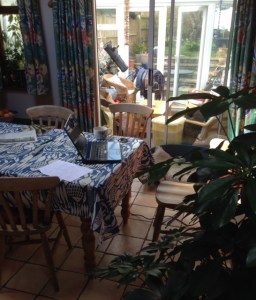
I usually write at my kitchen table which is fairly well-lit and from where there is a view of the garden. We have a small study in our house but I haven’t used it since I stopped writing on a PC as opposed to a laptop many years ago.
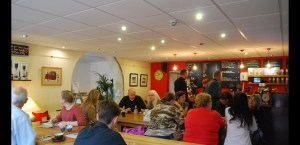
I also quite like working in a café (no café in particular), where there is hum of background conversation. It’s company of a sort, it’s nice having someone else make the coffee, and social convention prevents you from getting up, pacing around and checking whether there is anything nice in the fridge at regular intervals. I remember I discovered the benefits of working in a place where other people were talking as a 19-year-old first year student, when I wrote my first (unpublished) novel. I started by writing in what was called the Undergraduate Reading Room (a kind of annexe of the library), but I found it suited me better to sit in the small common room there, where you could buy nasty (in a good way) black coffees from a machine and (in those days) smoke equally nasty cigarettes, while other people came and went. (I don’t smoke anymore, but I still love the hit of coffee. It is my favourite of all drugs.)
I don’t work in a cafe all that often, though, because conditions have to be optimal. I love the background white noise of people talking but if I can actually hear what they are saying I eavesdrop and that becomes distracting, particularly if I find the people irritating. Also, intrusive background music irritates me, although I can cope with something tinkly and emotionally bland like (to my ears) most jazz.
Another place I love to write is on a train. When I was working part-time in Norwich, I used to regularly have a 3-hour return train journey there, and sometimes I’d get more done in those three hours than in a whole day at home. Provided there’s space, and a table, and not too much noise and mess, I love trains. A table to myself in a train, a black coffee, the world going by outside: it doesn’t get much better as far as I’m concerned.
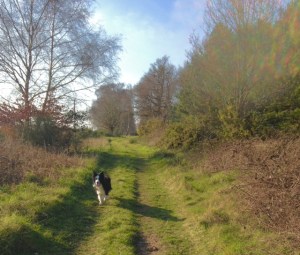
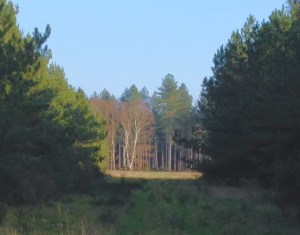
I suppose a lot of the work of writing takes place when you are not actually sitting at a keyboard at all. I don’t have any special way of accessing inspiration, but ideas come to me when I am travelling from a to b, or running, or swimming, or out walking the dog. I live in Cambridge and one of my favourite places to walk with him is the fairly nearby Thetford Forest. For a time it became rather a magical place for me, a place where I could almost routinely expect to free myself of the mundane and connect with the world of my imagination. Magic only lasts for so long in any one place, however, and now it’s just a place for me again, even though still a very pleasant one.
The other place I go is books. I sometimes have to remind myself that reading a lot is not an indulgence but actually part of my job as a writer, just as part of an athlete’s job is to exercise and get a good diet. I mainly read non-fiction. I don’t want to make fiction out of other people’s fiction.
How do you write?
Some people write with music in the background. I couldn’t stand that. How can I make up my own world with someone else’s imagined world blaring through my head? (But then I am very easily distracted and can easily be overloaded by sensory information. Sometimes I think there is something wrong with me!)
When it is going well, then I get entirely immersed. This can be embarrassing if I am on a train or in a café because I mutter the dialogue, complete with intonation, as I try to get it right. When immersed like that interruptions are horrible. As I say, I am easily distractible so it’s hard for me to reach a state of really focussed concentration, and it just feels cruel when I have finally managed to reach such a point, to be dragged out of it by external events.
I don’t make elaborate plans in advance. I’d be very happy to if I could but it simply doesn’t work for me: the story and characters emerge as I write. In order to ensure continuity and build up a head of steam, I will always go over the previous day’s writing before writing new stuff, and not infrequently, I will go back to the beginning and work back through to where I’ve got to as the story starts to get richer and I get more ideas. That’s often where the good stuff comes in.
Questions of style
I normally write in first person. If I write in third, it will be usually be free indirect style (ie still based on the viewpoint of a particular character). I dislike omniscient narrators. Ultimately stories can only be told from a point of view.
A story includes (a) characters, (b) a world/setting, (c) themes (ideas that the book is exploring) and (d) a plot. I generally start with themes, or with a world/setting that seems thematically rich (which is to say, a subconscious theme). My Eden books, for instance, start with a dark sunless world and the Biblical story of the Fall: theme and world together, which in turn tap into lots of things I want to think about and explore.
The imagined world is dull without characters though, and once you invent characters and place them in the world, you have to allow them to interact with it as their world, rather than making them mouthpieces for your ideas. This is the moment when the story comes alive. Plot to me is the least important element, and I kind of resent its artificiality. Real life doesn’t have a plot, and only rather narrow and driven people act in real life as if they were part of a plot (the reason I guess, that so many plot-driven novels/TV shows/films have narrow obsessive characters, such as workaholic detectives with disastrous lovelifes). Plot is nevertheless very important indeed (particularly in novels) –it’s what gives a story shape and structure– and I have to keep working and reworking my material until a plot emerges from the interaction of the other three elements.
For me, most of the process is unconscious. I don’t have a set of rules, and am intensely irritated when I see courses advertised for ‘How to write a novel’ etc. By all means teach particular techniques, or explore the techniques used by others, but there’s no ‘How to write a novel’ anymore than there’s ‘How to do a painting’.
When the first draft is done
In the days of word-processing, the concept of a ‘draft’ is much more elastic and hard to pin down than it would have been in the days of handwritten or typed manuscripts. By the time I reach the end of my ‘first draft’, many of the chapters will have been revised ten or even twenty times over, large chunks of material will have been added or deleted, and characters and scenes will have been added, removed or changed throughout the book. That is to say, the nominal first draft will include passages that have already been through multiple drafts.
Thereafter I put the entire thing through many more revisions, but I do find that, without outside advice, I am prone to revise too much and redraft too little. That is to say, I tend to be too cautious after that first stage, about major changes to the structure of the book. This is where other readers come in. I like to get advice from more than one friend, because tastes differ, and if one reader thinks a certain passage could be deleted altogether, while another thinks it’s the best part of the book, that gives you a certain perspective which you wouldn’t have got by listening only to one or the other.
The only novels of mine that have been edited by a full-time professional editor so far are my novel The Holy Machine and the three Eden books (it’s different for my short stories). Wonderfully helpful though friends have been, they are generally a bit too kind, and I have benefitted greatly from the cooler eye of a professional who has a vested interest, as I do, in the book’s success. Ultimately, though, it is my book, and I am not going to let anyone tell me it out to be about something other than I want it to be about.
What kind of writer are you?
I am equally proud of my short fiction as I am of my novels, so I would describe myself as a writer rather than as a novelist. My work hitherto has all been categorisable from a marketing point of view as SF, and I am happy with that: books have to be labelled so readers have some idea what to expect. However, I personally think of myself as a writer who happens to write SF, rather than an SF writer. By that I mean that my motivation is not to expand, develop or play with the genre of SF. My motivation is simply to take the stuff that’s in my head, get it out there in the world, and make something positive of it which I and others might find some use for. It just so happens that I’ve found the tools of SF very useful for that purpose.
Self promotion:

Goodbye Evernote, Hello Simplenote
Simplenote launched a client for Linux at the end of March, 2016. As a longstanding Evernote premium user, frustrated initially by the fact there’s no Linux client, and then frustrated even more by the fact I could no longer get the Windows client to run under WINE, I thought I’d give it a look.
As the name implies, Simplenote is simpler than Evernote. No notebooks, no reminders, no support for pictures.
In fact the only thing Simplenote handles is text, and that’s its great strength. Sticking to tiny text files means that notes load and sync quickly. Also, the whole experience doesn’t seem as cluttered as Evernote has become with its "all things to all people" approach.
Sticking to text means that Simplenote does a few things extremely well. It has Markdown support built in, for example. I write most of my Evernote notes using markdown format, but Evernote has a habit of adding extra hidden formatting that only becomes obvious when those notes are opened in Draft or Stackedit (it also throws in odd whitespace characters when I copy notes across to Emacs)
Simplenote allows you to download a zip file of all your notes, and its at this point the advantage of sticking to text only really hits home: the files downloaded are text files. That sounds obvious, but it means that rather than picking your way through xml or whatever, you can open an individual note in your favourite text editor and start editing. It’s that simple.
Keeping things text also reduces memory usage, which in turn allows Simplenote to add a history feature – pull back a slider and see previous versions of your notes.
There are some things that aren’t quite there… For example, although you can tag notes in Simplenote, I’ve yet to find a way to filter multiple tags, something that is essential if you want to replicate Evernote’s notebook stacks, which I do.
In summary then, Simplenote does a lot of things better than Evernote, but it’s not a full Evernote replacement.
So which will I be using in future?
No question. Simplenote, for the sole reason that it has the Linux client. It’s not just a question of what to do when there’s no internet connection, it’s also a question of speed. Chrome is so big nowadays it takes an appreciable amount of time to load. Add to that the occasional hiccup when changing between notes on a web browser and the benefits of having a client become obvious.
I wrote this blog entry on Evernote. It may be the last one I do…
How Writers Write: M. A. Griffin
How Writers Write is a monthly series of guest posts where established writers invite you into their workspaces, reveal their work habits and share their experience.
Follow this link for a full list of previous posts
The famously camera shy M. A. Griffin aka Fletcher Moss gives us a rare behind the scenes glimpse into his workspace…
What do you use to write?
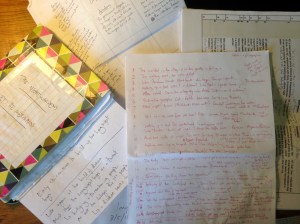
This looks chaotic, doesn’t it? But it sort of works. I start with pen and paper and cheap notebooks like the one above. (You can see there are two potential books outlined in this one, their names sellotaped to the front. One, ‘The Nightwardens’, has seen the light of day as ‘Lifers’, the other is foolishly titled ‘Let’s Be Mermaids’, so the less said about that one the better, I guess.)
I begin with free-form note-taking; character names, events and scenes, openings, lines of dialogue, chapter headings and so on. At some point – maybe a couple of weeks in – I begin tentatively working out what might happen in what order. The numbered list up there is a first attempt at sequencing a plot, for example. Each number is a chapter and each chapter, as a rough rule of thumb, will be 2000 words or so. In my copy of Stephen King’s The Green Mile, King writes about how he structures stories as he’s trying to go to sleep each night; “I tell [them] as I lie in the dark, writing them in my mind just as I would on a typewriter… Each night I start over at the beginning, getting a little further before I drop off.” That’s me too. It can take a month or so, sometimes, to straighten out enough of the start to get going. Sometimes – you can see it in the picture – I try to get fancy and type up huge tables of plot, chapter by chapter, usually to convince a publisher I know what I’m doing. But it doesn’t seem to prevent wholesale redesign half way through, so I’m trying my best to avoid it nowadays.
Once I’ve reached that hard-to-pin-down tipping point, I start typing. I use Word. (I tried Scrivener once, but it reminded me of that episode of Blackadder when Baldrick accidentally burnt Dr Johnson’s dictionary. Johnson comes round with a murderous gang to get his hand-written copy back, and Blackadder, panicking, says “You can’t have it yet. I want Baldrick to read it. Which unfortunately means teaching him to read.” I can see the huge potential in Scrivener, but I haven’t got the time to ‘teach myself to read’, as it were. I’d rather just crack on.)
When do you write?
At the moment, I have two clear writing days a week, and they’re blissful. I’ve heard a lot about creativity and the brain; it’s at its best in the morning when it’s freshest for example but thankfully it doesn’t seem to matter to me. I can get words on a page any time of day as long as I’m left alone.
Where do you write?
Anywhere, but mostly here:
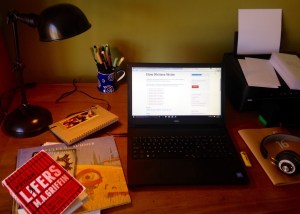
I’d like to point out that I don’t need copies of my own books nearby, they’re for purposes of illustration only. That copy of Shaun Tan’s ‘Rules of Summer’ though, that’s pretty much always on the desk. I recommend checking it out if you don’t know it. For me, it tells you everything about the surreal, magical, threatening world of childhood; rocket fuel for anyone writing for or about young people. I’m not fussy about a writing in a particular place (our host Mr Ballantyne by contrast has a favourite room in a favourite library in Manchester; maybe they bring him sweetmeats and cigars while he works) by the time I’ve put the headphones on and cued up the playlist, I’m transported. I could be anywhere. I’ve always written with distractions around me so I’ve learned to use music to close them all off.
How do you write?
The first draft can come pretty quickly. I’m not agonising over questions of style at this point. I’m just getting it down, telling myself the story as I’ve heard other writers say. 1500 words a day is the point at which I feel the job’s been reasonably well done but I can go for a thousand more if I’m on a roll. I don’t always go chronologically, and this helps. If you’re stuck at a particularly tricky section, skip it. If you know you’ve got a great scene coming up, start there. Sometimes, I skip to a section with a lot of dialogue which can guarantee a decent delivery of words each session. I’ve tried writing the end before I get there just so I can get my quota done – anything but stall at 300 words and stare at a blinking cursor for a dreary afternoon.
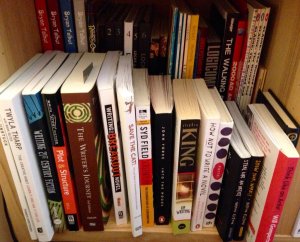
Here’s my shelf of wonder. If I’m having a particularly bad time of it, I’ll park myself next to this lot and spend a little time leafing through some of them. The titles often aren’t great, and you need to steel yourself against the evangelistic nature of some of the prose, but there’s plenty to learn once you do. The screenplay stuff is good for demystifying structure; in the case of ‘Save the Cat’ to a point where stories become formulas – not a good way to develop as a writer, but seriously reassuring if you’ve backed yourself into a corner and can’t see a way out. Donald Maas’s stuff always reminds me to raise the stakes even higher. ‘The Writer’s Journey’ has been recommended time and again; I eventually succumbed when writer/director Jon Favreau name-checked it on some podcast. John Yorke’s ‘Into the Woods’ is a great place to start, as is King’s ‘On Writing’.
If all that fails, I’ll go the graphic novels behind; you might just be able to see Joe Hill’s ‘Locke and Key’ series in the shadows there. A more majestic and inspiring source would be tough to find, I reckon.
Once the writing’s done, I go through it all again to iron out inconsistencies and fill in gaps, and that becomes version 1.0. That’s when my editor begins the work of pointing out all the things I haven’t noticed. There are often large numbers of corrections and culls. Entire sections, whole characters. I take it on the chin. She always ends up being right.
Questions of style
I’m hyper-aware of my failings. Selecting two adjectives when one will do. Reaching for onomatopoeiac verbs and paring them up in a really irritating manner. Over-doing the dialogue tags. Using the word hyper-aware. I could go on, but I’ll resist the temptation, the point is being able to ignore all that during draft one and instead trying to cull it all later.
When the first draft is done…
That’s when it goes to my wife Jo who has the unenviable task of hacking through a story that makes virtually no sense. “Why does this guy do this at this point?” she’ll say, and I’ll get stroppy and bluster, “It’s obvious isn’t it?!” Then I’ll calm down and realise it can’t be clear and it needs fixing. She’s pretty exacting which is of course what’s needed. I make corrections, go through my editor’s always extensive questions and suggestions, re-write it all again and send version 2.0 off. Five or six cycles of this, and things are starting to look considerably better.
I dream of delivering a fully-formed, ready-to-publish manuscript. Wouldn’t that be beautiful?
A little bit of self-promotion
Lifers
Now Lifers is done, I’ll be continuing work on a tale about an alien beastie trapped in the hull of a shipwrecked research vessel. Not sure about a title yet. I’m thinking of calling it ‘Let’s Be Mermaids’…
Microbits. Really?
The BBC likes to think it single handedly ignited the 80’s UK programming boom thanks to its BBC B micro. Well, maybe so. If you were the sort of kid who’s parents could afford one. Most of us learned our chops on cheaper machines like Spectrums, Vic 20s and even Dragon 32s. (Remember them?) – and were grateful for the opportunity.
Well, now the BBC is back to save the world (or at least that part of it that concerned with educating British children) with the Microbit. Another spectacular example of Auntie knows best.
Now don’t get me wrong. The Microbit is a lovely piece of kit. It’s cheap, it’s flexible, it comes with a well thought out website to help program it. Boxes of the things are being sent out, free of charge, to schools up and down the country.
The thing is, I never asked for them. Are Microbits the best way to teach kids programming? I’m a teacher and I don’t remember being asked for my opinion. The trouble with this sort of thing is that they’re always proposed and built by tech-heads; by people who are very good at IT. They get it, they enjoy it. They always found it easy.
… exactly the wrong sort of person to understand what the average 12 year old non techy finds interesting or difficult. I’m not saying that you can’t motivate kids to learn computing. That’s my day job. But you don’t do it this way. I’m sure that Microbits are going to be featuring in the pages of most local newspapers over the next few months. Expect to see lots of photographs of smiling school children talking about how they’re learning to program. You can’t argue with that. Except the lessons won’t stick, there’ll be no progress for the majority and in a year’s time the Microbits will be sitting in the bin next to the video conferencing kits, the control equipment and the ghosts of the Learning Grids.
No doubt a group of manufacturers are currently sitting round, patting each other on the back as they congratulate each other on doing their bit for education. Frankly, I’d rather the money had been spent giving me a bit more preparation and marking time.
There’s a teacher shortage in this country, there are too many people saying what needs to be done and precious few actually prepared to get their hands dusty at the chalkface. You want to help, get in the classroom and get teaching. Otherwise, shut up, and stop wasting my time.
Focus 65

“How Long Does it Take to Write a Novel” appears in Focus 65.
The article is made up of several posts that originally appeared on this site.
Learning the C Button Accordion Part Two
I’ve been playing the C button accordion for two months now. Here’s what I’ve noticed
- I’m really good at the piano accordion. This isn’t me showing off, more a realisation that having played the piano for something like 40 years now, my fingers go where they should without me having to think about it. I never really registered the fact that I just have to look at piece of music for my fingers to play it, nor that they can form the shape of, for example, a diminished chord all by themselves. Learning another instrument has been a pleasant reminder of what I can do. That doesn’t mean I’ll stop noticing my mistakes all the time, of course. I’ll always feel inadequate compared to better players.
- The fact that I already play the piano accordion has been a big help in learning the button accordion. I don’t have to think about the left hand or moving the bellows
- The button accordion patterns make sense very quickly. There are only three shapes to playing any major scale on three rows. Or any minor scale. Or any scale at all, for that matter.
- I find the crossover from little finger to thumb fiddly.
- The books I mentioned on my previous blog entry are excellent. I’m now using book 2 of Maugain Manu’s Methode d’Accrodeon. I’m still on book 1 of the HOHNER FERRERO MEDARD – METHODE D’ACCORDEON CHROMATIQUE COMPLETE. I’ve put links to the books at the end of this post.
- I am nowhere near ready to perform on the button accordion.
The books I’ve been using:
Methode d’Accordeon Vol1 by Maugain Manu


and the HOHNER FERRERO MEDARD – METHODE D’ACCORDEON CHROMATIQUE COMPLETE Educational books Accordion


(Click on the images to be taken to Amazon)

