The Human Way appears in the March/April 2017 Issue of Analog
Fans of the Recursion series may recognise Craig, Armstrong and Joanna – as well as the Eva Rye – from the beginning of Divergence.
The story continues the Fair Exchange series that has been appearing in Analog over the past few years. It takes place in the Recursion universe around 10 years after the events depicted in the novels.
Someone kindly emailed me to point out that my writing site had been hacked. Links for Cialis were now appearing scattered throughout the text.
A quick Google search revealed that this was a common hack, and was probably the result of some rogue code embedded in a file after a brute force attack. I ran a site security check (there are many free services if you search for them) which suggested that the problem was located in wp-config.php. I could have paid for a clear up, but taking a look at the file in question it was clear the code wasn’t exactly trying to conceal itself. Once snipped out, my site’s performance improved immediately.
… or so I thought.
A few days later, the adverts reappeared. This is a clever hack – snip out the code and it regenerates itself.
There are various flavours of the Pharma Hack, (a search for WordPress Pharma Hack will give you all the details you need and more) the one that hit me had added an innocent looking file: /wp-includes/init.php
I only discovered this after I’d deleted all my themes and plugins and installed fresh versions of wp-admin and wp-includes. When I restarted the site, the following message appeared at the top of the page:
include_once(.../public_html//wp-includes/init.php) [function.include-once]: failed to open stream: No such file or directory in .../public_html/wp-config.php on line 93
Checking line 93 of wp-config showed the offending line (I’ve surrounded it with **s):
I removed the line, reset my passwords, including the database passwords, reinstalled my plugins and (hopefully) that’s it.
I should have noticed this sooner, of course, but I’ve not been blogging recently as I’ve been concentrating on finishing my next novel.
Even so, I must hold my hands up and admit that I’ve not given my sites the attention they deserve. I’ve installed some security software following a quick search for WordPress security plugins on Google, I’ll take some time to monitor what’s going on in future.
I’d heard that his voice isn’t what it was, that he can’t always form the chords any more. Well, that’s what happens when you get older, and as my companion Crofty pointed out after the show "I love a musician that at 70+ doesn’t try to be anything other than themselves at 70+"
So last night wasn’t a virtuoso performance, but to be fair, that was never Carthy’s shtick. What we got was an engaging show, a bit of chat and an overwhelming sense of folk heritage.
On playing Bruton Town:
"I learned this from Davey Graham"
On an English version of Mrs McGrath:
"I didn’t realise there was an English version until I heard Tim Hart and Maddy Prior play it in ’68"
It would seem reasonable to assume that most of us in the audience had been part of the folk scene for the past decades, attending gigs in little pubs and clubs up and down the country. Carthy, of course, has been at the heart of all this.
I don’t listen to much folk music nowadays. Too many of the performers learned their craft in the conservatoires, and that doesn’t seem very folky to me.
Last night’s show may have had its imperfections, it was all the more enjoyable for it.
(And whilst not suggesting for a moment that Carthy is second rate, I’ve written more about performance here: Second Rate Entertainers)
Now that the A level results are out, many students are about to leave home. There are many articles out there giving advice on what to do when arriving at college for the first time.
Here’s mine.
I’m sharing this because a friend recently asked me this: what I would do if I could go back in time and speak to myself when I was 18? What one piece of advice would I give myself?
It was a good question, and I thought about it for some time. This what I came up with, and I’m convinced it’s the best guidance a young adult could have.
Here it is.
Learn to drink your tea and coffee black.
I stopped adding milk to my drinks after an illness when I was 25. Since then my life has been so much easier. No more running out to buy milk in the evening, no more coming back from holiday to find there’s nothing to put in the coffee. No more having to get involved with the milk kitty at work (honestly, we order hundreds of thousands of pounds worth of IT equipment on a regular basis and yet still never have enough money in the tin to buy a carton of long life).
And just think of all the time saved when making a hot drink. All those trips to the fridge add up.
If only I’d know that when I was 18. I’d never have got into stupid arguments about who was using whose milk in the communal fridge.
I encountered a fine example whilst on holiday in Madeira last week. He had a residence in the hotel: 8:30 until 10 every night. Keyboards and vocals, he was a competent player with a good voice that came into its own when doing Elton John covers.
As is the nature of a great second rate performer, he’d arranged everything himself. He switched between keyboards to play different parts, occasionally improvising, all this done over a drum track. Such performances are necessarily individual in a way that singing along to a backing tape never is. He did 70s and 80s covers: Hotel California, Sacrifice, that sort of thing. Given that he was singing in what was to him was a foreign language his phrasing was odd, but hey, he was singing in a foreign language.
It would be easy to dwell on his faults: the arrangements that didn’t quite work, the bland repertoire (necessary, given the venue), his intonation.
But then again that’s sort of the point. I’ve written about second rate performers before at the end of my novel CAPACITY, when the Watcher listens to just such a performance (the scene was based on a concert I attended in a church in France when I was writing the book).
It’s so easy to see perfect performances nowadays. They’re the result of multiple retakes and remixes, they can be autotuned and airbrushed… I don’t have a problem with this. But this can give the impression that all performances should be perfect. That everything should be first rate, all of the time.
No. None of us are capable of that.
That’s why appreciating second rate performances, appreciating people who are willing to make a go of it despite their imperfections, is such an important thing.
How Writers Write is a monthly series of guest posts where established writers invite you into their workspaces, reveal their work habits and share their experience.
I’ve bumped into Chaz in a number of places, but never had a chance to have a proper chat. A real shame, as this article reveals…
How would you describe yourself? Writer, author, novelist, SF, Fantasy, Horror?
People used to say my mystery novels were really horror, my horror was really fantasy, and my fantasies were essentially a mystery recast. So, yeah: I’m a genre writer, but I mostly inhabit the murky areas where one genre blends into another.
What do you use to write?
I was a kid in the sixties, and learned to write with pencils and then biros and then fountain pens, all for values of “learned to write” that encompass so much awkwardness of process and ugliness of result that people kept asking me if I was a suppressed left-hander, and would I perhaps find it easier to do it backwards and upside down? Nope, and nope: I just have no gift for making marks on paper in any way that conveys or retains meaning.
Nevertheless: always and always, I meant to be a writer. And I loved stationery, despite my awful handwriting. In my early teens I filled notebooks and journals and exercise books and looseleaf binders with stories and poems and unfinished novels – and then blessedly my big sister wanted to learn to type. She borrowed a heavy office typewriter from one of our mother’s friends, and bought a teach-yourself manual. I am not sure if she ever did actually learn to type, but I did. I spent an Easter holiday when I was fourteen working through that manual, page by page. A schoolfriend hauled another discarded office machine home from the dump and refurbished it, simply as an engineering challenge, and thus I had a typewriter of my very own; and since then, I have typed everything I conceivably could. My handwriting has deteriorated further, for lack of use, and frankly I’m delighted to see it go. That was always an embarrassment, and typing is a delight. I have chronic RSI in hands, arms, shoulders, neck; people suggest dictation software, but they’re missing the point. I am very short of physical skills, and typing is something I excel at. (These days so do most of my friends because computers, programming, Silicon Valley, yadda yadda, but that’s okay: I’m not competitive about it. I don’t need to be best, I just need to be good.)
So, in succession: office typewriter, portable typewriter (when I started selling stories, when I was eighteen: my first paycheque, £36 for a teen romance in ’77, proved to be just enough for an Olivetti in a carrying case), electric typewriter (bought from a town-centre business that was closing down), electronic typewriter (bought with my first-ever bank loan: £625, which was a monstrous amount of money, but half price, and hence a bargain; and it had a one-line screen so you could see what you had typed before it hit the paper!), and then my first PC in the mid-eighties. Oh, how I loved PCs, in those early glory days! I was a DOS power-user; the command line was my proper home.
And then mouse-and-icon GUIs took over, and we’ve never had the same relationship since, my computers and I. We get along just fine, but the romance is gone. Windows made an idiot out of me, and I never recaptured that fiery splendour. Geoff Ryman nudged me towards Linux sometime in the ’90s, and I have repudiated Microsoft ever since – but even so. I can’t get up to speed again with a command-line interface, I lost too much through the bad years.
Still, I do what I can. The desktop runs Ubuntu, and I work in Textmaker, a word processing package from those nice German folk at Softmaker. In my DOS days I was a WordPerfect fan, like so many of us writers. When I worked in Windows I used Word, and hated it, and it kept crashing on me; then I fled to Linux and looked around and tried various word processors and didn’t love any of them until I found Textmaker in the early ’00s. It’s lightning-fast, and rock-solid (has it ever actually crashed on me, in fifteen years or so? Not that I remember), and brilliantly compatible with the industry-standard Word formats. I tested it once, with the same long text file on the same dual-boot machine: Word running in Windows took thirty seconds to open itself and then the file. Textmaker in Linux just did it, too fast to measure.
I’m not much of a planner. I always think I ought to be, at the start of major new projects; I’ll buy new stationery for taking notes, or set up a wiki for keeping track of the worldbuilding, or experiment with Scrivener to keep all my ducks in a row. But then the notes never actually get taken, because writing things down is such a pain and I never look back at them anyway; and the wiki grows dusty from disuse; and Scrivener crashes on me twice through the tutorial process and I abandon it because who wants to risk that when the project’s live? So I revert to old habits, and occasionally I’ll scribble something down on the back of an envelope but mostly I won’t, I’ll just hope to remember it; and when I don’t remember it I’ll think of something else. I’ve been working this way for forty years; it’s not ideal, but it seems to be good enough.
Except that I’m going to be working with Ken Scholes on a shared project, and my individual private brain really isn’t going to be enough, so we’ll have to find some way of notetaking that works for both of us. I suggested that wiki again, but I was on a panel this weekend about collaboration, and someone spoke in favour of Evernote, which had simply never occurred to me. Evernote is for shopping-lists, right…?
goes off to research other ways of using Evernote
When do you write?
Every day, every week, from January to March, whenever I can…
Pretty much all the time, if we can stipulate that “I am writing; I’m just not typing” is a valid mind-state. There are always stories, snatches of dialogue, betrayals and revelations going on in the back of my head. Used to be I’d work on one thing at once, but that is no longer the case. Sometimes I’m trying to keep half a dozen half-finished pieces live in my head at the same time. It’s awkward.
When it comes to actually getting those pieces written, I have a history of working very intensively for eight or ten or twelve weeks, and then slackening off until the next cycle. That doesn’t work so well now that I’m married and so forth, because I need to shape my life around priorities other than the work. Even so: I write every day through the week, and one or two days at weekends.
What history teaches us is that I’m good in the morning, slack water in the afternoons and good again in the evening. I used to work through the night and then sleep till noon, but that was long ago and again not conducive to conubial bliss. These days, somewhere between six and seven o’clock, I abandon the study for the kitchen and see about dinner; and I no longer work after dinner.
I’m trying to learn to be flexible and responsive, to grab ten minutes’ worktime here or there if that’s all there is available, but I’m not good at that. I like to have a long session ahead of me, at least a couple of hours if I can’t have all the day; I take time to settle into the creative mindspace. Also, these days, there is the damned internet. Used to be, when I sat down at the keyboard I was automatically in working mode, because that was all the keyboard offered. This is no longer the case, and I am as prone to displacement activity as the next guy, shock horror.
Where do you write?
Desk, coffee shop, wherever I lay my hat…
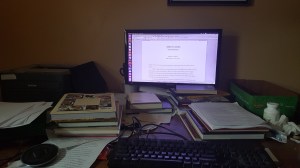
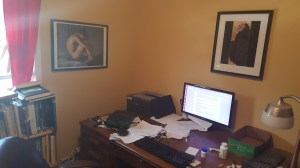
Here’s the desk with slightly fewer books on it, one step closer to the Platonic ideal of deskhood (which it does actually occasionally achieve, down to lemon-oil polish and everything; I’m good at projects, just really really bad at maintenance). Also, art on the walls: one Klimt vulture by Ursula Vernon, and my favourite picture of all time, Jeune Homme Nu Assis au Bord de la Mer by Hippolyte Flandrin. I used to have a print of this in every room of my old house in England. When I moved here to California, K had this study all set up and ready for me, complete with required viewing. I also still have a copy of every book I’ve ever seen with it on the cover. Tragically, I didn’t realise the original was in the Louvre till we were passing through the gift shop on our way out. Hey-ho: just have to go back to Paris, then, sigh…
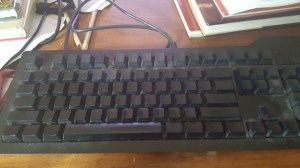
Habits change with circumstance. For twenty years at least, probably closer to thirty, I wrote at my desk at home, because that’s where the keyboard was. Demonstrably, I do still have a traditional desktop computer, on the traditional desk; and I do still work here. My evening writing happens here, and most of my internet engagement, so most of my actual typing. I’ve used ergonomic keyboards for the last fifteen years or so, but just a few months back I was seduced by the Das: it’s a lovely old-fashioned clicky keyboard with a solid aluminium plate and, as you can see, no letters on the keycaps. Pure anonymous unadulterated black. I love it.
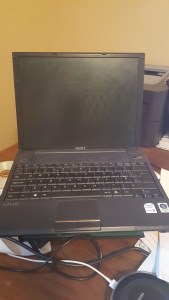
But, back in the early ’00s, I fell in love with a laptop. Not that I needed a laptop, because I was not one of those writers who worked in coffee shops, no sirree. But this was the most beautiful machine-for-writing I’d ever seen: carbon-fibre, light as a feather, gorgeous matt black all over. I have it still, though it sits in the back of a drawer now. I spent more than I could afford, and thus it became my Laptop of Heavenly Perfection, and I had to justify that by actually, y’know, using it. Which meant actually, y’know, working outside the house.
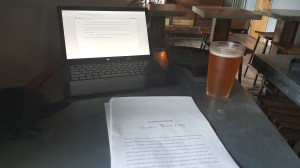
It was like a revelation. Library? Tick! Coffee shop? Tick! Pub? Double tick – work and beer! Train? Tick! Airport? Tick!
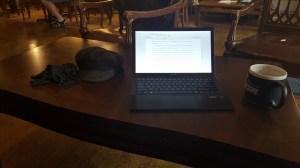
Etc, etc. Apparently I am after all one of those writers who can work pretty much anywhere (though too much noise makes me grumpy, and other people seem to be inveterately noisy), and most of my actual new fiction writing now happens outside the house. Back home I had my regular desk in the Silence Room of a private library; I still miss that space. Here I have the window seat of my favourite coffee shop, those few times it’s available; apparently I don’t mind visual distraction at all, it’s just noise that bothers me. I guess I can look and think at the same time, I just can’t listen and think. And there’s always a seat in the public library, but they don’t have a Silence Room and their Quiet Areas are not policed and hence not quiet by any definition I’d accept. I am considering noise-cancelling headphones (though wearing headphones for the sake of not listening to anything has a kind of perversity about it).
In the afternoons, there’s always the temptation of the wine bar. Two till five is happy hour, because there’s never anybody in. Cold beer and quiet, what could be nicer on a hot afternoon? And I’ll get a hell of a lot more work done than if I kick around at home. Spending money is a great incentive; so is the lack of wifi. I do that as rarely as I can, because money, alcohol, yadda yadda. But sometimes you’ll find me there.
Inspiration isn’t a place, it’s a process; if I need to think, I’ll go for a walk. Usually with an end in view; back in Newcastle I used to walk laps around the city, because I couldn’t think when I was sitting still, but these days I tend to be going somewhere. With the laptop in the backpack. We’re up to the second edition of techno-heaven, the Laptop of Utterable Delights, even slimmer and lighter than the last, tho’ I don’t love the form factor quite so much. (I’m getting used to widescreen, necessarily, but like US letter paper, it’s not right…)
How do you write?
Much of this I seem to have said already, but I like silence or at least quiet when I’m working, or else consistent background murmur that I can tune out. I envy my friends who can work to music, and I’m intrigued by those who construct separate playlists for separate projects – but I find music a distraction. So of course is the internet; those times I can avoid it, I do better. Probably I should investigate wifi-disabling software, but – like those headphones that cut off sound rather than supplying it – it seems strange to step backwards, away from something so useful.
As above, I don’t have notes to work from; I don’t plan or outline or plot ahead in any way. A book is a journey, and I think it works best when it’s as much a surprise to the author as to the reader; it’s a journey undertaken hand in hand, stepping into the dark. Someone once said that being asked to write a synopsis of a book he hadn’t written yet was like being asked to draw a map of a country he hadn’t visited. Me, I like to start with a title, a first line and often a last line too, a sense of where we’re going; it’s a journey and I like to know the destination. How to get there and in what company, I sort out day to day
Questions of style
The narrative voice of a story depends utterly on the story, its character, the effects I’m after. Of course I have my own voice – and I am not a writer who believes he should be invisible to the reader; I don’t do transparent prose, I like a strong sense of a narrator, authorial presence – and you can mostly spot a Brenchley by the rhythms, not the words. Nevertheless: each story is an individual artefact. First or third person, I’ll use either, depending. Present tense I mostly keep for shock value, because it tends to read artificial at full length – though there are no rules, and I did just finish a short story that is present-tense throughout.
Other people’s process is always weird, almost by definition, but I really don’t understand those writers who say they’re plot-driven. Plot is just what people do; for me, everything comes from the characters. Put a person in a situation, and plot will follow.
But honestly, I barely think about these things any more. I’ve been doing this so long, it’s pretty much second nature now. Title, first line, and I’m away. (I really, really like having the title first. If I know what it’s called, I know what it’s about, and I can write to that title from the get-go, so that it’s embedded. Finish a story without a title attached, and there are just so many options, and none of them will be truly rooted. I hate that.)
How many redrafts?
As few as possible. Growing up in the age of typewriters, where a new draft meant retyping every word, I learned to get it as right as possible as early as possible. Barring editorial interference, my first drafts are pretty much the story I end up with. I’ll fiddle endlessly with individual words and phrases, for I am all about the polish; but I rarely rewrite at any macro level unless required to. Having said which, I have a half-finished novel about Kipling on Mars which is so irretrievably broken I’m basically going to go back and write the whole damn thing again. I never do that.
How many readers?
I often say that I’m old-school, the last of those for whom writing really was a lonely business. We didn’t have creative-writing classes and MFAs and critiquing groups and beta-readers and such; before I was published, I barely met another writer. From choice, I still follow the ivory-tower model: I write a thing, and polish it, and send it direct to agent or editor. These days my wife does read everything at first-draft stage, but that’s okay; she tends to think better of my work than I do.
How easy is it to let go?
Letting go is easy; by the time a story’s been through edits and copy-edits and proofs on top of my own early rereading and polishing, I’m glad to see it gone. By then I’ve long been into the next thing, or the one after that. I don’t love them again until they’re actually in print.
Lastly, self promotion:
I have a Patreon! I am writing English girls’ boarding-school stories to the classic model, only set on Mars! I have also been writing grown-up stories in the same milieu. Basically the rubric is “If Mars were a province of the British Empire, so-and-so would so have gone there”, where “so-and-so” is a remarkable list of remarkable people: so far Oscar Wilde and T E Lawrence and more, and I’m working as I say on Rudyard Kipling. But I am a lifelong fan of the Chalet School series by Elinor M Brent-Dyer; and if Mars were a province of the British Empire, the Chalet School would so have had a sister-foundation there. So I’m writing it. “Three Twins at the Crater School” is half-finished, with a few short stories on the side, available to all my Patreon subscribers
But it’s not all Mars all the time, tho’ it can seem so on occasion. I just finished an SF bar-story for a David Bowie memorial anthology, and I have a space opera attack novel that I am totally failing to fend off (which is really Iain Banks fanfic, and why not?), and Ken Scholes and I are going to do great things together, and and and…