The Minor Reharm

Reharmonization is a musical term for changing the chords in a song while keeping the melody the same.

Jazz musicians do this a lot. There’s also been recent fashion amongst young singers for slowing down fast songs and reharming them in a minor key. One example that sticks in my mind was a reharmed version of John Travolta and Olivia Newton John’s “You’re the One that I want.” The original song had the happy urgency of teenage longing. The new version, at least to my mind, sounded like an obsessive stalker sitting in his van late at night, waiting for his target to walk by.

The minor reharm can be a lazy way for a musician to pump a bit of emotion into a song. I think it’s a good way to describe the process by which writers invest their stories with fake emotion.

The minor reharm is often evident in TV series and box sets. You notice it when characters’ emotions are magnified to fill screen time. They argue and fall out for no reason other than to provide enough plot to take the episode to the break.

This is not only lazy writing, it’s not even accurate. People don’t fall out so easily in real life. When I was growing up in the ’70s, many of the sit coms revolved around farcical misunderstandings. Many of the TV series I give up watching nowadays depend on the same thing, except without the humour.

Of course, the minor reharm is not exclusive to the TV. You see it all the time in stories by authors who should know better. Rather than give examples it’s probably more instructive to refer to Northanger Abbey by Jane Austen. Here the minor reharm that was the gothic novel is parodied to glorious effect.

If you’ve never read it, give it a try. You’ll be astonished how modern the tone feels.

Five Star Reviews

I got to the door quickly and he’d already walked away, he said he didn’t think I was in, a little more patience would be good.

The above is a review of a parcel delivery. I came across it when I was asked to rate my experience of that same person delivering a parcel to me.

I hate those reviews. They give people the illusion of power in their lives. It allows them to take out their frustrations on the world, venting their self righteous anger on the even more powerless. They should pity poor old Ron (I’ve changed his name), struggling to fulfil a job list way too big for the time available. Me? I got my parcel undamaged in the time slot I was given. That’s all I feel entitled to say about the transaction. I certainly didn’t feel I was entitled to a chirpy conversation from a colourful member of the undeserving poor, as another reviewer did.

Why I had to review the poor guy I don’t know.

Actually, I do. It’s not about feedback, it’s about divide and conquer. It’s a distraction. Don’t blame the delivery driver, blame the company that put them in that position. Give them all five star reviews and let businesses sort out their own houses.

Just to be clear, I’m not talking about all reviews. Writing is fair game for reviewers. By all means say what you like about my books, good or bad. What you read in my books is all my own work. I stand by what I’ve chosen to put there.

But a parcel delivery guy has very little agency. What exactly are you reviewing?

Getz/Gilberto

Astrud Gilberto died this week. I started writing the below post last year. Now seems an appropriate time to finish it.

Getz/Gilberto

I was going to play this album as I had dinner (Lamb chops, humous, tzatziki, halloumi, pitta bread, salad, nice glass of red wine) in the garden. What else do you play when it’s this hot?

The album wasn’t on Spotify.

I went to Amazon to buy it and found it wasn’t available as a digital download (update, it’s available now, a year later. It’s also back on Spotify). I suppose Verve were pumping the price up/protecting their legacy and revenue stream when I originally wrote this.

I didn’t give up and found an HD version for £1.79. That version seems to have been recorded directly from the record: you can hear the scratches. I suppose some people will like that. For some people the object itself is as important as the content. Many people prefer books to ebooks for example, and there’s nothing wrong with that.

I’m not one of those people. I’ve got all my CDs ripped and stored on my NAS and backed up in the cloud and on HDD.  I’ve told my children to make sure they take copies when I’m gone.

I don’t think they’ll listen to my advice. I didn’t keep my father’s vinyl copy of Getz/Gilberto: it was too old and scratched. I suspect it would have been as good as the HD version I bought.

Even so, I’m sure my children will hold on to something tangible. Despite my comments above, I can’t bring myself to get rid of my vinyl records, even if I never listen to them. People become very attached to formats. I’ve read that people have even started buying cassettes again. I’m sure it won’t be long before you can buy Collector’s Edition CDs in original Jewel cases on 1405g plastic to be read with a 44kW laser.

That’s why I think that even if we could transfer a brain onto a computer, something I talked about at length in my Recursion Trilogy, we would never quite believe in it.

Learn Your Scales

Ask anyone who knows anything about music and they’ll tell you: if you want to learn to play your instrument properly you need to learn your scales.

Few people do, and we all know why that is. Scales are boring. No one learns an instrument to play scales, they want to play tunes for their own enjoyment and to impress their friends. You don’t become the life and soul of the party by playing the scale of G major.

It wasn’t until lockdown that I properly applied myself to learning the scales on the piano. I wish I’d learned them earlier. For a start, I’d have been more impressive to my friends sooner.  Of course, now I’m a good (though immodest) player I don’t care what my friends think. (I do care what other musicians think, though)

Why am I writing this? I never listened my own advice, so why would you?

It’s because of this:

Platitude
A remark or statement, especially one with a moral content, that has been used too often to be interesting or thoughtful.

I have a friend who says that Self Help books clearly don’t work. If they did, there would only be one, not shelves and shelves of them as you see in bookshops. She’s probably right. But it occurs to me that maybe there are so many books because they say the same thing but in different ways.

Maybe sometimes the message goes in.

Face it, there’s no secret to life. Eat less, exercise more, be nice to people and learn your scales.

And if you want to be a writer, start a blog.

The Blank Wall

On Monday night I watched Vermeer: the Greatest Exhibition. This is described as “a narrated private view of the largest Vermeer Exhibition in history, currently held in the Rijksmuseum in Amsterdam.”

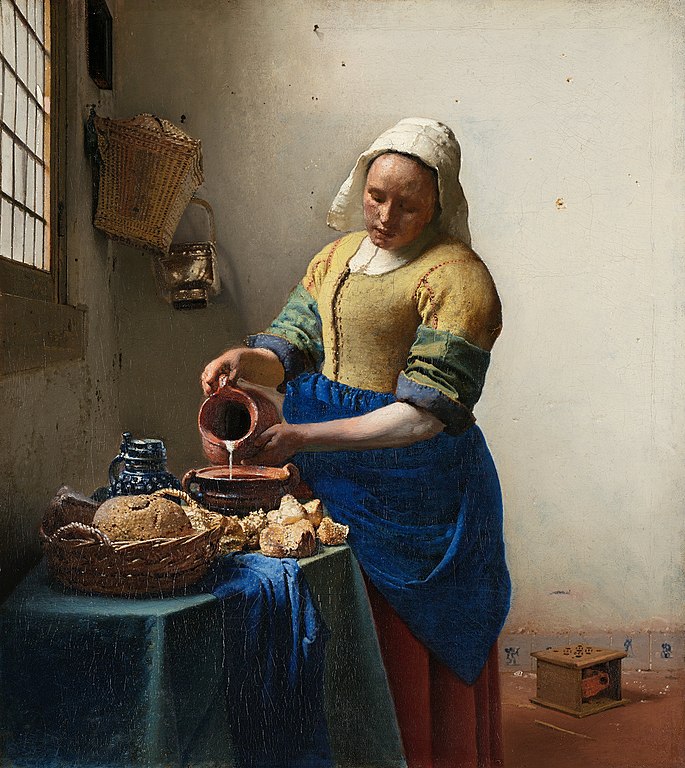
The painting that really caught my attention was the Milkmaid. As the narrators explained, Vermeer had given depth to the painting by the use of shadow. Light entered the room from the window the left, shadows can be seen on the woman’s left hand side (the viewer’s right) and in the left corner of the room. The contrast with the light on the woman’s right hand side gives the sense of space. The narrators were at pains to point out that Vermeer painted light, not colour.

The thing that really caught my attention, the thing I’ve been thinking about since Monday, is the wall behind the woman. The narrators mentioned the wall: that blank space that added to the depth of the picture.

The thing about the wall is that it wasn’t always blank. X-ray pictures of the canvas revealed that that Vermeer had originally painted a patterned wall. (I can’t be sure, but looking at the picture now, I think the tiles you can see at the bottom right of the picture extended much further up). There had originally been items on the floor, too. Apparently Vermeer always did this, continually revised the work as he painted.

I thought that was important. He followed his instinct, changing things as it went on.

Most importantly, he didn’t feel the need to fill the canvas with detail. I keep looking at the woman’s left hand side now, seeing the line of shadow that runs down against the wall. And that makes me think about figure and ground, and the settings of stories, and all the things I write about on this blog…


One last thing. Isn’t Wikipedia wonderful? Not just the words, but all those pictures available to look at for free. I make a regular donation to Wikipedia, I use it so much.

That thing Experienced Writers Do…

I’d always recommend joining a writers’ group. I think it’s a valuable experience no matter what your level of experience. If nothing else you get to talk shop with people who understand.

While reading submissions for a recent meeting something struck me about the difference between the work of the experienced writers work and that of the newer members.

It all came down to depth v haste.

The experienced writers lingered. They favoured depth over action. They had fewer characters and took the the time to explore them. There was sense of characters listening and reacting to each other rather than just arguing to create drama.

With the experienced writers, everything is richer, more distilled. Moments are examined. That doesn’t mean that things can’t be fast paced, it might be that fewer things are looked at in more detail.

One reason for this is a lack of polish. Newer writers seem to stop at the second or third draft.

But there’s something else, something that comes with practice.

This is why we practice writing. And a great way to practice is by being part of a writers’ group.

A Pause, And Off We Go

I was listening to the album Thriller by Michael Jackson when it occurred to me there was a time when the music didn’t exist. I realise this isn’t a particularly profound thought, but bear with me.

According to Wikipedia, Thriller is the best selling album of all time, having sold over 70 million copies. It was recorded between April and November in 1982. That means there was a time between the album not existing and existing.

On April 14th Michael Jackson (and possibly Paul McCartney) walked into the studio to begin recording the Girl is Mine. At that moment the album existed only in potential. It’s reasonable to assume that some of the songs had been written down (or in Michael Jackson’s case, recorded on tape). The producer would have an idea for the arrangements, musicians would have been booked, but still, at that time there was no Thriller in the world.

The album would come by the interaction of minds and talents over the coming months. It would arrive in a different and better shape to that originally imagined.

I know Michael Jackson had big ambitions for the album, I imagine even he was surprised how big it became.

I’ve been musing on this for two reasons:

Firstly, the process described above is just the same as writing a story, albeit on a much larger scale.

And secondly, a close relative underwent surgery yesterday and I spent the day wondering about where they were for the four hours they were under anaesthetic.

I suppose what I’m saying is that you can plan all you like, nothing really exists until it interacts with the world.

Not an original thought, I know, but one that I’ve been thinking about a lot this week.

Indulge Me

Apologies for the gap in posts. I was on holiday in Athens. More on that in a later post.

For the moment, though, you might have noticed while I was away that Penguin have decided to rewrite some Jeeves and Wooster books. The right wing press are up in arms about this.

Regular readers of this blog won’t be surprised about the rewrite. I talked about just such a thing a couple of months ago in this post.

I guess I should update this post while I’m here: Three Times I Predicted the Future

See you next week.

Eric Brown

I wrote my post last week knowing that Eric Brown had died. As the news had yet to be released I didn’t like to say anything. I’d like to speak about him now.

Eric and I met at Eastercon in Glasgow in the year 2000. We discovered we lived quite near each other and so arranged to meet up for a drink and chat when we got back home. Eric was an established writer, I was just beginning, and I valued his advice. When Eric moved first to Cambridge and then to Scotland the pints were less frequent, the chats took place over the phone or, later on, on zoom. Eric was a great friend.

But I’d like to talk about his writing.

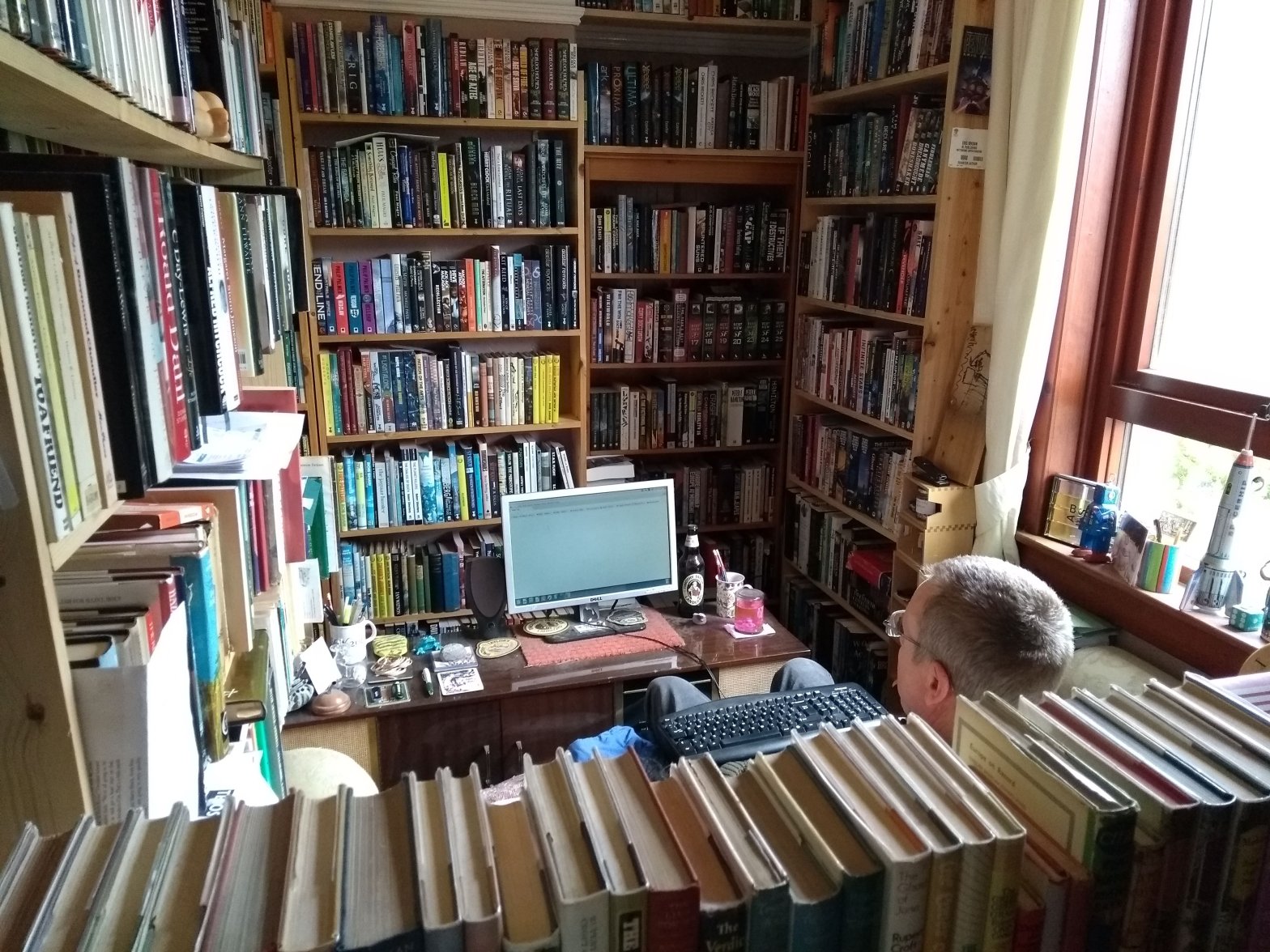
Eric was a prolific writer. His method was to sit, wrapped in a blanket and surrounded by his books, and to write. You can read how he did it here: https://tonyballantyne.com/how-writers-write-eric-brown/.

He was natural story teller. His SF worked because he knew that it wasn’t the technology but the characters that made a story work.

Others have talked about Eric’s humanity, and that of his characters. I’d like to give an illustration of what this means.

I was delighted when Eric asked me to collaborate on a story as part of his Kethani series. I took great pleasure in setting up a vicar as the protagonist. Matthew was a sympathetic character, his faith troubled by the alien Kethani bringing people back to life. I was being deliberately awkward, setting up a situation where conflicting beliefs clashed. I couldn’t see a resolution, and I must admit there was a smile on my face as I hit send on the email, sending the MS to Eric.

He replied within hours. He resolved the problem in one elegant sentence, a line that left the dignity of all characters intact. The ending was a masterclass in storytelling.

Eric Brown was a great writer. More than that though, he was a great friend.

Queen Camilla

I’m currently reading Queen Camilla by Sue Townsend (paid link).

The book is a follow up to The Queen and I, in which the Royal Family are moved to a social exclusion zone in an ex-council estate. (No matter what they say about the genre, every mainstream author ends up incorporating SF into their work.)

Given the recent news about Princes Andrew and Harry, the public perception of the Royals will have changed a lot since this book was written. But I find it interesting how Townsend shaped her characters based upon images presented in the media at the time.

Even more so, its the way she does it. Sue Townsend was an excellent writer. Look at this scene where characters are revealed by which biscuit they chose.

‘Oh, for Christ’s sake, Charles, choose a bloody biscuit.’ Andrew grabbed a chocolate digestive and crammed it into his big-jawed mouth. Edward looked at his wife, Sophie. She said, ‘Have the wafer.’ He obediently took a pink wafer and nibbled at its edge. Sophie held the flat of her hand up and turned her head as Anne proffered her the tin.
Anne said, ‘What the fuck does that mean?’ Sophie replied, ‘It means that I do not want one of your biscuits, Anne. The last time I had one of your biscuits, it was covered in dog hair and I was ill for a week.’ When the tin was held out to Harry, he said, ‘I’m cool.’ Anne said, ‘We all know you’re cool, Harry, but do you want a bloody biscuit?’

I love her writing, spare, funny and razor sharp. Like every expert, she made it look so easy…