Spaceship Turnover

Here’s something to think about on Inspiration Thursday

There are number of SF stories set on ships travelling between the stars.

Such stories should be quite different to those that take place on Earth. This is not because the action takes place on a spaceship. A good story will deal with the interaction of the characters within the ship. The fact that there is nothing outside but vacuum is irrelevant. If it’s an isolated environment the writer is after, then they could have set the tale in a hut in the middle of the Antarctic or on board an ocean going ship.

What makes such story SF is the physics. On Earth a vehicle that isn’t being powered will come to a halt. There are exceptions, you can roll a car down a hill, but as a general rule, if you take your foot off the accelerator the vehicle will coast to a halt. If the engines on your aeroplane cut out you better hope that the pilot can glide to a runway before friction robs the plane of momentum.

It’s different in space. Turn off the engines and a ship will continue to coast almost indefinitely. A journey between the stars would involve accelerating for the first half of the journey and then turning the ship around to decelerate for the second half. Make the turnover too late and you won’t stop in time, you’ll shoot past your destination.

This is counter intuitive, it’s not the way things work on Earth. Give your spaceship a hyperdrive (something I’ve done myself) and you don’t have to think about such things, you can look at other stories.

But just imagine you were on a spaceship that took ten years to reach its destination. Five years speeding up, five years slowing down. Just imagine the characters you could have on that ship. Actually, you don’t have to imagine. Al Reynolds did a great job with this scenario in his Revelation Space series.

I find these journeys a metaphor for life, I wrote about just that in Midway.

Some people spend the first half of their life accelerating up to speed and then slow to a graceful halt in the second half. Some people never learn to stop: they see their destination pass them by as they struggle to change direction and try and catch hold of it. And some people barely start at all.

Something for you to think about on Inspiration Thursday

Sacrificing the alien

I was going to post this last week but I was too excited by the Artemis launch…


The first time I went to Spain it seemed so alien.

It was the first place I’d ever flown to. Stepping off the plane I was hit by a wave of heat: I didn’t release that the climate would change so much in just three hours travel (in those days it took a lot more than three hours to travel by train to London from my home).

I didn’t know anything about Spain. Beyond such basics as adios and gracias, I didn’t know the language. I didn’t even know everyday words like salida, cerveza and chorizo.

The food was unfamiliar, the meals were lacking warming carbs, they didn’t come with potatoes, two vegetables and gravy. You didn’t order your drinks at the bar; you sat at a table and waited for a waiter to take your order.

But it was the heat that I remember above all else. The way the day was turned around, so you stayed inside at midday and went out at night, you closed the curtains against the sun and opened them to the stars. My three thick jumpers stayed in the suitcase for all ten days.

But that was a long time ago.

I’ve just got back from a week in Tenerife. You might have seen on the news that the island was lashed by storms. We were on the south of the island so we didn’t get anything like the trouble up north, mainly just a lot of rain and the occasional lightning storm.

But now the tables were turned, my Spanish friends.

As you stood in doorways holding out your hands to feel the raindrops, we happily strode out in our raincoats. As you shivered in the night we put on the jumpers that we still bring with us as we’ve never managed to break that habit.

We were feeling quite smug until the sea flung a bunch of jellyfish at us as we walked along the front. I took a picture of one (you can see it attached to this post) and sent it to my friend. He said it was actually a Portuguese man o war and very dangerous. Bearing in mind they now seem to be engaging in aerial attacks I’d say he had a point.

Things were quite light hearted to begin with. But then there were the power cuts, the loss of water. Roads and schools were closed, emergency shelters were set up for the homeless… Whilst we were on holiday eating salted sea bass, the locals were adapting to extreme events.

At the end of the week we flew back to England. It seems a bit heartless to say it, but we had a good time despite all the troubles the locals suffered. Essentially, we did our best to make what was happening around us normal, we related it all to our everyday experience. We sacrificed the alien for the sake of comfort.

Don’t judge us. You would have done the same.

How it works

Last night I did something I haven’t done for over fifty years. I watched a moon rocket take off.

I’d forgotten just how exciting it was.

I only just remember seeing the moon landings. I was three years old when my parents woke me in the middle of the night. They brought me through to the little black and white TV in the lounge to see Neil Armstrong step onto the moon. I was tired, I wanted to go back to bed, but my parents refused. They said I would remember this. They were right. I don’t remember very many other things from that age1.

I quickly grew to love rockets, though. They were on the television all the time, both real ones and pretend ones like Thunderbird 3. Everyone I knew, it seemed, had the Airfix Saturn V kit. I knew (or I thought I knew) everything about rockets. I was surprised, watching the TV last night, just how much the presenters were having to explain. About countdowns and separation and launch delays.

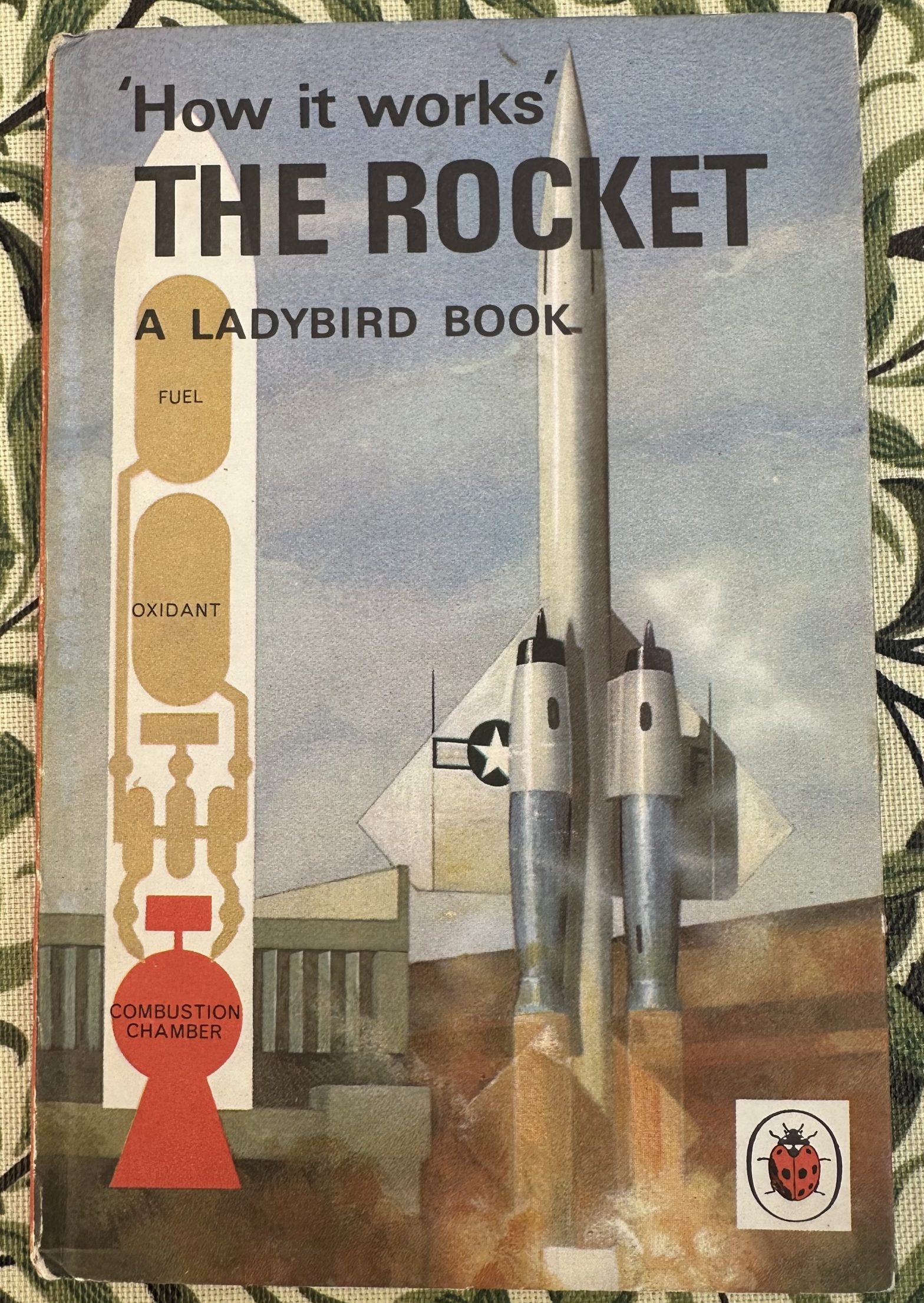
But of course, people nowadays don’t have the advantage of Ladybird books, in particular ‘How it works’ THE ROCKET2. I went and found my copy this morning. There’s a photograph of it at the top of this post. This is a book from a very different time, when six year olds were expected to read about Newton’s third law of Motion (see page 8).

Looking back, it seems as if they were launching rockets every week in the early 70s (I know they weren’t, but I was very young.) I quickly got bored with launches and discovered other things to be obsessed with, like trains and lego.

The trouble was, space exploration was an every day thing to me. It had been part of my world for as long as I could remember. Literally

But watching Artemis II lift off last night, I remembered just how exciting rockets were. There was the countdown. Countdowns are exciting, every writer knows that. Even Mr Spoon knows that. I watched on and off throughout the evening, watched the astronauts being fastened in, listened to the back and forth at launch control. I was there for the breathless pause at minus ten minutes when it looked as if things weren’t going ahead, I felt excitement at the resumption of the count…

And finally, the lift off. Watching that ship climbing into the sky (it seemed to rise much faster then I remembered) the sheer visible power of the thing, the thought that four people are leaving our planet… I was surprised how moved I was. I’d forgotten what it was like.

I remembered why I became an SF writer

Every so often I’m reminded that we live in the age of miracles.
I wonder how long it will be before we take it for granted again?


  1. I do remember the BBC News leading with the Beatles breaking up. I’m not sure I knew who the Beatles were at the time ↩︎
  2. If you like Ladybird books and you live near Cambridge you might want to visit The Wonderful World of the Ladybird Book Artists Exhibition ↩︎

Finally, it’s getting harder and harder to share these posts. The algorithms on social media sites favour internal content, not external blogs like this. If you’ve been relying on say Facebook to send you to this site then you’ve probably not being seeing many posts recently.

If you don’t want to miss anything, enter your email below to subscribe to this blog and receive posts by email.

Lip Salve

The tin of lip salve in the picture has sat there by the crossing for a few days now.

How did it get there? That’s the sort of question we like to ask on Inspiration Thursday.

The most likely explanation is that someone dropped it, then someone else found it and placed it on the box so that the owner might see it and retrieve it.

Of course, it could be a spy sending a signal to another spy, or an advanced monitoring device placed there by aliens. That could make for an exciting story, I suppose, but I don’t think that’s as interesting as thinking about what’s really going on here.

The crossing is just outside a local shop. I go there four or five times a week to buy bread and milk and so on, and I imagine that the owner of the lip salve does the same. They must have seen it by now, so why haven’t they taken it back?

Examining motives always makes for a better story. Why would they take it back? It’s lip salve. It’s been sitting out in the bad weather. Kids might have done something to it. Would you want to put suspect salve on your lips? Really, if the owner has seen the tin, they should have taken it and thrown it in the bin.

And what about the person who put it there? What did they expect to happen? Did they think through their actions? Did they believe they were doing someone a good turn, or were they just going through the motions, like in the bag of food waste? If they really wanted to be helpful they should have thrown the lip salve in the nearby bin. Or maybe they couldn’t be bothered to walk that far.

Or perhaps I’m just overthinking it. It was just a helpful act. Whatever, it’s the sort of thing to think about when writing a story.

Sunday at the Village Vanguard

Here’s a quick question. Which was Charles Dickens time travel story?

Got it? It was, of course, A Christmas Carol. Scrooge travelled back and forwards in time from the beginning to the end of his life.

If you didn’t get the answer it’s because I was deliberately misleading when asking the question. Time travel makes people think of science fiction, and A Christmas Carol isn’t science fiction (here’s a small taste of why not). And besides, Dickens didn’t write SF

I’m not a fan of time travel stories, I’ve only written one that I can remember (“The Blue Magnolia” – originally published in The Third Alternative 22), although admittedly I do play around with the concept in my current Fair Exchange stories

But no one will ever travel in time. I can prove it.

Go to Spotify or Apple Music, or possibly your record collection, and find the album Sunday at the Village Vanguard by the Bill Evans Trio.

Sunday at the Village Vanguard is reckoned to be one of the best live jazz recordings ever, and I agree. I love Bill Evans. If I had a time machine then this would definitely be on my must-see list.

Listen to the track “Alice in Wonderland”. You can hear the crowd talking throughout most of this album, but it’s particularly noticeable on this track during Scott LeFaro’s bass solo. If I was at this concert I would know that LeFaro was going to be killed in a car accident in eleven days time. I would want to tell the people around me to be quiet. And not just me, all the other Bill Evans fans who had traveled back in time would do the same. In fact, there would be so many of us that the regular crowd wouldn’t have got in.

So there you are. The fact you can hear the chatter shows there is no time travel.

Actually, the SF writer in me can’t let the above passage go unchallenged. If all of us Bill Evans Trio fans were listening in silence, I suspect the performance would have been very different. We’d have changed the performance just by observing it. That’s the trouble with time travel stories, you can’t pin them down. They keep wriggling into different shapes as you write them.

I read recently that people enjoy things more in memory than they do in the moment. I don’t know if this is such a bad thing. Who knows what those fans were talking about in the recording? The trouble they had getting there? Their worries about work the next day?

It’s nice to imagine them looking back later on and just remembering the good parts of the gig. As Joni Mitchell said, You don’t know what you’ve got ’til it’s gone.


Finally, it’s getting harder and harder to share these posts. The algorithms on social media sites favour internal content, not external blogs like this. If you’ve been relying on say Facebook to send you to this site then you’ve probably not being seeing many posts recently.

If you don’t want to miss anything, enter your email below to subscribe to this blog and receive posts by email.

The Queen’s Gambit

Mitchell and Webb once did a Medical Drama sketch, where two fictional screenwriters explained that the emphasis in their new series was on drama and not medicine, as “you can get bogged down too much on the so called research.”

This resulted in a show with doctors shouting such things as “This patient is poorly! Bring me the medicine! No, you fool, that’s the wrong medicine!”

I was reminded of this sketch whilst watching The Queen’s Gambit recently. If you haven’t seen it, it’s a series about a female chess prodigy who goes on to become World Champion in the 1960’s. Apparently the matches played on screen were meticulously researched, and reflected real games played back then.

But that doesn’t matter. I don’t think most people watching would follow the play – I certainly couldn’t – but that doesn’t matter because what made the show so watchable was the way the drama of the games was communicated.

I was gripped by the ebb and flow of the matches, by the pace of the game: the way players would make a series of moves quickly and then spend ages pondering the next one. There was drama in the expression on their faces, even in the way they moved the pieces…

But that was just the games themselves. Painstakingly recreated they might have been, but they weren’t the story.

David Hepworth, the music writer, gave this advice – Don’t write about the music, write about all the things around it.

I think that’s true of all writing.

Would the Queen’s Gambit have been as good if it had been about draughts or backgammon? I don’t think so. Maybe you could have made the tournament scenes themselves as exciting, but the drama was heightened through the 60s setting, the Cold War tension and the single minded devotion of the characters in studying past games. The story wasn’t about the chess.

It’s often said that the essence of drama is conflict. Many beginner writers misunderstand what this means. A fight doesn’t make a story exciting. Why the people are fighting, that’s what’s interesting.


On a separate note, I saw Hamnet last night. That was two hours of my life I’ll never get back. The only bit I enjoyed was the last ten minutes, and that was because it was a scene from Hamlet.

But there was a bit where Shakespeare was sharpening his quills whilst awaiting for inspiration to strike. I felt happy when I saw that. That was the Elizabethan equivalent of me messing around with my emacs config file on my computer rather than getting down to work.


Finally, it’s getting harder and harder to share these posts. The algorithms on social media sites favour internal content, not external blogs like this. If you’ve been relying on say Facebook to send you to this site then you’ve probably not being seeing many posts recently.

If you don’t want to miss anything, enter your email below to subscribe to this blog and receive posts by email.

It’s the dishonesty I can’t stand

I don’t know if you’ve ever used the Vivaldi browser, but take a look at this announcement for their latest update:

We’re launching Vivaldi 7.8 today, and honestly, this one’s different. While every major browser is racing to cram AI assistants into their products, Vivaldi is dropping a middle finger to that entire approach.

Good for them. Dell have realised that users don’t care about AI too. You can read about that here.

Pages used to be a rather nice little word processor that I occasionally used on my iPhone. Apple have just updated it to try and make me take out a subscription to their Creator suite. Two things:

1) I don’t want to use Apple Intelligence when I’m being creative. The pleasure is in the act of creativity, not in the output. You might as well pay someone to have sex for you.

2) Apple say that Pages will continue to have a free tier. No it won’t. Pages was never free, any more than iOS is free. You pay for them as part of the cost of the device. It’s the dishonesty I can’t stand.

If you want to use AI, fine. Personally, I don’t want AI anywhere near my computer. My thoughts are my own, I don’t want my thoughts rewritten by AI. It’s not what the markets want, either. Here’s what Analog says about AI

Statement on the Use of “AI” writing tools such as ChatGPT

We will not consider any submissions written, developed, or assisted by these tools. Attempting to submit these works may result in being banned from submitting works in the future.

Most other publications say something similar. So if you’re marketing a word processor, don’t pretend that it’s going to help me write saleable stories. It’s quite the opposite.


Finally, it’s getting harder and harder to share these posts. The algorithms on social media sites favour internal content, not external blogs like this. If you’ve been relying on say Facebook to send you to this site then you’ve probably not being seeing many posts recently.

If you don’t want to miss anything, enter your email below to subscribe to this blog and receive posts by email.

Newton Aycliffe: The Town of the Future!

There’s an article in the Guardian about my home town, Newton Aycliffe. The shopping centre is owned by a billionaire businessman. Over half the units are empty, the ones remaining are mainly owned by the big chains. Local shops are left to die.

This wasn’t really news to those of us who came from Aycliffe. When I was growing up it was often said that the rents for shops in the town were higher than those in Oxford Street, London.

I wrote about Newton Aycliffe in Midway. The ownership of the town centre wasn’t the only example of a monopoly. You can read in that book how television aerials weren’t we allowed on roofs and so we had to rent televisions from the same company. That company owned a huge TV mast at one end of the town, it funnelled BBC and ITV to homes via cable. The picture quality was poor, but if this was your first television, how were you to know that?

This was the 1970s. There was no internet, many people didn’t have cars. Our closest big towns were Darlington and Newcastle. All we knew of the world came from newspapers, television and the radio. And books of course. My mother was the town librarian. All we knew was what was all around us, and so that seemed the natural order of things.

Looking back on my childhood it seems like I grew up in one of those towns you get in SF movies. At first, a seemingly idyllic place, but things aren’t what they seem. There are dark forces at work, hidden in the background. Walk by an open door and you get the occasional glimpse of something strange lurking in a room. You see mysterious trucks rolling along the railway at night, there are lights in the sky…

Newton Aycliffe was supposed to be the town of the future. Quite an appropriate place for an SF writer to grow up in, I suppose. When I was a child I imagined aliens and evil supervillains everywhere. But as you’ll see from the article the truth is both far more mundane and ultimately depressing.

As is so often the case, something built with the best intentions ends up being exploited by those whose only motivation is profit.


‘You’d be ashamed to bring someone here’: The struggling billionaire-owned high street that shows Reform’s road to No 10 | Communities | The Guardian

Inspiration Thursday!

I just spent a week in Marrakesh, hence this post.

The picture shows the Jemaa El-Fnaa Square in the centre of the Medina. You can see the Koutoubia or Kutubiyya Mosque in the background. There are far better photographs of the mosque online – I just looked back over my camera roll and this was the best I had. But hey, you don’t look at this blog for the pictures.

According to Wikipedia, construction on the mosque begin sometime in the 12th Century. The name Koutobia derives from the Arabic word meaning booksellers, as this was main activity of the vendors in the square at the base of the mosque. The three golden spheres at the top of the minaret represent Islam, Christianity and Judaism and are intended to show that all religions are welcome in the city.

While in Marrakesh I happened to pass the mausoleum of Sidi Abou Fariz Abdelaziz Tebbaa. According to the notes written outside, he ranked high among his contemporaries in science, knowledge and honesty. I was impressed that this was how they measured his worth.

I’ve been thinking for a while about doing a series of posts on an “Inspiration Thursday” theme. I don’t know if this could be the first.

Write a story set in a world where people are respected for their knowledge and their honesty. Where books are valued and different religions are tolerated.


Granted, such a world seems pretty far fetched at the moment, but apparently it was not always the case. We are talking SF and Fantasy after all.


Customer Service

I spoke to the bank the other day.

Well, I say spoke. I was messaging a chatbot. I asked to speak to a human, and got put onto someone called James (I’ve changed the name, you’ll see why later on).

James was not a good customer service representative. His mind was clearly elsewhere. He didn’t read my questions properly, he just posted standard answers based on the first couple of words I wrote. He was so unhelpful I began to suspect that James was just another chatbot, and I said so.

James took offence to this. He said that he was real human, and I should have known that as he’d introduced himself as James. He then spent some time trying to justify his previous answers.

The conversation became increasingly petty with James trying to score points over what he thought I had said (he still hadn’t read my questions properly). I thought about just ending the chat but with patience I eventually got the answer I needed, I said thank you and goodbye and broke the connection.

I could imagine James turning at that point to the person next to him and complaining about me. I certainly wasn’t happy with his attitude.

Two minutes later the satisfaction survey arrived.

Do you know what I did then?

Nothing.

I might not have liked James’s attitude, but I like these surveys even less. Maybe James was having a bad day. Maybe he was overworked and I was just one call among many. Maybe I was a little tetchy having to speak to a chatbot and I was a little short with him. Whatever the reason, a bad conversation is not the worst thing that can happen in a day.

I hate the way that every transaction nowadays is reduced to a five star rating and a comment. Those surveys aren’t about improving the customer experience, they’re a way for our corporate overlords to keep us workers in our place by turning our fellow proles against each other.

I’d had a tetchy conversation, nothing more. If I really wanted to complain about James, then I would have complained properly. There’s something really rather pathetic about firing off one of these surveys after the event as a way of exacting revenge.

Anyway.

I just heard that Gordon Goodwin has died. That’s a sad loss. Amongst other things, he was the leader of Gordon Goodwin’s Big Phat Band, one of the great modern big bands.

I’ve written this listening to his Big Phat Christmas. Why not give it a try?