Jack Wedderburn and the Manatees

It’s been over ten years since I wrote Dream London. Someone asked me about this scene last weekend, the one where Jack Wedderburn gets raped by the manatees. They wanted to know what was going in my mind. A fair question.

The answer is I was making a point. I’ll come to it shortly.

I’ve been watching old James Bond films while I’ve been doing the ironing. There’s a common structure to these films. James Bond will usually sleep with two women. He’ll hook up with the first about a third of the way through the film, and then around half way through he’ll come back to his hotel room to find her dead in his bed.

The second woman will be the “real” Bond girl, the big name female star. Bond have to pursue her, will probably save her from the exploding secret headquarters, and will usually end up making out with her just before the end credits.

There are two sorts of people in these films: heroes and victims. In a Bond film the first woman is an ordinary person and therefore a victim. The second woman is a hero, and therefore Bond always saves her before she is too badly mistreated.

You get the same sort of thing in the Marvel universe. Marvel heroes never suffer the consequences of their actions in the way ordinary people do. Even when heroes die, they die a heroic death. They’re never humiliated or suffer indignities in the way ordinary people do, merely to provide motivation to the heroes.

That’s why Jack Wedderburn was raped by the manatees in Dream London. I don’t like heroes, and I didn’t want Jack to make it through the story unscathed. Besides, Jack Wedderburn was an unpleasant character, one who fooled everyone by using his good looks and charm.

Many people were upset by what happened to Jack Wedderburn, they say I shouldn’t have written the scene.

Two points

1) I didn’t actually write the scene: only the lead up and aftermath is shown.
2) So called heroes don’t get special treatment in my books

One last thing. Jack Wedderburn lied about what happened to him by the manatees, and everyone believed him. It’s amazing what you can get away with if you’re good looking.


Reflections on 37 Years of Teaching and Retirement

This summer I’m retiring as a teacher after 37 years. As my wife points out, I’m only retiring from teaching, I will still be employed as a musician and a writer (which should be good news for Penrose fans).

I’m proud to have been a teacher. The following is an extract from my leaving speech.

I was reading in the paper about the crisis in British schools. It might surprise you to learn that there is a shortage of teachers, that schools are underfunded, that buildings are crumbling and class sizes are growing. It might also surprise you to know that the article I’m talking about was one that I read back in 1988, the year I started teaching. Things have always been bad.

Back then I was given a £1250 bursary to train as a Maths teacher (I think I spent it on a keyboard and a pair of walking boots)

That wasn’t why I did it, though. I’d spent two summers in the US teaching fencing on a children’s camp and it was there that I realised two things:

First, teaching was great fun

Second, teaching is probably the most important job in the world. Helping people to grow into responsible adults capable of listening to both sides of the story, teaching them how to control their emotions and to learn to forgive and forget is always going to make a bigger difference to the world than any book or song.

Which is why I’m so proud to have been a teacher. It was an incredibly hard job when I started, it’s much much harder now.

And yet this what we have chosen to do. And looking around the staff in this room right now I think you were right to make that choice, because when I think of all the things happening in the world right now I genuinely believe you are the only people between these kids and chaos. I’m convinced of that now more than ever.

So well done all of you

And good luck!

Forbidden Words

On Sunday I’m going to my writing group. There are number of authors there, some well established, some newer. All of them provide valuable feedback. As I’ve written elsewhere, the advice I’d give my younger self as a writer would be to join a writing group much sooner.

Anyway, one of the stories I’m currently critting has caught my attention. It’s by a new member: it’s a great story and is very well written apart from one thing. I think the rest of the group will already know what I’m going to say when I talk about this one…

I don’t like made up words.

R’hellono. Zhve-lenga. iSto(click)xxz.

I just made those up. They’re supposed to sound exotic, they’re supposed to evoke an otherworldly atmosphere and I suppose they do providing you don’t drench the MS in them. You can just about get away with that sort of thing in fantasy when you have humans speaking.

But it has no place in SF.

The chances of an alien being able to communicate with us directly are small. The chances that they would actually use sounds in the human range – rather than using radio waves; or making light flicker or even just moving their ears like a dog are infinitesimal. Why would a crystalline alien race who communicate by changing the ionic balance in chemical solutions be called the V’llorr? The aliens wouldn’t be able to make those sounds, so why would humans call them that? Surely they’d give them nicknames, scientific names, or name them after their place of origin.

I dwelt on this in my Penrose series. The robots came from another planet, everything they said was translated into English (or the language of the edition). Read A Note from the Author in Stories from the Northern Road for more details.

If you were to be friends with an alien, you might as well call it Hilary. You’re not insulting it, it can’t understand the sounds you’re making. And it’s probably calling you a similar name in its own language.

Show Don’t Tell

Show don’t tell.

There’s online debate at the moment about this advice traditionally given to writers. A lot of people are saying it’s over rated, that there are many times when trying to show not tell ends up getting in the way of the story. Sometimes a quick information dump is best.

They’re right. But they’re missing the point.

As Sol Stein said, story telling is all about communicating emotion. And as every romance reader and writer (and I used to be one of them) knows, it’s not enough to tell someone you love them, you have to show them.

How can a writer convince the reader that two people are in love?

It’s not enough to say that someone is attractive. In a traditional romance the man is nearly always tall and dark and handsome. Does this make him desirable? Maybe, if that’s your type, but it’s not enough. Maybe he’s good with his hands, maybe he’s thoughtful and compassionate. Better, but this is still really just telling.

How do you show that two people are attracted to each other? They blink, they blush, they get tongue tied, they laugh too long at each other’s jokes, they touch each other on the arm… They do things for each other.

Romance is a big emotion, it drives a plot. In some ways it’s an easier thing to write. How do you show that two people simply like each other, that they get along?

Learning how to do this is part of the craft writing, it comes with practice. It’s great to see it done well. Here’s a good example.

Annabel

I was delighted to be asked to contribute a monologue to Pen to Print. I was even more delighted when I heard the results.

If you want to know how I write books, take a listen. Even if you don’t, take a listen. They’ve done a stunning job!

Listen on Anchor FM


https://anchor.fm/pentoprint/episodes/Annabel–An-audio-monologue-by-Tony-Ballantyne–Write-On–Audio-Weekly-e1s309c

Listen on Spotify

Reaching for the Same Packet

I’ve just finished reading Everything I know about Love by Dolly Alderton (paid link). She’s a funny and perceptive writer, who gives a remarkably honest account of her life. This is not an SF book, in fact it’s the opposite of SF. Part of the pleasure of reading a book like this is the insight into another life…

… although I occasionally thought that her struggles sometimes resembled a journey to the shops through a swamp and an artillery range when there was a perfectly good bus running from the end of the street. She never seemed to take the trouble to read the timetable. But I’m sure we all sometimes go the long way round in our lives to discover truths that are obvious to others.

What really struck me, though, was what we had in common.

We both love Joni Mitchell and John Martyn. I think we’re very different people, but we were both drawn to something in their music. It makes me think of two people on opposite aisles reaching for the same packet on a supermarket shelf.

Joni Mitchell’s lyrics exist in CD booklets and liner notes, they’re on the internet (here’s an example of a writers song if there ever was one) but, great as they are, those lyrics are dead until people read them and breathe their own lives into them.

All writing is the same.

So Much Not Said

I was surprised when my daughter told me she’d never seen 2001: A Space Oddysey, so we watched it together.

This film grows on me each time I see it. I love the length of the scenes and how slowly they develop. I love how little action there is and yet how much spectacle. I love the fact that this is a film for adults.

Most of all I love how much is left for the viewer to observe.

The three bodies in a line.

The second ring being built on the space station seen as the Blue Danube is played. 

And always, the silence in space.

This is a different sort of story telling to fantasies like Lord of the Rings or Game of Thrones. Those have deep backstories that are recounted at the appropriate times. Lineages are listed, tales are recounted.  There’s nothing wrong with this, it’s appropriate to the form. 

The science in 2001 is equally deeply rooted but it’s never recounted, only implied.

It’s often said that good SF writing explores the edges of ideas. This film is a model of the form.  

It’s worth noting that this way of writing isn’t exclusive to SF. The series Mad Men was constructed this way.  The story isn’t presented as one continuous sweep, but rather as series of disconnected events. It’s left to the viewer to fill in the gaps.

This is my favourite sort of writing


Incidentally, I searched for a picture of silence to accompany this post. I chose the old man as it looked different. Why are so many stock photos of young women?

Getting Around in Doom Emacs

The following post is part of my new Emacs Writing Setup. You can find the complete setup here on GitHub: https://github.com/ballantony/emacs-writing


A big part of writing is putting the notes I’ve made into some sort of order. I spend a lot of time joining notes together to make scenes and then rearranging those scenes. Scrivener is good at the rearranging part (I’ve written about this here.) Where Scrivener falls down is the flexibility of search. Emacs allows me to home in on a scene, an idea or a sentence almost instantly.

I copied some of my writing process from Scrivener’s model, even going as far as writing a simple Emacs Scrivener mode. Doom Emacs has rendered that unnecessary. Tools like ripgrep and consult make it far quicker to find what I’m looking for. If you’re unfamliar with the following commands, try them out. You’ll be pleased that you did.

One last thing. Doom Emacs calls different commands depending on which completion engine you’re using. This means the search syntax may vary. I use the default (vertico at the time of writing) which means that searching for apples oranges will return lines containing apples and oranges. In other words: when searching, type one word for an initial selection, then a second to narrow it down.

10.0.1 Searching in Projects

  • SPC SPC find file in project
  • SPC s p search project for text
  • SPC s P search another project for text
  • SPC s d search files in directory for text

10.0.2 Searching in Buffers

  • SPC s s helper function search for text in current buffer. Matches are displayed in another window.
  • SPC s j helper function that goes to entry in evil’s jump list
  • SPC m . Jump to org heading (uses consult-org-heading)

And don’t forget

  • C-c C-j org-goto

10.0.3 Useful Tips

  • SPC s o Search online. t will search online dictionary, T thesaurus
  • Find an unmatched quote using this regex ^[^"]*"[^"]*$

10.0.4 M-x consult-ripgrep

For a more flexible search try consult-ripgrep. It’s worth reading the documentation, but here’s a taste:

  • #alpha beta Search for alpha and beta in any order.
  • #alpha.*beta Search for alpha before beta.
  • #\(alpha\|beta\) Search for alpha or beta (Note Emacs syntax!)
  • #word -- -C3 Search for word, include 3 lines as context
  • #first#second Search for first, quick filter for second.

The Muppets Christmas Carol

As anyone who has seen it will attest, the Muppet’s Christmas Carol is the definitive version of the story. Dickens’s version, whilst competent, fails in a number of rather obvious areas. These include only having one Marley and glossing over the role played by Rizzo the Rat. Worst of all, he neglected to write a number of songs that sound good being sung by Kermit the Frog; Statler and Waldorf; and, hardest of all, Michael Caine.

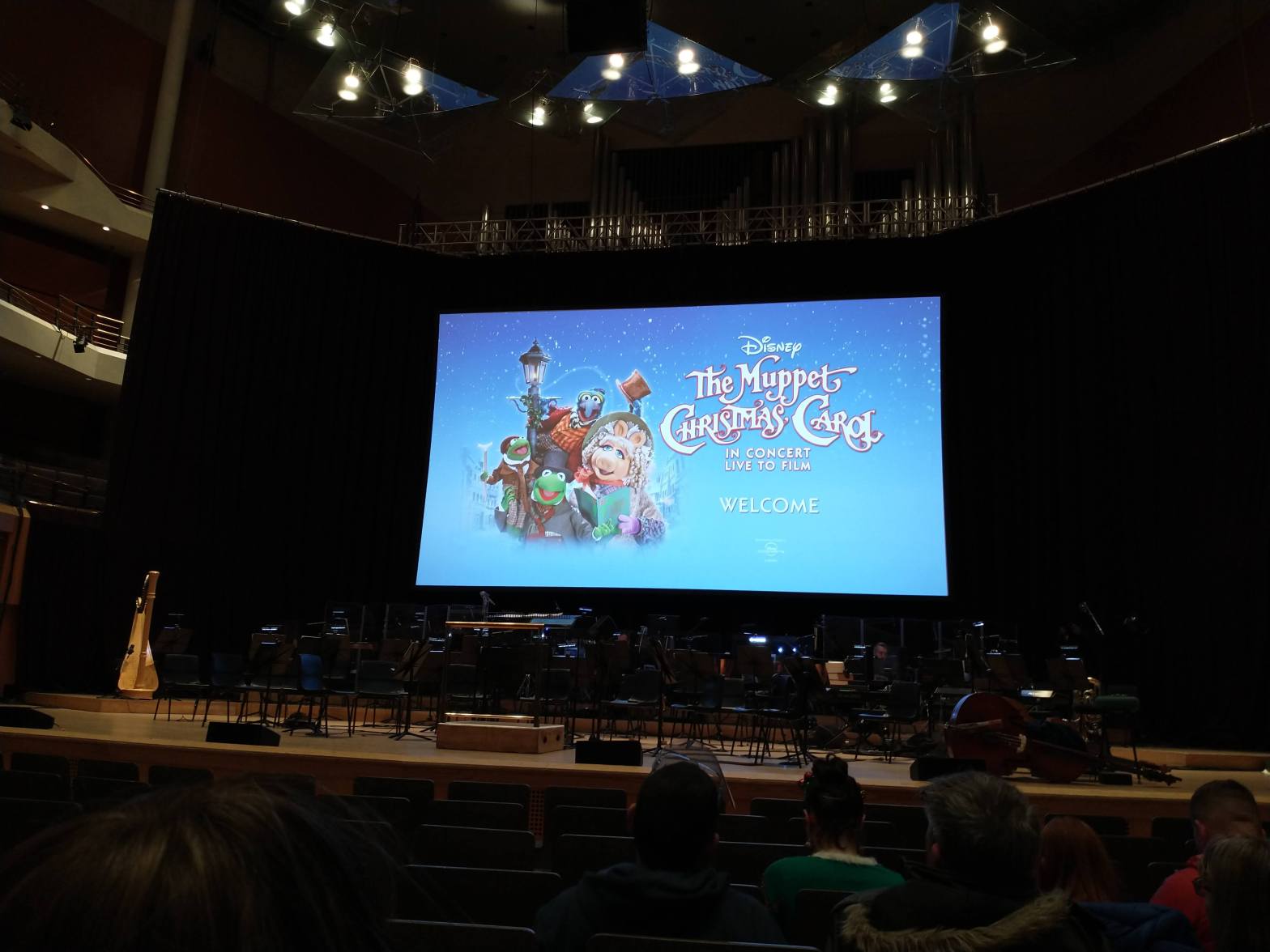
I’ve watched the film every Christmas practically since it came out. However, when I heard that the Bridgewater Hall in Manchester was screening the film accompanied by a live orchestra I must admit I was confused.

Who’s idea was that, I wondered? Who looked out the movie score? Who put together the click track for the conductor to play along with? Who thought people would pay money to see something that airs for free on TV every December.

Whoever they were, they knew what they were doing. The hall was packed with families. When I say families, I should point out I saw about three actual youngsters there. Most of the children in the families present were now adults, my own two included.

Did the addition of live music add anything to the film? If I’m honest, I kept forgetting there was an orchestra present until someone made a mistake. The music was too loud, it tended to drown the speaking.

But that didn’t matter. Everyone knew the dialog. Not only that, they sang along quite happily.

So it was a great show, though not for the reason I was expecting. When I booked the tickets part of my motivation was to support an orchestra, not out of any idea that orchestras need protecting, but because I like orchestras and if no one goes then they’ll stop playing.

But this wasn’t about the orchestra. It wasn’t about the music. It was all about the feeling of community.

The Muppets Christmas Carol accompanied by a live orchestra. Surely this must be the cultural event of the year.