Capturing and Refiling Notes

The following post is part of my new Emacs Writing Setup. You can find the complete setup here on GitHub: https://github.com/ballantony/emacs-writing

Capturing Notes

Like any writer I’m always capturing ideas. I used to carry a notebook everywhere, now I capture ideas on my phone using either orgzly or Evernote.

When working in Emacs I use org-capture.

GTD means capturing ideas quickly. I used to have templates to capture to different locations, I realised that this was an unnecessary step. Now I either capture everything as a TODO, either directly to my gtd file, or directly to the story file I’m currently working on.

As org-capture requires you to select a template I wrote the following two functions. The first calls org-capture with the ’t’ template preselected, the second does the same but uses let* to change org-capture-templates to the current buffer for the current capture only.

(defun tb/capture ()
    "Capture to do without options"
    (interactive)
    (org-capture nil "t"))

  (defun tb/capture-to-this-buffer ()
    "Capture note to this buffer"
    (interactive)
    (cond  ((not  (eq major-mode 'org-mode))
            (message "Can't capture to non org-mode buffer"))
           (t
            (let* ((this-file buffer-file-name)
                   (org-capture-templates
                    `(("t" "Todo" entry (file+headline ,this-file "Captured")
                       "** TODO %?"))))
              (org-capture)))))

2. Refiling Notes

org-refile makes it easy to refile notes, particularly with a completion system like Vertico. On Doom Emacs this means hitting SPC m r r

Why Doom Emacs?

Way back in September I posted about my new Emacs Writing Set Up: Productivity Overview

Things might have appeared to have gone a little quiet since then. Behind the scenes, however, I’ve been making changes. One of these is to begin the process of moving my Emacs Writing Setup across to GitHub: https://github.com/ballantony/emacs-writing.

I’ll continue to blog relevant content here. Here’s the first, explaining why I’ve adopted Doom Emacs.


Emacs is incredibly configurable. I can choose, for example, the shape and contents of my agenda, the completion engine I use and even such things as the colour of my Todos.

And that’s a problem. Emacs allows me to configure many things that, if I’m honest, I really don’t care about.

It’s very easy to fall into the Emacs trap of sending time configuring the system rather than doing any actual work. I don’t want to think about how many hours I’ve spent experimenting with new packages and thinking of the perfect key bindings when I could have been writing stories instead. GTD can be a powerful procrastinator.

That’s why I’m happy to let someone else do it for me.

Enter Doom Emacs. So what if the TODOs are a different colour to the ones I use, and the capture templates aren’t quite the ones I was using, they’re still good. The key bindings may be different, but they’re far more extensive than any I’ve ever set up and I could probably finish a short story in the time it would take me to replicate them (and I can always override the few I really care about: C-e for example).

Most of all, Henrik Lissner, the creator of Doom Emacs, knows so much more about Emacs than I. I’ve learned so much simply tracking through his code. I wasn’t aware of Vertico until it turned up in the Doom config. I don’t have the time or inclination to try out all new Emacs packages. It’s great that someone else is doing this, and if I don’t like their choices, well, Doom is flexible enough for me to change them.

One final observation. Doom Emacs is fast to load. This is important to me. I like to take notes or begin writing when inspiration strikes. I can open Doom Emacs (or Orgzly on my mobile phone) and take a note in the time it takes apps such as Evernote or Notion to load.

Productivity Overview

My second most popular post ever describes my Emacs Writing Setup. (My most popular post, if you’re interested, is this one.)

I wrote five novels and about thirty short stories using the method described in my Emacs Writing Setup, all the while experimenting with other methods. For example, I replicated some Scrivener features in Emacs and wrote about them here.

But over the past year all this has changed. So much so that I’m rewriting my Emacs Writing Setup from scratch.

So what’s changed? Briefly, I’ve started using org-roam and Doom Emacs for my writing flow. This has had a knock on effect for my productivity flow in general.

I think that I’m a productive person. I’m an assistant head teacher. I’ve had 8 novels and around 70 short stories short stories published. I maintain three blogs. I play jazz piano, accordion and baritone horn and am a member of two bands. Most importantly I’m a husband, carer and father to two children.

My two secrets? I watch very little TV and I rely heavily on productivity systems. I think if you’re not using a system then you’re not meeting your full potential.

The systems I use are GTD and Zettelkasten. I’ve experimented with others, but these are the two that best match my needs and personality.

I’ve also experimented with various software applications over the years. I’ve yet to find one piece of software that meets all my needs, although Emacs comes close. If I were to work solely on a laptop, that’s all I would use, but like most people I also rely on a phone and browser.

Orgzly and beorg do a good job of replicating the Emacs experience on a phone, but Emacs without a proper keyboard is always unsatisfying. And, as yet, I’ve not found a satisfactory way of using Emacs via a browser.

So my current productivity system relies on three ‘applications’

  • Emacs
  • Evernote
  • Notebook and pen (I use Leuchtturm1917 notebooks and Uniball Jetstream pens for preference)

I use Emacs for most things, principally org-mode for writing and org-roam for Zettelkasten

Why do I use Evernote when I have Emacs? Remember, Zettelkasten is a tool for thinking, it’s not a reference tool. One of the principles of Zettelkasten is that you should separate your notes from your reference materials.

Evernote is ideal for reference, it’s also more suited for phone and browser access. The newly added Evernote Tasks feature goes some way to replicating org-agenda. Okay, it’s got a long way to go to match Emacs but I can live with it for the convenience. (I experimented with Todoist for a while before Evernote tasks came out. I liked Todoist so much I almost feel guilty for not using it. It’s an excellent piece of software, but I like to have all my to dos in one place)

Finally, I use a notebook for ideas and thinking things through.

As word documents are the de facto standard in the publishing world , I still use LibreOffice Writer for submissions and editing, but I would say that I spend 99% of my time on Emacs, Evernote and in my Notebook.

This series of posts describe how I use these Emacs, Evernote and my notepad to implement GTD and Zettelkasten, particularly to support my writing process. As I don’t have the patience to watch videos, as I’m not interested in personal anecdotes or dubious research to support self evident points I won’t be including any of those things here. I will include How Tos and config files for those who are interested.

If there’s anything missing, let me know.

Productivity 2021

My second most popular post ever describes my Emacs Writing Setup. (My most popular post, if you’re interested, is this one.)

I wrote five novels and about thirty short stories using the method described in my Emacs Writing Setup, all the while experimenting with other methods. For example, I replicated some Scrivener features in Emacs and wrote about them here.

But over the past year all this has changed. So much so that I’m rewriting my Emacs Writing Setup from scratch.

So what’s changed? Briefly, I’ve started using Zettelkasten, org-roam and Doom Emacs for my writing flow. This has had a knock on effect for my productivity flow in general.

Over the next few months I’ll be going over my new set up. Let me know what you think.

You’re using folders and tags the wrong way round

According to Ian Small, CEO of Evernote, only 5% of Evernote users use tags. Evernote is not the only application that uses tags and folders, and I suspect the picture is similar in other applications. Most users rely on folders alone to categorize their work. I can understand this. Everyone has used paper folders in real life, the folders in applications replicate this experience.

However I think tagging is better, the reason being that although a note can only be in one folder, it can have more than one tag.

Here’s an example. Suppose you have personal notes and work notes. Some of those notes are just regular notes, some notes outline projects. You could tag your notes as follows:

  • Holiday (personal, project)
  • Shopping (personal)
  • User Manual (work, project)
  • Presentation (work)

Tagging like this gives you more flexibility. You can now filter for all of your projects, or filter for work projects only. By adding additional tags for things such as year 2021, 2022 you can then find, for example, all the personal projects you started in 2021.  Tagging gives your searches a granularity you don’t get by using folders.

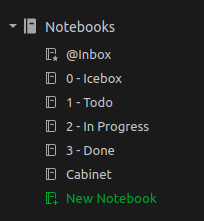
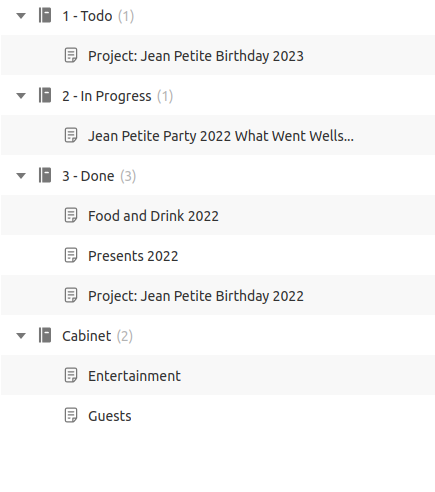
Does that mean folders are no use? No. Folders are useful when something can only be on one state. A good example is :

  • Todo
  • In Progress
  • Done

You can set up those three folders and move notes between them. This is the opposite of the commonly recommended practice that you tag work with Todos.

Why are folders better? Because notes can only be in one folder at a time. It’s possible to accidentally tag a note as both Todo and Done. There’s also something quite satisfying about dragging a note from the In Progress to the Done folder…

What if you want to separate your work and personal to-dos? There are two ways. You can go to the Todo folder and filter by work or personal tags. Or it might be easier just to have two sets of folders

  • Work Todo
  • Work in Progress

And

  • Personal Todo
  • Personal in progress

Does it matter if you’re using folders and tags the wrong way round? Of course not. If you can find the right note at the right time, your system is fine. My suggestion is that using tags correctly adds flexibility.

Seduced by Productivity

I feel that I’ve been seduced by productivity. 

It’s been a gradual process. It began when I discovered GTD. At the time I was swamped with work. I constantly felt there was something else more important that I should be doing. GTD reassured me that I wasn’t neglecting anything, it organised my life. You can implement GTD with a pen and paper. I used Emacs.

That’s where the seduction began. You see, Emacs is just too useful. You can use it for everything, and for years I did. I used Emacs for everything from writing novels to reminding me to chase people for returns at work. It was my calendar, my project planner, my note taking system, everything. 

But slowly I started to introduce other applications into my workflow. Like most people, I spend a lot of my time away from my desktop computer and so I had gradually moved some of my work onto Evernote and Todoist: apps that work well in a web browser or an a mobile phone.   

I spent most of 2020 at my desk: it will probably be the last year that I use Emacs for everything. Emacs remains a powerful, flexible tool that I will use for many aspects of my writing, tech and personal life, however despite such excellent applications as Orgzly and Beorg (both of which I use), there’s no getting away from the fact that Emacs works best as a desktop application.   

I’ve had a love/hate relationship with Evernote for years. I currently love it and the direction it’s going, but therein lies the problem. Like Emacs, Evernote is getting just too useful.

I’ve heard it said that before there were washing machines and vacuum cleaners people were content to wash and clean much less frequently. New technology made these tasks easier and so people did them more often.

It’s the same with tools like Emacs and Evernote and Todoist. They mean I can be more productive, and so I am.

But since when did being productive become my primary aim?

Productivity tools mean I can be a more productive writer, but I didn’t start writing because I wanted to be productive. I started because I enjoyed writing, because I had something to say. Over the years I found I was writing because my todo list told me to.

Yes, I want to be more efficient, yes, I don’t want to forget things, but why should productivity be my principle goal? I can understand that it’s my boss’s aim for me to be more productive, but why should it be mine? 

I had a revelation a few months ago about my writing regime. I wrote about it here, and what I said there still holds true. 

I continue to use Emacs, Evernote, Todoist, but now I try to use them to improve my work life balance. I use them to try and maximize enjoyment of what I’m doing. Yes, I frequently forget this and slip back into old habits, but I’m getting the hang of a new way of working.

It’s much more satisfying.

Milanote

Milanote is a tool for organizing projects into kanban like boards. It’s targeted at creatives, and comes with a variety of templates, not only for writers but for fields as diverse as game design, interior design photography and software development.

You can write notes and todo lists, upload images & files and save things you find on the web, which is pretty typical for this sort of software. Where Milanote differs from other products mentioned on this site is the way you can organize things visually.

Crucially, you can export your boards as pdfs or pngs, or export them in doc, md or txt format.

There is a free version available with no time limit. The PRO version is $9.99 per month (monthly and annual plans)

Disclosure: Milanote shared a lifetime subscription with me in return for writing this post. I must admit, I’m a plain text sort of guy and always will be, but if you think in pictures and not in words, this may well be the tool for you.

Goodbye Simplenote, Hello Again Evernote

We’ve all got a list of our favourite CEOs.

Okay, we haven’t. But if we did, mine would be Ian Small of Evernote.  You can see him here, clearly uncomfortable at being in front of the camera. I rather like him for that. Being good on camera doesn’t mean you can do the job. I’m increasingly wondering if the opposite might be true.

Anyway, read this message Ian Small wrote back in January, stating Evernote’s priorities for the year ahead. I particularly liked this passage:

And honesty requires us to state—straight out—that we can do better with the product you have today than we are currently doing. In fact, we can do better than we have been doing for some years.

He goes on to promise to concentrate on getting the foundations of the product right before adding new features.

Since then he seems to be making good on his promise.  

You might remember this article I wrote in 2016 saying I was leaving Evernote for Simplenote. Well, I’ve now gone back to Evernote. I like the direction things are going. I’m still disappointed with the lack of Linux support but I’ll trade that in for something that’s solid, or at least is attempting to get things right.

And I must admit, I rather like Ian Small’s (rather awkward) style.  Many people seek advancement by promising to make big changes.  They go for the grand gesture and then move on, leaving others to sort out the mess they’ve made. It’s rather refreshing to see someone quietly getting on with the challenge of trying to make something that’s already quite good work just that little bit better.

Six Lessons from Music…

… to think about when you feel that your work as a writer is not receiving the recognition it deserves…

  • Shostakovich wrote during the siege of Leningrad whilst working as a fireman.
  • Messiaen wrote his Quartet for the End of Time in Stalag VIII-A, a prisoner-of-war camp.
  • Mahler was forced to work as a conductor in order to pay the bills. He resented the time lost when he could have been composing.
  • None of Bruckner’s eleven symphonies were commissioned. Two of them received such harsh criticism he retracted them. This is why his last symphony is known as his ninth.
  • Bach was expected to write and perform one cantata a week whilst working in the St Thomas Church in Leipzig.
  • Mozart wrote his last three symphonies without a commission. The last, the 41st is regarded by many critics as among the greatest symphonies in classical music.
  • Finally, remember that Franck “steadily inculcated a disdain for immediate success, and a disregard of the public as a prerequisite for attaining durability in a work of art.”

See Also

Tagging #3: My Tagging System

The following are some of the tags I’ve evolved to help me organize and retrieve my writing notes.

I rely on two sorts of tags, those relating to GTD or workflows, and those relating to story notes.

The story note tags are quite straightforward, here they are:

5alien, 5atmosphere, 5bio, 5character, 5colour, 5ek, 5place, 5plotlet, 5scene, 5structure, 5tech

In case you’re wondering, an ek is an eyeball kick:

Vivid, telling details that create a kaleidoscopic effect of swarming visual imagery against a baroquely elaborate SF background. One ideal of cyberpunk SF was to create a “crammed prose” full of “eyeball kicks.” (Attr. Rudy Rucker)

I write SF so the alien tag should be no surprise. As my story worlds are all tagged, I can easily search for 5aliens in the 3recursion universe.

Possibly of more interest are my workflow tags.

I started out following GTD, labelling all my notes TODO NEXT or DONE. That worked out pretty well in my daily life, but not in my writing life. Over the years I’ve settled on the following

conceit -> idea -> story -> developing -> next/working -> staged -> published/used -> archived

What’s the difference between a conceit, an idea and a story?

The first two are explained in the Turkey City Lexicon. Here’s my thinking on the process by which a conceit becomes a story.

I get lots of ideas – I think most writers would say the same – however most of them are never used. Looking back through my notes I can see ideas that I’ve not had time to use, ideas that don’t go anywhere, ideas that just don’t seem that interesting now. Some ideas I don’t even remember what I was thinking when I wrote them down. But occasionally I will see an idea that joins with another idea and sparks something. When enough ideas join themselves together they become a story.

What’s the difference between next and working?

This is something I think many writers will experience. A story marked next is something that has to be done to a deadline, that’s why I’ve applied GTD to it. Something tagged as working is something that I’m ermmm… working on. I tend to work on stories over periods of months or even years so this tag indicates something I will keep coming back to. When inspiration fails, or when I’m looking for a next project, or simply because I want to move on, I bring up all the things I’m working on and decide what to concentrate on next.

When a story is completed it will be staged, ready to be submitted.  Hopefully I will someday  be able to tag it as published.

More on Tagging