Why Loving Unfashionable Art Can Lead to Success

I rather like Andrew Lloyd Webber’s work.

On the rare occasions I mention this most people feel the need to tell me they don’t like his music. There are two possible subtexts to their comments, either they’re telling me that I’m wrong in liking his stuff, or they’re telling me that they have better taste than I do. 

Anyway, I recently read and enjoyed Unmasked, his autobiography. It gave me something to think about.

Near the beginning of the book, Lloyd Webber describes how he was always uncool.  He liked musicals when they were out of fashion and, in particular, he liked Rogers and Hammerstein when the critics were slating their work. (I love Richard Rogers’ music even now). As a child, Lloyd Webber’s other interests were Victorian Art and Medieval architecture, both also desperately uncool at the time. At one point he describes the moment he first heard the Beatles and he realises that his street cred had just gone into negative.

Even so, he still loved musicals. You’ve got to really love something to keep pushing yourself on whilst everyone else is turning their nose up at what you’re doing.  If you’re just doing something because you think it’s cool  you’re never going to be more than half-hearted about it at best.

That thought led me to wonder if people who like unfashionable stuff are more likely to succeed.  Not because what they like is unfashionable, but rather because the fact that it’s unfashionable doesn’t bother them. 

I love SF and have done as far back as I remember. My mother was a fan, and she introduced me to Ray Bradbury and Isaac Asimov, as well as Star Trek and The Day the Earth Stood Still.

I can’t say my friends ever laughed at me about it when I was a kid, but it wasn’t a popular topic of conversation back then.  I was an SF fan long before I was a writer.

But I think I realised while reading his book that I’ve never loved SF as much as Lloyd Webber loves musicals.

He always loved musicals, he always wanted to write musicals and so he set out to do just that. True, he had the family and connections to help him succeed, but he was single minded in that pursuit.

Good for him.

P.S. The image attached to this post came from Pexels free photos. I searched for cool and stylish and that’s what came up. I don’t want the model thinking I’m calling them uncool. Far from it. That’s their thing. Let them do it.

Stevie Wonder

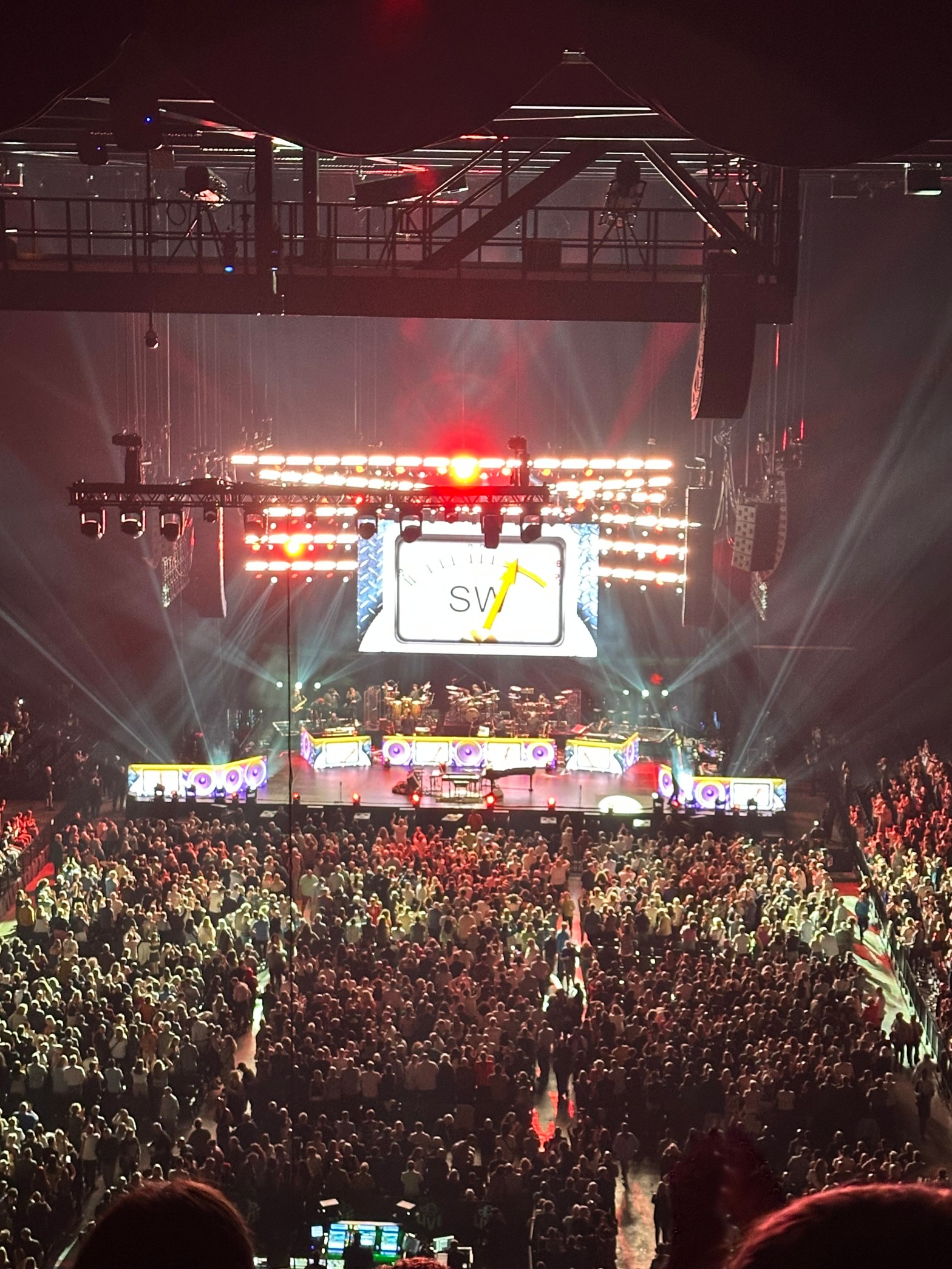
Last weekend I saw Stevie Wonder at the Co-op live arena in Manchester. A fantastic gig at no doubt the worst venue I’ve ever been to.

I was going to blog about Stevie Wonder, but there’s nothing much to say. After a shaky start his voice was still very strong, the band was, naturally, excellent, the hits kept on coming. I think he’s one of the major songwriters of the twentieth century and I’m not alone. One of the singers began his solo set by repeatedly saying “Mr Stevie Wonder. The Legend”. I understood what he meant. I was slightly awestruck to be in the same building as him. This man was sharing the same stage.

But this isn’t a piece of music criticism. It’s more an observation of the changing world. There was a great variety of people there that night, young and old. I myself went with my children who are big Stevie fans. There were undoubtedly a lot of music fans. But I don’t think that music is important to people nowadays as it was in the past.

That’s not to say that there aren’t lots of young people really into music nowadays. I regularly play in bands with young people whose musicianship far higher than I remember when I was younger. Teenagers nowadays have access to a far wider range of music through things like Spotify than was available to me as a child, and as result of this they have far more eclectic tastes.

But music doesn’t form such a big part of most teenagers identity as it once did. When I was at secondary school you liked Pop, or Northern Soul or Heavy Rock. It was a question you always asked when you met someone. What sort of music do you like? It was understood that it was part of your identity. I remember how one girl in my form would always be late to afternoon registration as she’d stayed home to listen for the number one record on the Thursday charts. I remember the excitement or disappointment when we heard that Duran Duran or Adam and the Ants had reached the top spot.

I don’t see that same level of tribal loyalty now, at least for music. That’s not a good or bad thing. That’s just the way it is.

I saw it at the Stevie Wonder concert. Many of the audience members spent most of their time shuttling between their seats, the bar and the toilet. That’s partly the result of the modern practice of seeing an audience as an opportunity to maximise its revenue stream, something the Co-op live has taken to an extreme (Did I mention how much I hated the place and the contempt they showed their customers?).

But it’s not just that. I’ve been to lots of gigs where I’ve left before the last song. But not for an artist I really cared about.

You have to wonder at the number of people who got up and left as the last song began on Saturday night. This was a gig where the tickets cost a minimum of £100. It was likely the first and last time people were going to see this artist, a legend in many people’s eyes.

Music is, of course, very personal. A song that some love can leave others cold. But this was the last song of a gig. It was Stevie Wonder playing Superstition. What on earth did they expect to see? Were they surprised? Were they disappointed. Or would they rather just get off early so they could have another drink?

Like Milhouse said: “You’ve changed man, it used to be all about the music.”

Death and The Maiden

My friend, Chris Beckett, suggested writing down what I thought about whilst listening to a piece of music…


I’m writing this listening to Schubert’s String Quartet No. 14 in Dm, "Death and The Maiden"

The violence of the opening chords, the sense of impending doom that fills the first movement seems obvious to me, and a quick search on the internet suggests that others feel the same.

I often wonder where those emotions come from. Are they innate, part of the music itself, or are they associations gained through years of listening to music?

I believe the feelings generated by music are programmed into us at some basic level. It seems likely to me that we have a common operating system written into us by Western culture and conditioning and through this we interpret the music in the same way.

Extending the idea, if we were to play the music to someone from a different culture and then see that they feel the same emotions, could we deduce that the music is tapping into an operating system at a lower level?

Does it go even wider than that? I don’t think so. No one expects a dog to understand music. Like a book needs a reader, music needs a listener. I think that music and literature are both little parts of our intelligence that are extracted and replayed. Both need our intelligence to make them live.

But what if I’m wrong, that both are filled with some spirit that stands apart from us?

The second movement is playing now. I first heard this piece in my twenties, I think, and it didn’t move me then anywhere near as much as it does now. Has my ability to appreciate the music increased, does my life experience speak more to me, or is it a mixture of both?

It wouldn’t be true to say there was more sadness in my life at the moment, in fact I’d say I’m more content than I’ve ever been. I can, however, see the beginning of my decline in the distance. I’ve achieved nearly everything I set out to achieve in my life, and this too is an ending of sorts. Schubert died aged 31. Perhaps he saw more sadness than I did, or perhaps he crammed more emotion into that early part of his life. Or perhaps he was overly emotional, and I can tap into that better now I’m older.

I think Schubert was a genius, but I tend to think that an artistic genius is someone who was popular in a certain way at a certain time (perhaps that time was after their death, as is true for Schubert.) His music is very clever: the chromatic adeptness; the innovative use of the flattened submediant; the sudden modulations. I know all that intellectually, but that’s not why I’m listening. I’m sure the music wouldn’t have have been remembered if it didn’t have those melodies, that ability to touch emotions across 200 years.

Yesterday morning I walked to work listening to choral music. It made me think of autumn / winter; bare trees; cold stone buildings. Those feelings were not innate to the music. I know that the reverb sounds like empty churches, the voices remind me of carols sung by choirs when I was a child, they stir memories of Christmas, snow and frosty breath. Associations. A lot of music is like this: drums that beat military tattoos and trumpets that sound the charge.

I’m more interested in the emotions intrinsic to the music. I heard the seas rolling in the final movement of Rimsky-Korsakov’s Scheherazade before I knew the story behind the music, but this too is an association of sorts: the rise and fall of the strings imitate the waves.

I’m listening to final movement of Death and the Maiden now and as an experiment I’ve tried imagining disparate pictures against the music – bees in a hive, people arguing, two lovers having a picnic, an icy pond, a fairy in a bottle, the US flag on the moon. Some of the pictures fit, some of them clearly don’t.

I think that much of music is association, but these associations are built on something intrinsic. I’ve read that children aren’t frightened of spiders, they have the capacity to be frightened by them, they learn this fear from those around them. This doesn’t work for everything: children don’t have this innate capacity to be frightened by bottles, for example.

The music has finished, and I’m left wondering where the intrinsic part of the music lies. In it, or in me?

Martin Carthy

I wondered about going to see Martin Carthy last night at the Band on the Wall

I’d heard that his voice isn’t what it was, that he can’t always form the chords any more. Well, that’s what happens when you get older, and as my companion Crofty pointed out after the show "I love a musician that at 70+ doesn’t try to be anything other than themselves at 70+"

So last night wasn’t a virtuoso performance, but to be fair, that was never Carthy’s shtick. What we got was an engaging show, a bit of chat and an overwhelming sense of folk heritage.

On playing Bruton Town:
"I learned this from Davey Graham"

On an English version of Mrs McGrath:
"I didn’t realise there was an English version until I heard Tim Hart and Maddy Prior play it in ’68"

It would seem reasonable to assume that most of us in the audience had been part of the folk scene for the past decades, attending gigs in little pubs and clubs up and down the country. Carthy, of course, has been at the heart of all this.

I don’t listen to much folk music nowadays. Too many of the performers learned their craft in the conservatoires, and that doesn’t seem very folky to me.

Last night’s show may have had its imperfections, it was all the more enjoyable for it.

(And whilst not suggesting for a moment that Carthy is second rate, I’ve written more about performance here: Second Rate Entertainers)

Second Rate Entertainment

I love second rate entertainers.

I encountered a fine example whilst on holiday in Madeira last week. He had a residence in the hotel: 8:30 until 10 every night. Keyboards and vocals, he was a competent player with a good voice that came into its own when doing Elton John covers.

As is the nature of a great second rate performer, he’d arranged everything himself. He switched between keyboards to play different parts, occasionally improvising, all this done over a drum track. Such performances are necessarily individual in a way that singing along to a backing tape never is. He did 70s and 80s covers: Hotel California, Sacrifice, that sort of thing. Given that he was singing in what was to him was a foreign language his phrasing was odd, but hey, he was singing in a foreign language.

It would be easy to dwell on his faults: the arrangements that didn’t quite work, the bland repertoire (necessary, given the venue), his intonation.

But then again that’s sort of the point. I’ve written about second rate performers before at the end of my novel CAPACITY, when the Watcher listens to just such a performance (the scene was based on a concert I attended in a church in France when I was writing the book).

It’s so easy to see perfect performances nowadays. They’re the result of multiple retakes and remixes, they can be autotuned and airbrushed… I don’t have a problem with this. But this can give the impression that all performances should be perfect. That everything should be first rate, all of the time.

No. None of us are capable of that.

That’s why appreciating second rate performances, appreciating people who are willing to make a go of it despite their imperfections, is such an important thing.

Because, for the most part, that’s who we are.

There’s a Lesson Here Somewhere

I saw Chris Smither, one of my favourite singer songwriters, on Thursday night.

50 years in the business, he played to a crowd of around 80 in Manchester’s Band on the Wall, but I suppose there are many whose talent have gone unrecognised.

In some ways it was like meeting an old friend: I’ve watched him perform all over the country for the past twenty five years or so.

I spoke to Chris at the end, and we both remembered the gigs he uses to do at the Half Moon in Putney. I think there’s something storylike in the way we both live completely different lives and yet we connect infrequently in different venues, far from both our homes.

One of the many reasons I like him is he’s that he writes lyrics for grown ups. Yes, I like rock and pop music, but the stuff that I listened to when I was younger doesn’t have much to say to me now that I’m married with two kids.

Someone requested that he play Hold on. He began the song, but had to stop half way. It was his own song, his own arrangement, and it wasn’t working. As he explained, it had been a while since he’d performed it, and if you don’t practice them every day, you quickly forget them. This from an expert musician who performs live to an audience most nights.

There’s a lesson there somewhere.