Sacrificing the alien

I was going to post this last week but I was too excited by the Artemis launch…


The first time I went to Spain it seemed so alien.

It was the first place I’d ever flown to. Stepping off the plane I was hit by a wave of heat: I didn’t release that the climate would change so much in just three hours travel (in those days it took a lot more than three hours to travel by train to London from my home).

I didn’t know anything about Spain. Beyond such basics as adios and gracias, I didn’t know the language. I didn’t even know everyday words like salida, cerveza and chorizo.

The food was unfamiliar, the meals were lacking warming carbs, they didn’t come with potatoes, two vegetables and gravy. You didn’t order your drinks at the bar; you sat at a table and waited for a waiter to take your order.

But it was the heat that I remember above all else. The way the day was turned around, so you stayed inside at midday and went out at night, you closed the curtains against the sun and opened them to the stars. My three thick jumpers stayed in the suitcase for all ten days.

But that was a long time ago.

I’ve just got back from a week in Tenerife. You might have seen on the news that the island was lashed by storms. We were on the south of the island so we didn’t get anything like the trouble up north, mainly just a lot of rain and the occasional lightning storm.

But now the tables were turned, my Spanish friends.

As you stood in doorways holding out your hands to feel the raindrops, we happily strode out in our raincoats. As you shivered in the night we put on the jumpers that we still bring with us as we’ve never managed to break that habit.

We were feeling quite smug until the sea flung a bunch of jellyfish at us as we walked along the front. I took a picture of one (you can see it attached to this post) and sent it to my friend. He said it was actually a Portuguese man o war and very dangerous. Bearing in mind they now seem to be engaging in aerial attacks I’d say he had a point.

Things were quite light hearted to begin with. But then there were the power cuts, the loss of water. Roads and schools were closed, emergency shelters were set up for the homeless… Whilst we were on holiday eating salted sea bass, the locals were adapting to extreme events.

At the end of the week we flew back to England. It seems a bit heartless to say it, but we had a good time despite all the troubles the locals suffered. Essentially, we did our best to make what was happening around us normal, we related it all to our everyday experience. We sacrificed the alien for the sake of comfort.

Don’t judge us. You would have done the same.

How it works

Last night I did something I haven’t done for over fifty years. I watched a moon rocket take off.

I’d forgotten just how exciting it was.

I only just remember seeing the moon landings. I was three years old when my parents woke me in the middle of the night. They brought me through to the little black and white TV in the lounge to see Neil Armstrong step onto the moon. I was tired, I wanted to go back to bed, but my parents refused. They said I would remember this. They were right. I don’t remember very many other things from that age1.

I quickly grew to love rockets, though. They were on the television all the time, both real ones and pretend ones like Thunderbird 3. Everyone I knew, it seemed, had the Airfix Saturn V kit. I knew (or I thought I knew) everything about rockets. I was surprised, watching the TV last night, just how much the presenters were having to explain. About countdowns and separation and launch delays.

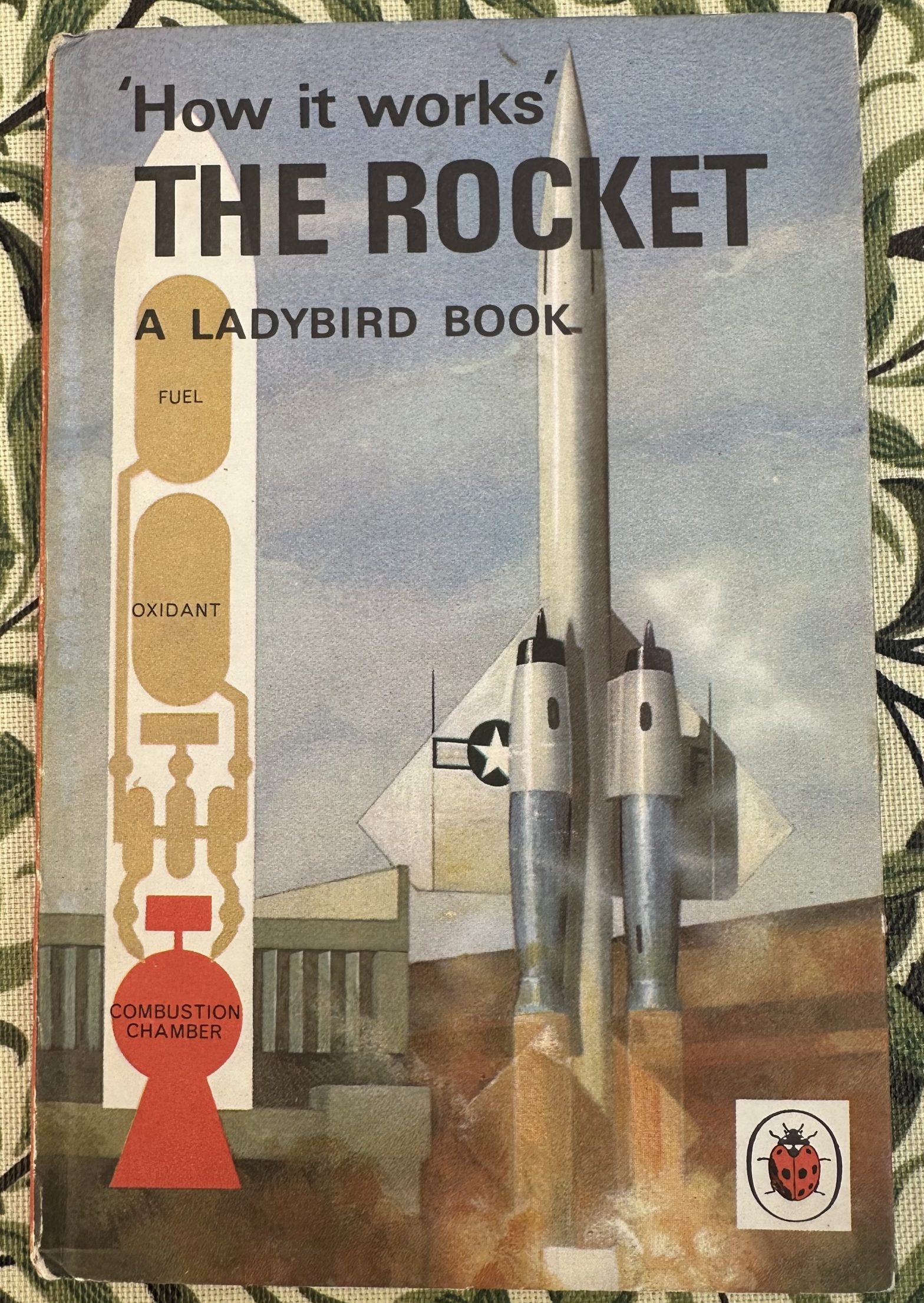
But of course, people nowadays don’t have the advantage of Ladybird books, in particular ‘How it works’ THE ROCKET2. I went and found my copy this morning. There’s a photograph of it at the top of this post. This is a book from a very different time, when six year olds were expected to read about Newton’s third law of Motion (see page 8).

Looking back, it seems as if they were launching rockets every week in the early 70s (I know they weren’t, but I was very young.) I quickly got bored with launches and discovered other things to be obsessed with, like trains and lego.

The trouble was, space exploration was an every day thing to me. It had been part of my world for as long as I could remember. Literally

But watching Artemis II lift off last night, I remembered just how exciting rockets were. There was the countdown. Countdowns are exciting, every writer knows that. Even Mr Spoon knows that. I watched on and off throughout the evening, watched the astronauts being fastened in, listened to the back and forth at launch control. I was there for the breathless pause at minus ten minutes when it looked as if things weren’t going ahead, I felt excitement at the resumption of the count…

And finally, the lift off. Watching that ship climbing into the sky (it seemed to rise much faster then I remembered) the sheer visible power of the thing, the thought that four people are leaving our planet… I was surprised how moved I was. I’d forgotten what it was like.

I remembered why I became an SF writer

Every so often I’m reminded that we live in the age of miracles.
I wonder how long it will be before we take it for granted again?


  1. I do remember the BBC News leading with the Beatles breaking up. I’m not sure I knew who the Beatles were at the time ↩︎
  2. If you like Ladybird books and you live near Cambridge you might want to visit The Wonderful World of the Ladybird Book Artists Exhibition ↩︎

Finally, it’s getting harder and harder to share these posts. The algorithms on social media sites favour internal content, not external blogs like this. If you’ve been relying on say Facebook to send you to this site then you’ve probably not being seeing many posts recently.

If you don’t want to miss anything, enter your email below to subscribe to this blog and receive posts by email.

Newton Aycliffe: The Town of the Future!

There’s an article in the Guardian about my home town, Newton Aycliffe. The shopping centre is owned by a billionaire businessman. Over half the units are empty, the ones remaining are mainly owned by the big chains. Local shops are left to die.

This wasn’t really news to those of us who came from Aycliffe. When I was growing up it was often said that the rents for shops in the town were higher than those in Oxford Street, London.

I wrote about Newton Aycliffe in Midway. The ownership of the town centre wasn’t the only example of a monopoly. You can read in that book how television aerials weren’t we allowed on roofs and so we had to rent televisions from the same company. That company owned a huge TV mast at one end of the town, it funnelled BBC and ITV to homes via cable. The picture quality was poor, but if this was your first television, how were you to know that?

This was the 1970s. There was no internet, many people didn’t have cars. Our closest big towns were Darlington and Newcastle. All we knew of the world came from newspapers, television and the radio. And books of course. My mother was the town librarian. All we knew was what was all around us, and so that seemed the natural order of things.

Looking back on my childhood it seems like I grew up in one of those towns you get in SF movies. At first, a seemingly idyllic place, but things aren’t what they seem. There are dark forces at work, hidden in the background. Walk by an open door and you get the occasional glimpse of something strange lurking in a room. You see mysterious trucks rolling along the railway at night, there are lights in the sky…

Newton Aycliffe was supposed to be the town of the future. Quite an appropriate place for an SF writer to grow up in, I suppose. When I was a child I imagined aliens and evil supervillains everywhere. But as you’ll see from the article the truth is both far more mundane and ultimately depressing.

As is so often the case, something built with the best intentions ends up being exploited by those whose only motivation is profit.


‘You’d be ashamed to bring someone here’: The struggling billionaire-owned high street that shows Reform’s road to No 10 | Communities | The Guardian

And through the wire…

A few years ago I bought myself an expensive phone, a change from the cheap ones I’d always used until then.

I would have been delighted with it apart from one thing: it frequently failed to charge.

Searching online, I found lots of other people having the same issue. Naturally, there were lots of opinions on where the fault lay. The OS, the manufacturer, the fact people hadn’t updated their phone. But in the middle of all the complaints one message kept patiently popping up: it’s all down to a faulty bunch of cables. Replace the USB cable and everything will be fine. I tried everything else before taking this advice, and guess what…

I had a similar experience when I replaced my 12 year old PC. I was having trouble burning DVDs (don’t ask) and I thought that maybe I’d pushed the old hardware as far as it could go. I bought a new PC and everything was fine. Problem solved.

It wasn’t until someone asked for a kettle lead to plug into the PA at a gig I was playing. I lent them my old PC lead. We turned on the PA and heard nothing but crackling. It turned out that, like with the phone, it wasn’t the device that was faulty, but the lead.

I was reminded of this at recent writer’s group meeting when critting a story. The world building was excellent, the plotting tight, the characters interesting. But the story wasn’t working.

The trouble in this case wasn’t anything to do with the story itself, it was the sentences themselves. Reading the story out loud (an old trick) revealed just how convoluted they had become. The writer was so intent on delivering all the ideas they had developed they had lost sight of the actual words they were using.

Stories like this remind me of playing the cornet. As they say in brass bands, it doesn’t matter how great your technique is when you’re blowing on your instrument, if you’re not making a pleasant noise, no one wants to hear.

When things aren’t working, whether with machinery, or stories, or indeed life itself, we have a tendency to blame the big obvious things and to forget about all those other less glamorous mechanisms that keep things running. Quite often we lose sight of the really simple changes that can be made in order to improve things.

Have I mentioned going for a walk recently?