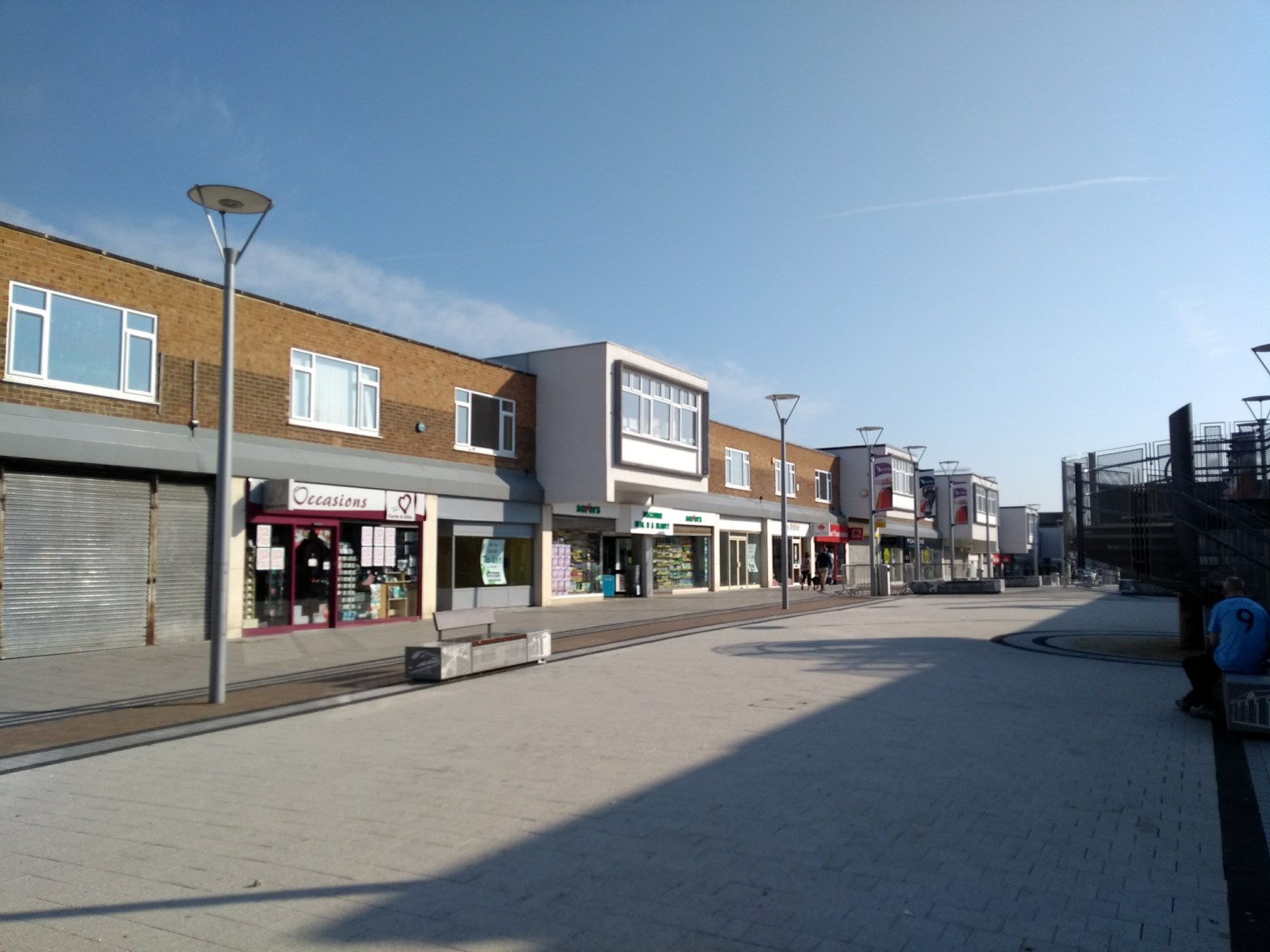
Newton Aycliffe: The Town of the Future!

There’s an article in the Guardian about my home town, Newton Aycliffe. The shopping centre is owned by a billionaire businessman. Over half the units are empty, the ones remaining are mainly owned by the big chains. Local shops are left to die.

This wasn’t really news to those of us who came from Aycliffe. When I was growing up it was often said that the rents for shops in the town were higher than those in Oxford Street, London.

I wrote about Newton Aycliffe in Midway. The ownership of the town centre wasn’t the only example of a monopoly. You can read in that book how television aerials weren’t we allowed on roofs and so we had to rent televisions from the same company. That company owned a huge TV mast at one end of the town, it funnelled BBC and ITV to homes via cable. The picture quality was poor, but if this was your first television, how were you to know that?

This was the 1970s. There was no internet, many people didn’t have cars. Our closest big towns were Darlington and Newcastle. All we knew of the world came from newspapers, television and the radio. And books of course. My mother was the town librarian. All we knew was what was all around us, and so that seemed the natural order of things.

Looking back on my childhood it seems like I grew up in one of those towns you get in SF movies. At first, a seemingly idyllic place, but things aren’t what they seem. There are dark forces at work, hidden in the background. Walk by an open door and you get the occasional glimpse of something strange lurking in a room. You see mysterious trucks rolling along the railway at night, there are lights in the sky…

Newton Aycliffe was supposed to be the town of the future. Quite an appropriate place for an SF writer to grow up in, I suppose. When I was a child I imagined aliens and evil supervillains everywhere. But as you’ll see from the article the truth is both far more mundane and ultimately depressing.

As is so often the case, something built with the best intentions ends up being exploited by those whose only motivation is profit.

‘You’d be ashamed to bring someone here’: The struggling billionaire-owned high street that shows Reform’s road to No 10 | Communities | The Guardian

The Arctic-Alpine Pea Mussel

I heard the Arctic-Alpine pea mussel mentioned on Radio 4 earlier this week when they were discussing the three thousand species in Wales that now exist in five places or fewer. I don’t want to diminish the struggles of the pea mussel but I couldn’t help but think it might not be so endangered if it weren’t quite so picky about its choice of ecosystem.

Or maybe not. Thinking about it, I suppose there are lots of cold streams in high up places. The name tells you something about the creature.

Rather like the glutinous snail, which I heard mentioned on the same program. At first, I thought I’d misheard this one so I looked it up. It wasn’t mentioned in the accompanying article, but after a little more googling I found an article about the snail here.

Reading about creatures like these doesn’t make me wonder why writers bother to invent aliens and fantasy creatures. There are very good reasons for this which I’ve talked about elsewhere, and I’m sure I’ll talk about in the future.

But it does make me wonder yet again why writers make up names.

If a group of glutinous snails have just slithered down the ramp of their flying saucer and demanded to be taken to our leader, why would they confidently announce that they were the K’Kzzlia?

They’re snails. They don’t have tongues and teeth. They wouldn’t have the ability to make K and Z sounds. They do, however, have the ability to build a machine that can translate their language into English (assuming they’ve landed in an English speaking country). So why doesn’t that machine just introduce them as the Glutinous Snail People of Betelgeuse 5?

I hate made up names. They’re overused by beginner writers to lend an air of exoticism to their world building. They end up just confusing people. Worse, they muffle the drama.

I quickly become bored reading stories where Oolma rides a Vlurp through the gates of Mlzra in search of the stolen Glevar of the Throom. Wouldn’t it be far more exciting to say that Emma rides a horse through the gates of the dungeon in search of the stolen daughter of the King? Call your smeerp a rabbit and have done with it.

The thing about most exotic names is that they aren’t actually very exotic. I thought that Suidobashi in Tokyo sounded enchantingly strange when I stayed there. It turns out that Suidobashi just means aqueduct bridge.

And as every expectant parent poring over lists of baby names knows, everyday names can have some rather exotic meanings.

For example, Tony means “priceless one” or “highly praiseworthy”.

That seems about right to me.