I’m pretty sure the title of this post is the first time I’ve written the word Chutzpah. That last sentence was probably the second.
It’s not a word that I think I’ve ever used in everyday conversation, either. But I’m using it now because I’ve just experienced what I think is an excellent example of that quality.
By the way, if you’re a regular reader of my stuff, you may have realised that I like to protect people’s anonymity. For reasons that will very quickly become clear, I can’t do this in this post…
Yesterday I received a LinkedIn invitation from a Senior Project Manager called Tony Ballantyne. Now, I’ve made contact with another Tony Ballantyne in the past – the Historian Tony Ballantyne who I’m occasionally mistaken for – so I thought… why not?, and I accepted.
This morning I received an email from the other Tony Ballantyne explaining that he was moving to Australia, and asking if I’d like to buy his personalised car number plates. Maybe I should have been annoyed, but I had to admire his cheek. And thinking about it, isn’t that an inspired use of social networking? It’s not like he was trying this trick on just anyone.
Anyway, I’m not interested in personalised plates, so I wished him good luck on his move and that was that. If the other Tony is reading this blog post – think of it as more free advertising.
And if anyone else is thinking of contacting me in this way, don’t bother. It’s only amusing when it’s original.
How Writers Write is monthly series of guest posts where established writers invite you into their workspaces, reveal their work habits and share their experience.
I’ve been lucky enough to work with Juliet E McKenna in the past on Aethernet Magazine. I was delighted to get this chance to see how she goes about the process of writing…
What do you use to write?
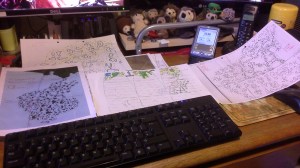
When I’m starting out on a story, I make preliminary notes with paper and pencil. By the time an idea’s ready to become a book, I’ll be working in an A4 spiral bound notebook which will soon have separate plastic folders tucked inside it with roughly sketched maps and other background material. There’ll be character and plots notes and an overall outline and then I’ll roughly draft each chapter’s events and interactions over a couple of pages before I start typing.
I like the freedom of paper and pencil; I can add arrows to link things together and circle or scribble stars by particular thoughts that I know I’ll want to come back to. Yes, I’m sure there’s software that allows writers to do the same thing on a screen but I’ve worked this way for so long now – since I was writing essays at university – that it’s second nature. I don’t see the need to waste time learning how to do it some other way. And since almost no one but me can read my handwriting these days, I don’t have to worry about data security!
When I’m researching, I make notes in more spiral bound notebooks or on loose leaf pages which go into a ring binder. I use yet more notebooks for making notes when I’m reviewing a book. Other notebooks are for short fiction. Yes, they do add up, and yes, keeping them close to hand in the study is very useful, particularly when I need to check some background detail for a novel I wrote over a decade ago, or refresh my memory of a particular book.
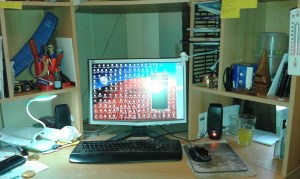
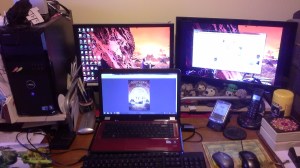
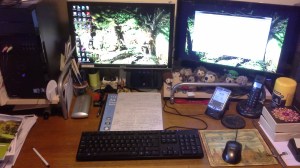
Once the story’s laid out on paper and in my head, it’s time to open a fresh computer file and start typing. I’m a fast and fluent touch typist so I work straight onto the screen, amending and rephrasing as I go. I’ll quite often start a day’s work by looking over what I wrote the day before and tweaking it as necessary. I use MS Word; it’s what the computer comes with, the software does what I need it to do and publishers can read the files without any faffing around. I work on a desktop with two screens for ease of having multiple files open when I need to – each chapter gets its own file while I’m working on a first draft. If I find I really do need three screens, I’ll get my laptop involved, though that can get awkward when I forget which mouse or keyboard relates to which screen. Otherwise, my laptop’s used when I’m travelling or on holiday. It’s not my main working machine.
When do you write?
I write Monday to Friday and keep office hours, so I’m working from around 9 am to around 5 pm. Not all of that time’s spent writing fiction. Sometimes I’m reading books for research or to review them. I also record television documentaries on historical or literary topics and every so often, I’ll take a day to catch up on those. A writer’s always in search of fresh inspiration and that’s how I find a lot of new ideas for plots and characters. We spend a lot of time on holidays visiting historic towns, buildings and museums and I invariably find those stimulate my imagination.
Then there’s all the administration that comes with running a small business which is what a full time author must do these days. Every so often, I’ll have errands to run in Witney, the local town, or I’ll head into Oxford to use the libraries there. It’s good to get out of the house from time to time.
Where do you write?
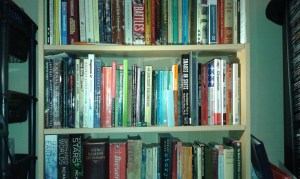
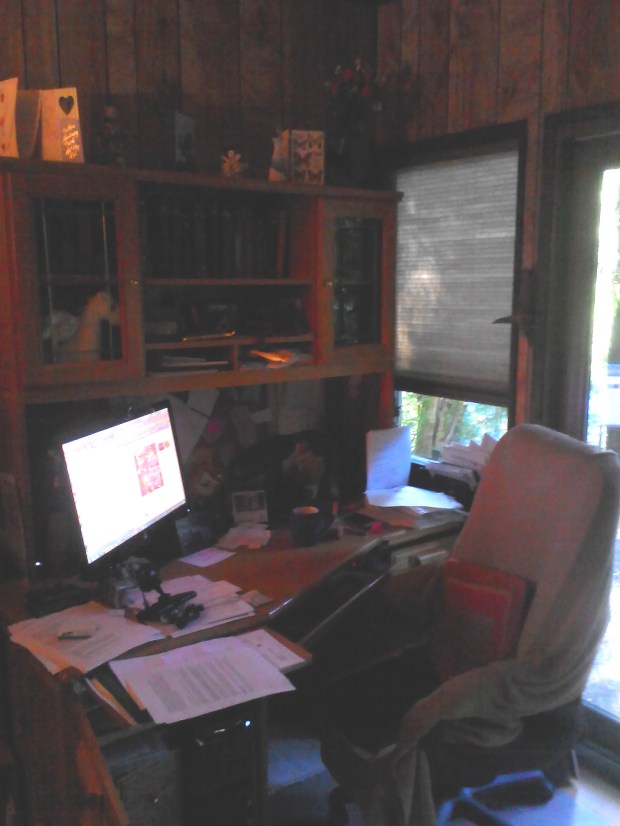
I mostly work in my study, which is the smallest of the upstairs bedrooms. It’s even smaller now with a large desk, a filing cabinet and five crammed bookcases in it. Yes, the joists are resting on load-bearing walls downstairs. I like having my reference books and notes within easy reach, and when my sons were small, I needed a door which I could shut so they knew Daddy was the parent on duty. I don’t have music playing or the radio on or anything like that. When I’m writing, I’m totally focused.
Though I’m not one of these authors who absolutely has to be in their special place or they’re unable to write. I can work anywhere else if I need to. I just prefer to be in my study when I’m writing. When I’m reading for research or review, I’ll head downstairs to the sofa in the lounge with the relevant book in hand and a notebook and pen. A change of pace is always refreshing – and it’s closer to the kitchen and the kettle.
Questions of Style
I’ve written in first person and third person, depending on how close to the characters I want the reader to get. That choice tends to be obvious to me from the first idea for a story. So far I’ve always written in the past tense and I’d need a really compelling reason to write in continuous present tense. It’s not a style I enjoy much as a reader and I find very, very few books where it contributes anything significant to the narrative beyond the author enjoying the stylistic flourish. Though there certainly are some books where it’s integral to the story and its effect, so I won’t say that’ll never change in my work – but don’t hold your breath.
How do you write?
I work from my outline and my notes, though not as rigidly as I used to when I was first writing novels. I’m much more open to changing my mind, particularly as a character develops through the writing process and the internal logic of a narrative acquires its own momentum. A decade ago, I’d stick much more closely to the plan I originally had for the first draft and end up doing a lot more rewriting to get to a final draft. These days, I’ll be more flexible in the first draft and the rewrite will focus far more on language and tone than on revising the structure.
When the first draft is done
I’ll do two drafts of a novel, first and final, because I’ve done so much of the thinking things through in my pencil and paper drafting stage. Ideally, a couple of trusted test readers will read the first draft and I’ll get some time away from the text before I come back for the second pass. When I first started out, the first draft was the bit I loved and the second pass was the hard work. I can’t tell exactly when that changed but these days, the first draft is the humdrum bit I just want to get done and it’s the rewriting and revising that I really enjoy. Honing and polishing.
Fresh eyes are always invaluable. It’s not praise you’re looking for from test readers (though that’s always nice), it’s nit-picking about the details that somehow don’t quite add up and challenges over whether or not a character, major or minor, would really have acted or reacted in the ways you need them to, in order for the plot to unfold. This is how you find out why and where you’ve not quite achieved your storytelling aims. There’s no point ignoring your test readers’ quibbles, no matter how crystal clear it all might be inside your own head,. It’s your job to sort their problems out. Then the story will make sense for any and every reader who picks up the book in a shop or a library and hasn’t got the opportunity to pick your brains about what you really meant – even in these days of Twitter and Facebook.
Wrapping up that final draft is when I’ll find myself working to midnight and through the weekends. I won’t let a book go until I’m satisfied that I’ve done the very best job I can. Once the text’s off to the publisher, for copyediting and proof-reading, that’s fine with me. That particular story’s off on its way into the wide world for readers to enjoy and I’m thinking about the next thing.
Lastly, self promotion:
What am I working on at the moment? Well, this past year, a staggering amount of my time has also been taken up with campaigning for reform of a particularly damaging piece of legislation as far as anyone selling digital products online are concerned. Authors these days need the choice of selling their own ebooks direct as well as through the likes of Amazon, Google and iTunes, so I’ve been working hard with the EU VAT Action Campaign to convince the Powers That Be in Westminster and Brussels that they’ve got this one badly wrong. We’ve got them to admit that now and to commit to changing the law. Now we just need them to sort out interim easements since legislators reviewing the regulations will still take a couple of years which small online businesses cannot afford to waste.
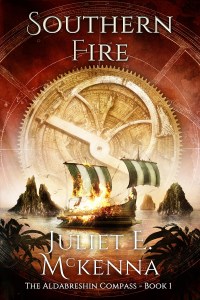
So I’m really looking forward to getting back to writing some extended fiction. 2015’s been all short stories for me, coupled with the work needed to turn The Aldabreshin Compass stories into ebooks. That’s been a major project for me and Wizard’s Tower Press, with the invaluable help of some dedicated fans. We’re just about there now, with Southern Fire released this month. The fabulous artwork by Ben Baldwin is the crowning, finishing touch as far as I am concerned.
I saw Chris Smither, one of my favourite singer songwriters, on Thursday night.
50 years in the business, he played to a crowd of around 80 in Manchester’s Band on the Wall, but I suppose there are many whose talent have gone unrecognised.
In some ways it was like meeting an old friend: I’ve watched him perform all over the country for the past twenty five years or so.
I spoke to Chris at the end, and we both remembered the gigs he uses to do at the Half Moon in Putney. I think there’s something storylike in the way we both live completely different lives and yet we connect infrequently in different venues, far from both our homes.
One of the many reasons I like him is he’s that he writes lyrics for grown ups. Yes, I like rock and pop music, but the stuff that I listened to when I was younger doesn’t have much to say to me now that I’m married with two kids.
Someone requested that he play Hold on. He began the song, but had to stop half way. It was his own song, his own arrangement, and it wasn’t working. As he explained, it had been a while since he’d performed it, and if you don’t practice them every day, you quickly forget them. This from an expert musician who performs live to an audience most nights.
How Writers Write is monthly series of guest posts where established writers invite you into their workspaces, reveal their work habits and share their experience.
I was delighted when Alma Alexander got in touch and asked to be part of How Writers Write. Read on to see why…
What do you use to write?
I began with a pencil and a hardcover notebook. In fact my oldest surviving novel dates back to when I was 14 years of age… writen in pencil… in FOUR consecutive hardcover notebooks… over 200,000 words’ worth of story. And it’s a decent story. Someday I might go back and pick its bones clean of the fluff put there by the inexperienced 14-year-old and put it back together as something that a now-seasoned professional wouldn’t be ashamed to put one’s name to. But those days… are long gone. Once I discovered a keyboard and a screen… there was no looking back. I can type faster than I write, I can type as fast as I think, and that is gold. I have a basic desktop computer which is God Central and holds all my material – but I have a laptop I take on outings and it has seen some memorable prose being pounded out on its keys.
Planning stages… well… that could be interesting. I have notebooks full of scribbled notes I take when reading research books (when the novel in progress warrants such research), I have scraps of paper which I scribbled stuff on when it occurred to me in the middle of having dinner out somewhere, for instance, and which needed putting down on something immediately before good ideas got forgotten. I’ve even nutted out the basics of a book while driving with my husband as a sounding board in the passenger seat (and used HIM as a memory aid). In this context, anything goes, really. And yes, in defiance of everyone who swears it’s stupid or “difficult”, I’ve used Word for YEARS. I’m sure Scrivener is everything some people say it is but my mind rebels against that kind of thing, it has its own boxes and pigeonholes and doesn’t like being shoehorned into those somebody else designed. My mind is my best planning tool. I have an eclectic and often eidetic memory and this is where stories get planned and pre-written. Most people write a terrible first draft – with me, that stays inside me, mostly, and what I first put down on the page is literally draft #2 at least. And I very rarely have to do major overhauls. My subconscious seems to know what it is doing
When do you write?
There are days I can do ten hours at a stretch, when something is in the middle of exploding and I cannot let go until the dust settles. There are times that days will go by without my having put down a word of the actual story in progress – but that doesn’t mean that I am not working on it on the down-low, inside my head. There are times that I am on a research reading kick and I don’t WRITE, but every word of everything I read in support of the story is being sorted and catalogued by that weird inner computer that I have in my brain. But on the whole the answer to that question is WHENEVER IT IS NECESSARY and the explanation of that statement is simply IT IS NECESSARY ALL THE TIME. So whatever I am actually doing in any given moment… I am probably, on some level, writing.
Where do you write?
I can write anywhere, really – and I have. I’ve written on planes and trains, in hotel lobbies, in quiet corners of other people’s houses, in the kitchen at parties, in restaurants waiting for meals, with a notebook on the back of a purring cat. Words come, and don’t ask where I am when they get there…
How do you write?
I’ve been on a lot of convention panels which discuss the “pantser vs outliner” question – and all I can say, again, like I’ve said many times on those panels, that I cannot outline anything and then still want to write it when I’m done. My back brain sees a detailed outline and goes, oh, you’ve written that story now, go on to something new. No, I am a true “pantser” in that I tend to find out what happens next in my story… by WRITING IT. Even when I am forced into a synopsis – like when one of my YA series got sold on a sample chapter and a sales synopsis – the books that finally emerged at the end of it all had very very little to do with the sales synopsis I originally submitted. I rebel against being boxed in, in any way at all, and I need to follow the wind when it changes if my story is to have any kind of life to it at all. I dream on the fly. And yet, somehow, it all comes together in the end. It’s like I let loose a cloud of butterflies, and they scatter every which way, but in the end they will settle in their proper place and I will be able to follow my story to where it needs to go, butterfly by butterfly.
Questions of style
I am an instinctive writer, and I am the kind of writer who all too often writes by taking dictation from my characters, so stylistic choices are not something I pre-plan. If I start a story in the “wrong” voice, I”ll soon know it, and it’ll go back to the drawing board for a proper perspective. I don’t really enjoy present tense narrative all that much – I can see where it might be useful but very few people can get away with using it effectively, and for most of the rest it’s just a mess. So I tend to stick in past tense. Voice, though first or third or omniscient POV – that is decided on a book by book basis, and I don’t set out to do any book a certain way. if it needs to be told in first person, it will be. If not, it won’t. I’ll find out when I start writing. In terms of writing style, I’ve been reliably informed that I will never be a Hemingway – that my style is lush and poetic and rich and complex and also that I must have swallowed a dictionary when I was five years old. What can I say? I am in love with language and it shows…
When the first draft is done
I’ve often said that what I love about writing is the WRITING, not the (admittedly essential) rewriting and editing and polishing that comes after. The original act of writing is what makes it alive for me, the creation of the faw story; that is the joy, that is the dream. Everything else, it’s, well, WORK. My first hard-copy draft is read by my husband, an editor with many years of experience under his belt, and the first really “finished” draft is born after I go through the thing that he has read and incorporated his edits and suggestions. Then it goes out to at least one trusted beta reader who hasn’t seen the story before and cold-reads it for context and for flow and for continuity. Only then does it go out to a professional (editor, agent, what have you). But, like I said, my Draft #1 is really Draft #3, because I fiddle and self-edit in my head before I write, and it’s usually pretty clean. “Secrets of Jin Shei” needed ONE pass on the original MS before it went out to the agent, and sold. And that book was written at white heat, 200,000 words in less than 3 months. Letting go… well, it’s a little like taking your child to the first day of school and releasing that clinging little hand and gently pushing this precious thing you’ve created out there into the world, to find new friends, to grow, to live its life. And yes, it’s JUST as hard to let go as you would expect. And you never quite stop worrying about it, afterwards. Whether it’s being bullied, or whether it’s getting enough sleep…
Lastly, self promotion:
I’ve always got several projects on the boil, but currently I am in full research mode in what is going to be a GLORIOUSLY American fantasy – involving the building of the transcontinental railroad across the continent, the carnie culture, the goldrush(es)… and the fae. I’m hip-deep in history and anecdote and piles of pictorial evidence. It’s going to take a while. But I have hopes that this thing will be magnificent if I can put together on paper what I am seeing in my mind. Over and above that, I”m working on a short story collection, and possibly the next three books in my on-going Were Chronicles (starting where “Shifter”, the third book in the current Chronicles set which is due out in November, leaves off). Over and above THAT, there’s this other historical fantasy that I’m thinking about…
There’s always something going on.
I’m a novelist and a short story writer and an anthologist; I mostly walk in worlds of fantasy but I recently branched into two unexpected directions at once – humor AND science fiction – and produced this thing called “AbductiCon”, a novel of fandom and a love letter to that world, to the con circuit and the family that I have accumulated there. I took the recently-released book to Worldcon in Spokane in August of 2015 and it got every bit of a delighted reception that I hoped for – people recognise this thing, and their eyes light up when they pick it up. I couldn’t be more pleased.
Look for more about me and my stories on my website (www.AlmaAlexander.org) where you can also find more information on where else on the Web you can find me (Facebook, Twitter, all that jazz). You can also subscribe to my blog, and/or to my peripatetic newsletter, if you so choose. Hope to see you there!
How Writers Write is monthly series of guest posts where established writers invite you into their workspaces, reveal their work habits and share their experience.
I’ve always enjoyed Ian Creasey’s stories. Hearing that he’d just published a collection was enough for me to ask him if he wouldn’t mind contributing this extra post. I was delighted when he said yes…
What do you use to write?
I use a very old version of Microsoft Word. Every time I get a new PC, I install my CD of Office 2000. It does the job. I don’t like learning how to use new software: it’s too much of a distraction. I’d rather just use something I’m already familiar with, so that I can concentrate on the actual writing.
When do you write?
I prefer to write late in the evening, say around 10pm onward. By then, it’s usually quiet outside. I hate noise, and I can’t write when there’s an external racket such as people mowing the lawn and so on. (The most heartfelt story in my new collection, Escape Routes from Earth, is a novelette called “Danny and the Quiet Police” — it’s about people who hate noise so much that they set up a community called Quiet Island, full of decibel meters and policemen enforcing the Noise Code. The story’s protagonist is a teenager who rebels against the community; but my own sympathies are firmly on the side of the Quiet Police.)
Where do you write?
I have a dedicated room in the house. My house is a standard 3-bed semi-detached, and I use the third bedroom (what people sometimes call the box room) as my study. It’s small, but I don’t mind — in winter it’s an advantage, because the room heats up quicker and stays cosy. I usually keep the curtains closed, to reduce distractions from outside.
How do you write?
I don’t like to get all hi-falutin about my so-called “process”, since it only really consists of two steps. The first step is a lot of brainstorming, which continues until I have a broad outline and I know what note I want to hit at the end. The second step is to actually write the story based on the outline.
Questions of Style
I don’t worry about style. I figure that everything I write is automatically in my own style, which is probably a mishmash of influences from Douglas Adams to J.G. Ballard.
Very occasionally a story will demand a particular voice, and in that case I’ll usually find an appropriate source to borrow from. For instance, my story “The Unparallel’d Death-Defying Feats of Astoundio, Escape Artist Extraordinaire” is a first-person narrative from a showman’s viewpoint, and I modelled his voice upon illusionist Derren Brown (based on his shows and his books). Not that Derren Brown has ever escaped from a black hole — at least, not as far as I know. (I wouldn’t put it past him.)
When the First Draft is Done…
When I’ve finished a first draft, I get it critiqued. I’m a member of NorthwriteSF, an in-person writing group that meets in Yorkshire every three months. I’m also a member of online writing forums Codex and Critters.
Having said that, it’s a bit of a circular question because I actually define a first draft as the first version of a story that gets seen by anyone else. Up until that point, it’s what I call a zero draft. I generally tinker with a zero draft for a while before declaring it an official first draft and showing it to other people. This is because I want critiquers to point out issues that I didn’t know about; I figure I’m wasting their time and mine if they mention problems that I already knew existed.
What Are You Working On At The Moment?
I’m in a gap between projects because I’ve just finished putting together my collection, and I’m taking a breather before moving onto the next thing. The collection, Escape Routes from Earth, contains 14 SF stories, all originally published in magazines — half of them in Asimov’s Science Fiction, and half of them elsewhere.
I have plenty more story ideas on file, so it’s just a case of going through them and deciding which of them I want to write next.
It’s a common question asked of all authors: why did you write this book?
So when I finished Dream Paris, just like when I finished all my other books, I sat down and thought about what my answer would be when asked that question.
It was only than that it occurred to me how odd this was. I’d just spent 381 hours or 15 and a bit days (I timed myself, see my website) writing a novel over the course of a year, and I hadn’t once stopped to think why.
Why am I doing this? Why write at all?
There’s a very easy answer to this. That great writer about writing, Sol Stein said that a writer was someone who couldn’t not write. But perfect though that answer is, it doesn’t actually answer the question. Why write at all?
I spent a lot of time over the summer, wondering just that. I spend a lot of my time writing, my family put up with it, they’ve rearranged their lives to a certain extent to let me spend my time sitting at keyboard.
Why do I write? I could say it’s because I’m a story teller, but every human is a story teller. The first story we tell ourselves is the story of who we are. We make up the story of what sort of a person we are: happy or sad or popular or deserving or hard done by. We make up stories about other people, our friends and acquaintances, and our stories about them never match their stories of themselves. We put ourselves in their shoes so we can try and understand their motives and actions. This is what scientists call a theory of mind, some say this is the dawn of intelligence.
So I don’t think it’s enough to say that I’m a story teller, because everyone is.
I could point out that like many people in this room I’m a professional story teller, what’s called a teacher, and have been since I taught fencing on a children’s camp in America and discovered to my surprise that I enjoyed it. All teaching is story telling, teaching is taking the real world in all its splendid, unknowable complexity and reducing it to a story that a child can understand. Not only understand, but believe. And any teacher will tell you that the student doesn’t always believe what you’re saying.
So I’m a teacher and a writer. I don’t know which of those things come first, I know that they’re both linked. Incidentally, my wife often points out that those are two things nearly everyone thinks they can do until they try it…
Now, I don’t know if the above explains why I’m a writer. I know it leaves me thinking who wouldn’t want to be a writer?
But that still doesn’t explain why I write what I write.
There’s a certain cachet in being a writer, and whilst I’m delighted with this, it’s a sign of our society that someone who has written an impenetrable 80 000 word novel about the pain of being middle class is generally held in higher esteem than someone who gives up all their free time to run a Scout Troop or a Brownie Pack.
It’s also true that there is less cachet in writing SF. Indeed it’s not uncommon for people to ask me if I ever intend to write a ‘proper’ book. And yes, that is as rude as it sounds.
Well, I believe that SF is the only truly original form of literature of the past 100 years. SF encompasses everything from the mainstream but adds its own unique sensibility. I believe that SF is read by people who appreciate the beauty in Euler’s Identity just as readily as they appreciate the beauty in the St Matthew Passion, and if they don’t understand either of those things then they don’t scoff at them, they don’t say they are boring they are pretentious, they set off to learn about them. SF recognises that there is as much beauty in maths and science as there is in the arts, and that all these things make humans what they are. In my opinion, to try and explore the human condition without acknowledging the cold equations is to fail as a writer.
I believe what I just said to be true, and I could say that’s why I’m an SF writer, but it’s not.
The truth is, I’m an SF writer because when I write, I write SF. That’s the way that I think. SF isn’t about the robots and spaceships and rayguns – I rarely write about those things anyway – it’s about the way you look at the world, it’s the way that the stories are told. I can’t write a story without extrapolating, without asking what if, without acknowledging the fact that there is a cold, impersonal but ultimately wonderful universe out there.
I want to explain the world, I want to find wonder in the everyday. Ultimately, I think that the fact of the evolution of the horse is more wonderful than any unicorn and I can’t pretend otherwise. That really would be selling out. This is why I write This why I write what I write. I can’t help it, I have no choice
How Writers Write is monthly series of guest posts where established writers invite you into their workspaces, reveal their work habits and share their experience.
Well, apart from the inevitable notebooks that I carry round and have by my bedside, I’ve always used a PC and I have a high spec laptop which I use mostly as a desktop machine even though it’s theoretically portable. When I got my first book deal my writer-friend Karen Traviss, whose output is prolific, advised me to get three things: a large monitor, a good quality keyboard and Scrivener. She was correct on all three counts. With my first advance I treated myself to a Cherry gamers’ keyboard which has a responsive, mechanical click, a Samsung 23 inch monitor and, yes, I went out and bought Scrivener for PC. Scrivener does take a bit of getting used to. Unlike a basic word processor, you can’t just click and go. It probably has more features than the average fiction writer needs, but you can just learn the basics. There’s a word processor element, which is pretty much the same as Word or whatever you’re used to, but it also has a left hand column which shows your chapters, scenes, notes and research. You can save all your bits and bobs there. Before Scrivener I had files full of research notes and characters, but Scrivener lets me keep everything in one place.
When do you write?
I’m a night owl, often writing until three in the morning. When I’m on a roll I’ve been known to pull all-nighters and crawl into bed at 9 a.m. (or not at all). During the daytime hours, my time is rarely my own. I’m a music booking agent, working from home. The phone rings. Someone wants something doing yesterday and I have to scramble. A lot of things happen outside of normal office hours in the music industry, so my timings can be erratic (at best) or even chaotic. But, usually, after about 8 or 9 p.m. everything goes quiet and that’s often when I get my most productive writing done. Needless to say I’m not usually up very early in the mornings unless I have to be.
Where do you write?
I think it’s really important to have a space which you don’t have to share with other people, or clear for other domestic usage. I have an actual office in the front of the house, the oldest part that dates from around 1800. It’s a house with many additions. In 1880 part of it became a shop (now closed). My office is the old draper’s department and still has plain, darkened, pine-lined walls and marks where the shelves used to sit. I claimed it as work space more than twenty years ago. It’s very basic, but you can hardly see any of it for shelves, books, files, stacking boxes, and filing cabinets. Any spare wall space is covered in posters, maps and photographs. It’s not posh, but it is comfortable. It’s messy and organic, and I love it.
I can look out of my back windows across green fields which lead up on to the bleak Pennine moorlands of Yorkshire. I don’t really need to go anywhere else to write. I’m not someone who ever seeks out coffee shops or libraries as work space, I need my peace and quiet and this old stone house works well for me. Prising me out of here is difficult.
How do you write?
In silence. I can’t write with music or radio on in the background. Perhaps it comes from my years in the music industry, but I have a deep distaste for musical wallpaper, or background sound-wash. Music is for listening to as far as I’m concerned.
I’m a burst writer. I’ve been known to write 10,000 words in a day, but I can’t keep that up for long, but if I can clear the decks of distractions I know I can manage a steady 50,000 words in a month. Of course, distractions always intrude. The day job will never leave me alone for long.
Questions of Style
I don’t have any set style. My preference is for clean, invisible prose that lets the story shine through. Every story, every character within a story, has a voice and as an author you’re always looking for ways to make that voice individual and appropriate. Much depends on how the stories beg to be written. My Psi-Tech space operas are third person, past tense, with a limited number of viewpoint characters. There are sections, as my characters are transiting through foldspace where everything is weird, so those sections are written in third person present. Present tense is a challenge, and can be very effective, but I’d hesitate to use it for a whole book. My historical fantasy, Winterwood (due in February 2016) is a first person (past tense) narrative. Telling a story from a single viewpoint requires a much tighter focus.
When the First Draft is Done…
I always like to share a first draft with a few trusted beta-readers. I’m one of the organisers of Milford, a week-long SF writer’s conference which focuses on peer-to-peer critique of works in progress. A lot of my books, the first chapters, anyway, have been subjected to MIlford critiques, often tough, but never cruel. Always fair. A couple of years ago a few of us who met at Milford formed Northwrite, a small critique group that meets face to face once a quarter. We can also call upon each other for beta-reading duties when a draft is finished.
When I have a completed first draft I send it to my editor at DAW and then cool my heels for a few weeks. She phones me with comments and suggestions and points out all my logic blips. The redraft usually takes two to three months, depending on the extent. After that there may be a third, much smaller, polishing edit. It’s never easy to let go, but when you’re working to a publisher’s deadline, you don’t really have much choice. I guarantee there are always things that hit you in the face once you have the printed book in your hands and you wish, wish, wish that you’d done something differently, but a book is always a snapshot of what you thought worked well at the time.
What Are You Working On At The Moment?
Crossways, a sequel to Empire of Dust, came out from DAW in the USA on 4th August this year. The Psi-Tech books (I suppose you can call them space opera) are set about five hundred years in the future, after the Earth has been knocked back to the Stone Age by a devastating multiple meteor strike, and is now in a Renaissance with Africa and Europe as the main powers. Almost being wiped out was the kick up the backside humanity needed. Space colonies abound and platinum, essential to space travel through the Folds, is competitively sought (and fought over). Megacorporations have grown to be more powerful that any one planetary government. My characters, Cara and Ben, are implanted with psionic technology.
In the first book, Empire of Dust, I mostly deal with Cara’s story and its repercussions. She gets on the wrong side of the megacorporations and in particular her ruthless ex-lover. The strap line is: Is anywhere in the universe safe for a telepath who knows too much? In Crossways Cara and Ben’s fight against the megacorps continues, but something is stirring in the depths of foldspace. The strapline is: A hunt for survivors turns into a battle for survival. DAW has asked for a third Psi-Tech book. In Nimbus I’ll be dealing with whatever is lurking in the Folds. I’m still thinking up a good strapline for that one. I’ve written two and a half scenes so far, but I know where the story is heading.
In a completely different vein, my first historical fantasy, Winterwood, is due out in February 2016, and DAW has already ordered a sequel to that, too, which will be called Silverwolf. Winterwood is set in 1800, in a Britain with magic, and features Ross (Rossalinde) Tremayne, a cross-dressing female privateer captain (and occasional witch), accompanied by the jealous ghost of her dead husband, and an annoyingly handsome wolf shapechanger who gets very upset if you call him a werewolf. There’s a mystical box made out of ensorcelled winterwood, and a problem to be solved before an ancient wrong can be set right. Silverwolf deals with the aftermath because, of course, when you make one change in the world, the ripples eddy outwards and the ramifications must be dealt with.
I’ve had several short stories published over the years, details of which can be found on my website at: www.jaceybedford.co.uk. You can join my mailing list from the contact page there, or you can find me on twitter: @jaceybedford, and facebook at: facebook.com/jacey.bedford.writer