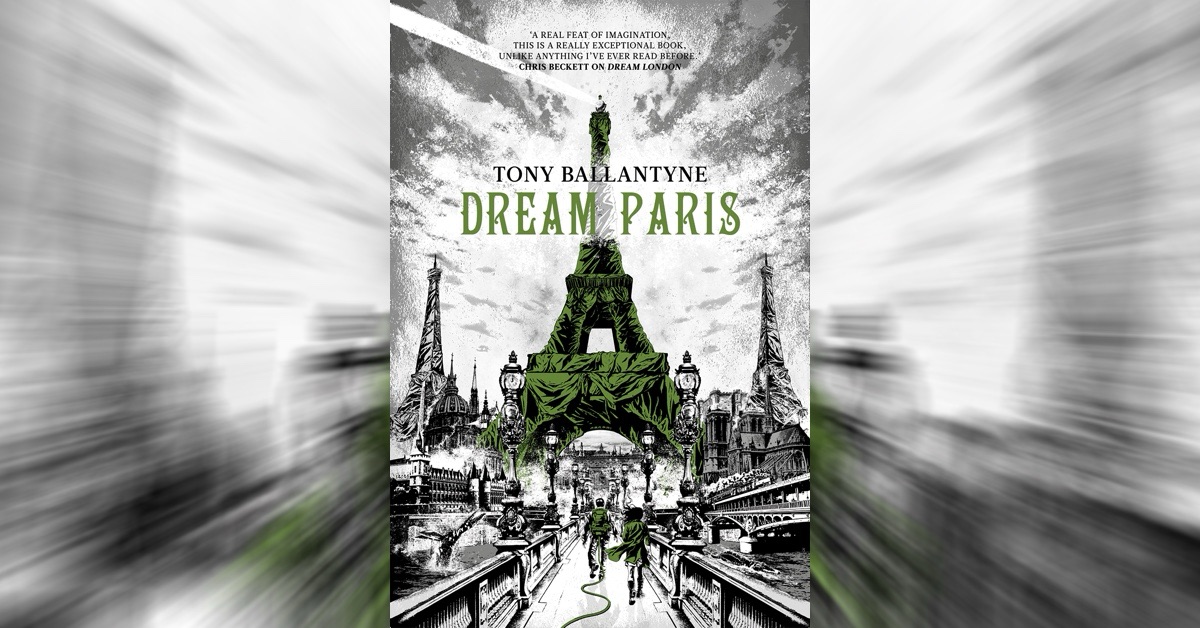
Anna Sinfield marched into the parks, when Angel Tower burned and Dream London fell. She marched to free the city, to end the madness, to find her mother and father. The day was won, but her parents – and thousands like them – are still missing, lost to the Dream World.
And now she has a chance to get them back. A man with gem like eyes has walked into her life, wearing a bespoke suit and bearing a terrible scroll. Mr Twelvetrees claims to know where the missing Londoners are; but to find them, Anna has to give up a life she’s started to rebuild and go into the Dream World itself. Into another Paris, where history has been repeating itself for two hundred years.
Vive La Révolution!
Buy on Amazon UK | Buy on Amazon US
Extract
Silver: The Social Worker
The sky was the colour of an unpolished euphonium, tuned to a dead key.
I paused. It didn’t do to let odd thoughts pass by unexamined. Dream London may have passed away months ago, I may have been living in plain old London once more, but strange thoughts still curled into the mind and tried to take root. If you wanted to stay sane, then those thoughts had to be examined, checked and classified. A dead key I thought. Exactly what colour is that?
The colour of this January evening, when there is no life to the world. When it’s cold, but not winter cold. When the air doesn’t burn the cheeks or fill the lungs with icy excitement, when the streets hold a chilly dampness that can’t commit itself to rain. That’s the colour.
I resumed my walk home. Beneath my duffel I wore a vest, a thick shirt and jumper. Hot sweaty air puffed from the neck and cuffs as I walked, but I didn’t unbutton my coat. They may have been relaying the gas pipes, but they’d yet to make it to Hayling Street and so it didn’t do to waste warmth.
The workmen had dug a service trench across the entrance to my road some weeks ago and had then, typically, forgotten about it. Yellow pipes lay curled up at the bottom, wrapped around piles of gravel, half submerged in puddles of dirty water. NothingSilver
The Social Worker unusual in that, the whole of London was being reconnected to the rest of the world, pipe by pipe, wire by wire. I used the narrow plank bridge to cross, jumping over the sickly puddle that covered one end, my heavy carrier bag banging my leg as I landed.
In Dream London, one of the many thoughts that had taken root in people’s minds and flourished was that females were incapable of looking after themselves. Many of the people living in Hayling Street no doubt still imagined I needed a man looking after me. I could see the curtains twitch as I made my way down the street. Funny that, all that concern about my moral wellbeing, whilst other neighbours were left to go hungry.
I rang Mr Hiatt’s bell.
“Corned beef,” I said, holding up the carrier bag as he opened the door. “I tried for some milk but there was none left.”
“Maybe next time,” he said, pulling out his wallet. I could hear music playing softly in the background, and I shuddered. Mr Hiatt handed across a couple of Dream London dollars, the once bright patterns faded to dull mustard.
“You’re a good girl, Anna. How’s your Mum and Dad?”
“Still missing.”
“I heard that they found another whale skeleton under Cooper Street. That makes four.”
“I heard that, too.”
The sound of violins playing on the radio wove their way through the house. Violins weren’t so bad, I told myself. Still, I felt myself trembling.
“I wonder what’s buried beneath our houses?”
“Best not to think about it, Mr Hiatt. Look, I’ve got to be off.”
“Thank you for the food. Goodbye, Anna.”
“See you, Mr Hiatt.”
He closed the door, gently. I crumpled the worthless Dream London dollars and dropped them on the pile of rubbish overflowing from the dustbin, making a mental note to take some of his waste to the communal tip down on Katherine Street.
I continued home, turning to pass beneath the dark yews guarding the garden. The house was still too tall, just like all the others in the street. Workmen had been through and erected scaffolding a few months ago, making things safe: propping up a wall here, throwing polythene sheets over the spaces where the tiles had separated on the roof there. They’d even gone to the trouble of placing braces beneath the bedrooms that had grown outwards. One of the workmen had taken a shine to me, he kept asking if I wanted to go for a coffee after I’d finished school. His gaffer had told him to leave me alone, said he wouldn’t like to think of one of his daughters living by herself. He took offence when I asked him how he’d feel if it were one of his sons, and I pointed out that there were lots of people worse off than me in London. At least I had somewhere to live.
The evening shadows made my home look as if it were dying. In the middle of this scene of unchanging stillness, the sudden movement of the woman waiting by my door made me start. She was drinking tea from a plastic cup. Something about that relaxed me a little. When she saw me, she drained the cup and quickly screwed it onto the top of a thermos flask.
“Can I help you?” I asked.
“Anna Margaret Louise Sinfield?” She pushed the flask into a large bag, speaking all the time in a broad Brummie accent. “I’m Petrina. I’ve come to check that everything’s okay.”
She fumbled in her pocket and produced a laminated card bearing her name and photograph.
“Social Services,” I read out loud. “I suppose I shouldn’t be surprised.”
Petrina was back in her bag again. That irritated me. It’s not so difficult to keep things organised. Perhaps if she’d got herself a briefcase with separators instead of that impractical handknitted ethnic bag…
“Sorry to take so long, but as you can imagine we’ve been very busy! Oh, where is that… ah, got it! You know, I haven’t had a moments rest since I was – bloody pen’s leaked everywhere – seconded here last week. Ah!”
She looked up and smiled, a pad and pen in hand. “Shall we go inside?”
“I don’t think that will be necessary. I’m perfectly okay, thank you. I don’t need any help.”
Petrina made a show of looking up at the crooked house. It was dim in the shade of the yew trees, the scaffolding further enfolding us as the January evening descended.
“I saw from that notice at the end of the road that this house isn’t back on the grid yet.”
“It will be in March. In the meantime there’s plenty of candles at the distribution centre. And we’re fortunate enough to have fireplaces and chimneys here…”
Petrina scribbled in her pad. She was going to patronise me, I just knew it.
“Anna, I don’t think anyone would say that you’ve not been doing a fantastic job of looking after yourself. You don’t need to tell me – oh, is it too much to ask for a pen that works? Ah, that’s it – tell me about how brave you’ve been. But you’re – how old, I had it written down here – sixteen, was it?”
“I’m seventeen. I’ll be eighteen in two months’ time.”
In other words, old enough to be legally responsible for myself.
Petrina pushed her pad under her arm and fumbled some more in her bag
“Seventeen!” she mumbled, pen clasped between her teeth. “Sorry, this is bloody ridiculous! They expect us to do all this extra work without bothering to update the records…”
I tried being polite. “I can see that you’re busy. Why don’t you just skip me and go on to your next client? There must be far more urgent cases than mine.”
It didn’t work. Petrina gave me that look that some adults give when they think they’re cleverer than you.
“Everyone is important, Anna.” She turned her attention back to her bag. “Now, I’ve got your school records in here somewhere. According to them, your parents are missing…”
“They got sent to the workhouse on the last day of Dream London. They were marched into the parks…”
Petrina glanced up from her search.
“Marched into the parks? You’re the third person today to say that. Is that some kind of euphemism? Are you saying that they’re dead?”
“No. I’m saying they were marched into the parks. Didn’t they brief you about how Dream London ended?”
Even if they had, it wouldn’t have mattered. If you weren’t here, if you didn’t live through the changes, if you didn’t experience how the streets moved around at night or how people’s personalities were subtly altered, if you didn’t see the casual cruelty, the cheapening of human life, the way that easy stereotypes took hold of people… If you weren’t there, you’re never going to understand what it was like.
Petrina adopted her experienced persona. Didn’t she realise it would have had more credibility if she was dressed in a suit and not a baggy tie-dyed skirt?
“I’m from Birmingham Social Services. I was seconded here to help sort out the mess. Look, this would be a lot easier if we went inside…”
I was tired of standing in the cold, and she clearly wasn’t going away. I opened my duffel coat and pulled out the heavy door key that I wore around my neck on a piece of string. Dream London had turned the door into a gothic arched portal of dark timber. There’s a knack to opening the door: pull on the handle, a half twist and then push with your shoulder as you turn the key the rest of the way.
I tumbled into the hallway.
“Wait there, while I get some light.”
Petrina wrote something on her pad as I felt for the box of matches on the shelf by the door. She really began to scribble as I struck the match and began to light the candles. Yellow pools of light sprang up one by one, illuminating a hallway that was slowly creaking its way back to its walnut-panelled glory.
Petrina followed me gingerly inside, careful where she trod. A line of orange Le Creuset pans marched down one side of the hall, ready to catch the drips from where the room above was separating from the rest of the house. Drips plip plip plipped into the pans at random, in A-flat, a quarter tone above E, a little too flat for middle C.
“It smells so damp.” Petrina wrinkled her nose.
“That’s because the house is leaking. It’s okay in the kitchen.”
I led her there. The warmth from the Rayburn smelled so good.
“I’ve always wanted one of those,” said Petrina, crossing to take a closer look at the oven.
Her face glowed orange, and I saw that she was really quite pretty when you stripped away the worry. I thought I knew her type: she’d spread her compassion wide and shallow, rather than engage on the specifics. Or maybe I was being too harsh. She was here, after all. She was trying to do the job.
“Where do you get the fuel from?” she asked.
“There’s a bunch of sheds in the back garden. I’ve been pulling them apart.”
“Why did your parents have a bunch of sheds in the back garden?”
“They didn’t. The sheds turned up when Dream London was dying. You really don’t understand what it was like, do you?”
Petrina didn’t like that. She didn’t like being told that she didn’t understand. She placed her bag on the table and took a careful look around the kitchen, noting the unopened cans arranged in a line, the clean plates on the drainer by the sink, the opened cookery book on one of the counters.
“You’re feeding yourself properly?”
“I get free lunch and dinner at school as part of the Emergency Support Grant. I also get a food ration twice a week from the distribution centre.” I didn’t mention that I shared some of it with Mr Hiatt. She was here to see me, Mr Hiatt was someone else’s problem. Actually, Mr Hiatt was no one’s problem. That was the problem.
“What about water?”
“The water still runs. The downstairs toilet is working.” The upstairs toilet had been blocked with mackerel. I’d scooped out as many of them as I could and buried them in the back garden. The section of the pipe that I couldn’t reach was now filled with rotting fish, but I didn’t feel the need to share that information.
Petrina seemed to remember something at that point. She was back in her bag, rummaging. I can’t begin to tell you how irritating that was.
“Always too many – what’s that doing there – got it!”
She pulled out an orange plastic folder and began to flick through it. I read the words on the front: London Disaster Zone Protocols, Ver 1.1
“I’m sure I saw it in here… prostitution, dog attacks, native and non-native birds… Ah! Here it is. Water supplies… I see. Thought so. It says here that not all water supplies can be trusted. Do you know if yours has been verified?”
“I always boil the water before drinking.”
“It might be better if you were to get your water from somewhere else.” She paused to suck her bottom lip, to look concerned. “To be honest, Anna, I’m not that happy with you living here on your own. What if someone were to break in?”
“Did you see the door? I’m safer in here than I would be in most places in London.”
“What happens if you get ill? What if you need help?”
“My boyfriend’s family makes sure I’m alright. I go round there sometimes.”
Petrina perked up at that. I could almost see her thoughts, her excitement at the thought of teenage sex.
“And does your boyfriend ever stay the night?”
“No, his parents won’t allow it.”
“But you’d like him to?” she prompted, a little too eagerly.
“What? So I can have unprotected sex in a damp house followed by the possibility of pregnancy and a delivery at what used to be Dream London Hospital? Yeah, now you mention it, that would be a far better choice than studying Physics at university. Thank you Petrina, I think I’ll give him a call right now and get him round here.”
Petrina smiled.
“I can see you’re a sensible young woman.”
“Don’t patronise me.”
“I’m sorry… but you say this is a damp house?”
“Of course it’s damp! All the houses in London are damp. The buildings are slowly shifting back to their normal form and now nothing fits properly. This house is as dry as anywhere else.”
She shook her head.
“It isn’t, Anna. There are places that have been fixed up.” She was looking thoughtful now. She was solving a problem. I felt my stomach tighten. “To be honest, Anna, you shouldn’t be living here on your own. I think you’d be happier in a teen hostel amongst people of your own age.”
“I can look after myself.”
“Even so, that’s what I’m going to recommend.”
“Why?” I was struggling to remain calm. Start shouting and she’d mark me down as a hysterical little girl. I had to remain calm. “Why? I’ve managed on my own for nine months. I’ll be eighteen in March; in eight months’ time I’ll be at University. Don’t you have more deserving clients to visit?”
Petrina’s mouth became a hard line. She wasn’t listening. I ploughed on.
“But I suppose they don’t have such nice houses. I’m sure you’d rather be sitting here in this kitchen than in one of those flats on the Broomfield estate with the druggies downstairs and two drunk parents spoiling for a fight in the room with you.”
“Anna, I think…”
“You don’t want me to be able to look after myself, Petrina. You’d rather that you could help me, because that’s how you validate yourself. Well, I’ll tell you when I needed help: back when Dream London ended. Tell me, where were you then? Back home in Birmingham, no doubt. You know where I was? Marching into the parks! Whilst people like you just sat at home, I was marching into the parks!”
I could see by Petrina’s face that she didn’t understand what I was talking about, but it didn’t matter, I was angry now. Angry at Petrina, angry at all the people like her…
“You’re all here now, all the people who were nowhere to be seen at the end. You weren’t there when we were fighting in Snakes and Ladders Square. But you’re here now, and guess what? You all know what to do! You’re all here with your advice about how we should have done things! All the politicians, all the bankers, all the parasites. All the people who allowed Dream London to happen in the first place and then ran off to hide when it was spiralling out of control. It’s always the same, isn’t it?”
“Anna, I think you’re getting a little emotional. I’m only here to help.”
“But you don’t get it, because you weren’t here! And if you were, I know where you would have been. You wouldn’t have been marching, you’d have been getting pissed or fucking or fighting, or writing letters to the Dream London newspapers. Well, I was out there trying to make a difference. I saw half my band killed. I walked in another world. Then I came back here only to see the same old people taking control again. It makes me sick!”
I was shouting now. I was red in the face. I couldn’t help it. You hold in the anger as long as you can, and then suddenly it all comes spilling out.
“You saw people killed?” said Petrina, flicking through her folder once more. “… Trauma, trauma… here it is…”
She read the passage, nodding as she did so. “I realise it isn’t nice to get so angry, Anna. I realise that later on you’ll feel bad for shouting at me like that, and I want you to know that I don’t blame you. No, I don’t blame you. It’s just a reaction to the stress that you’ve been under. Perfectly normal, nothing to be ashamed of. But you need help, Anna. That’s why I must insist that you go to live in a hostel. Somewhere you can be looked after properly.”
I folded my arms.
“No. I don’t see how you can, anyway. I’m over sixteen.”
“That was before the Emergency Act. Anyone under eighteen living alone is our responsibility.”
“Of course they are,” I scoffed. “And what happens to the properties they vacate? Who takes control of them?”
“That’s nothing to do with me, Anna.”
“I bet it isn’t. They wouldn’t let do-gooders like you know what’s really going on. You’ll go home thinking you’ve done a good job and meanwhile some shyster will have taken control of my house.”
She became indignant.
“No, Anna, it’s not like that…”
“Are you going to drag me away?”
“I could return here with someone to escort you…”
“I don’t think that will be necessary.”
We both jumped at that. Neither of us had noticed the tall, dark stranger who had slipped into the house. The stranger who now stood in the doorway to the kitchen. Not looking at us.
Petrina’s eyes widened in terror as she gazed at the intruder. Petrina hadn’t been in London for very long, after all. No wonder she found him so… unusual.
Buy on Amazon UK | Buy on Amazon US
Read about Dream London



 |
|