How Writers Write is monthly series of guest posts where established writers invite you into their workspaces, reveal their work habits and share their experience.
The series started last month with Keith Brooke. This month it’s BSFA award nominee Neil WIlliamson’s turn…
How would you describe yourself?
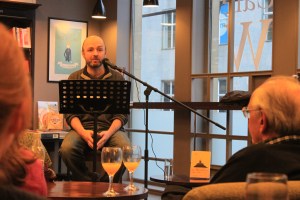
I’m not fond of trying to describe myself. Other people are usually so much better at it, even (especially) when they don’t agree. I’m a writer and a musician. If pushed to define musician I’d go with piano player, cabaret performer and songwriter. If pushed to define writer I’d tend towards fantasist, but with plenty of science fiction and a little supernatural horror on the side, as well as a stubborn streak of what we used to call slipstream back in the day. I like having the whole genre paintbox to play with.
What do you use to write?
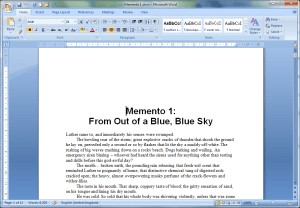
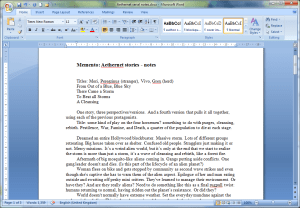
A pocket notebook for notes on the go. And my trusty wee Asus netbook for the actual writing. On the netbook it’s Word for short stories and Scrivener for novels. Word has always caught a lot of flak, but it does the job perfectly well. Scrivener I like for long works, but I only use a certain amount of its features because the netbook’s screen is tiny.
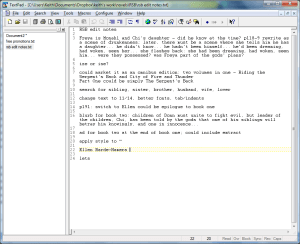
Short stories are written into a pre-formatted template, with any story notes kept in the same file until the end. Novels, obviously being larger, require a bunch of different files: character notes, plot outlines, timelines, snagging lists of bits that need to be added at some point but not right now. These can be in Scrivener or separate doc files, text files, spreadsheets, emails, whatever’s at hand.
For later on in the process, I’m still a fan of the print-out-and-scribble school of editing. Scrawled margin notes, emphatically scored out paragraphs, whooshy connecting lines. It’s all so much more colourful and dramatic than Word or Scrivener editing tools. Additionally, though, it allows me to second guess the changes I was so confident of a few days ago before I commit to them.
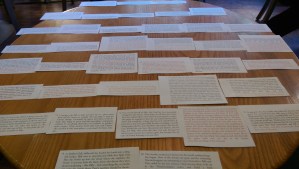
Recently, I went even more hands on by resorting to printing out all of my plot points and cutting them up and physically rearranging them in front of me. What can I say, you go with what works, don’t you?
When do you write?
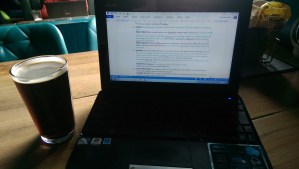
I have a regime that fits my writing in around my day job, home life and other creative pursuits. I had to establish one because there are so many things going on that nothing would get done otherwise. So, on weekdays I leave early and write for an hour before going into the office. Then at lunchtime I pop out and steal another hour. That adds up to ten hours a week. Weekday evenings I usually do not write: when I’ve not got a gig or a rehearsal, I usually don’t have the mental energy for it anyway, and I actually enjoy spending time with my bidey-in too. On Saturdays and Sundays, though, I try to spend three to four hours getting a good chunk of work done. So most weeks I’m doing 20-25 hours of writing. Which I don’t think is too bad.
Where do you write?
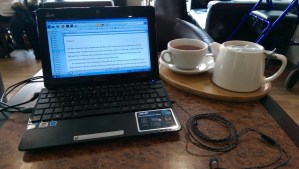
The weekday session take place in one of the many popular chain coffee establishments. These places seem to be purpose built for writers. Chair, table, power, wifi, selection of beverages, occasional moral support from interested serving staff. What else do you need? Somewhat obtusely, it’s my habit to drink copious amounts of tea in these sessions. This is for two very important reasons: it takes far less time for baristas to prepare which means more time for writing…and I fricking love tea.
The weekend sessions can be in a variety of local places. There are a few good cafes in our community, and there’s one in particular in which I’ve become part of the furniture. To change it up, I occasionally opt for the craft beer pub across the road instead, because…hell, craft beer? I got into the habit of using outside venues because our upstairs neighbours used to be pretty noisy, but we’ve new neighbours now, so I’ve recently “moved back in” as it were. I still find it easier to write outside of the house though, partially because the café environment is what I’m used to. It’s the office, it’s where the work gets done. And it doesn’t have a TV.
I am prone to distraction, though, so one vital ingredient is isolation music. I’ve got a Spotify playlist consisting mostly of film soundtracks that does the job very nicely.
How do you write?
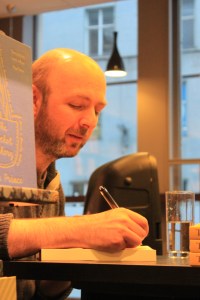
This is something I don’t often really think about or analyse to be honest. With short stories, I have ideas, and note them down and when I have enough notes I…just go for it. That sounds insultingly simple, doesn’t it? Partly that’s because I’ve been a short story writer for many years, and have got used to creating on that scale, so the process is something that just happens now.
Novel writing is relatively new to me (I’m finishing my second one right now), and the process is similar except that for novels there are more notes. Many more notes. One of the things I found interesting (both frustratingly and rewardingly so) about writing The Moon King was that the deeper I got into writing the novel, the more ideas about the way the world worked suggested themselves. I went through several iterations where the plot changed quite substantially because I’d written myself deep enough to understand more about the world and the characters. I kept snagging lists of notes of stuff I needed to go back and change on the next draft. Sometimes these were tiny changes, sometime they were big. It seems like an inefficient approach, but the point is that I couldn’t have sat down and thought it all out in one go. I needed to write the place, to live there with the characters to discover these things. So far Queen Of Clouds has been the same. The longer I spend in it, the deeper I go, the richer the world gets, and the more times I have to go back and ripple it all through the story…sometimes changing the story itself pretty substantively. Hopefully it makes for a better book at the end, but it’s a slow process. Who knows, maybe I’ll get better at it once I’ve been writing novels as long as I have short stories.
In terms of drafting and redrafting, I used to be an inveterate polisher. Every word, line, paragraph had to be at least good before I could move on. Now I just don’t have time for that. Getting the story down is much more important. If I can’t think of the right adjective I’ll throw three in that are roughly in the ballpark and sort it later. I’m not sure about a detail or a character name or a piece of action, I’ll leave a gap and write myself a wee note to fix it in the next draft.
I don’t work to a daily word count, but I do give myself deadlines. That seems to work pretty well.
Questions of style. First Person, Third person, present tense, past?
Whatever suits the story. I’ve used all of those in the past (and why did you leave out second person?). I personally tend to avoid omniscient viewpoint. It can be done brilliantly, but also very badly, and I’ve no great facility with it, so I leave it well alone.
How many redrafts? – How many readers? – How easy is it to let go?
Redrafts – depends on the story. Some stories are pretty much good to go right away. Others never quite feel right and I can tinker with them for years before finding a way to make them work. I mentioned that novel writing, for me, seems to be a process of discovery through redrafting, but I’ve not done enough of those to know whether it takes two, or five or ten drafts before a book is generally right.
Readers – I’m very fortunate to be a member of the Glasgow SF Writers Circle, an excellent and longstanding peer critique group. I’ve also got some wonderful writer friends who I drag into service from time to time, but try not to abuse their generosity.
Letting go – I’m a pretty honest appraiser of my own work. I know when, even if it’s not perfect, it’s at least good enough to do the job I want it to. And I know when, even if people enjoy it, it’s still lacking something. I’m honestly not a perfectionist, but my internal quality controller has high standards.
What are you working on at the moment?
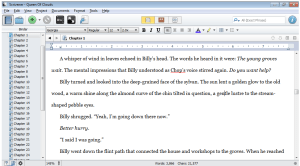
The second novel, Queen Of Clouds, is finally in the finishing stages. I’ve done all I can with it. Mined all I can from its depths. I’m just lining the words up for hopefully the last time (for now) and then we’ll see what my agent makes of it. And after that we’ll have a chat about what’s next on the novel front. I’ve an idea for a series of short adventure fantasies that I’d like to get into, but we’ll see.
Other than that, I’ve got a near future science fiction novella about surveillance states part-completed and a whole load of ideas for short stories. One of the things I’d like to do this year is go back and try my hand at horror again. I made my first sale to Black Static magazine recently with a supernatural tale called The Secret Language Of Stamps, and I’ve got a few more darkish ideas in production too.
That’s the thing about being a writer. You’re never short of ideas.
More Information
Neil Williamson’s Website: http://www.neilwilliamson.org.uk

 Tony Ballantyne