How we used to write: Part one

Who remembers this?

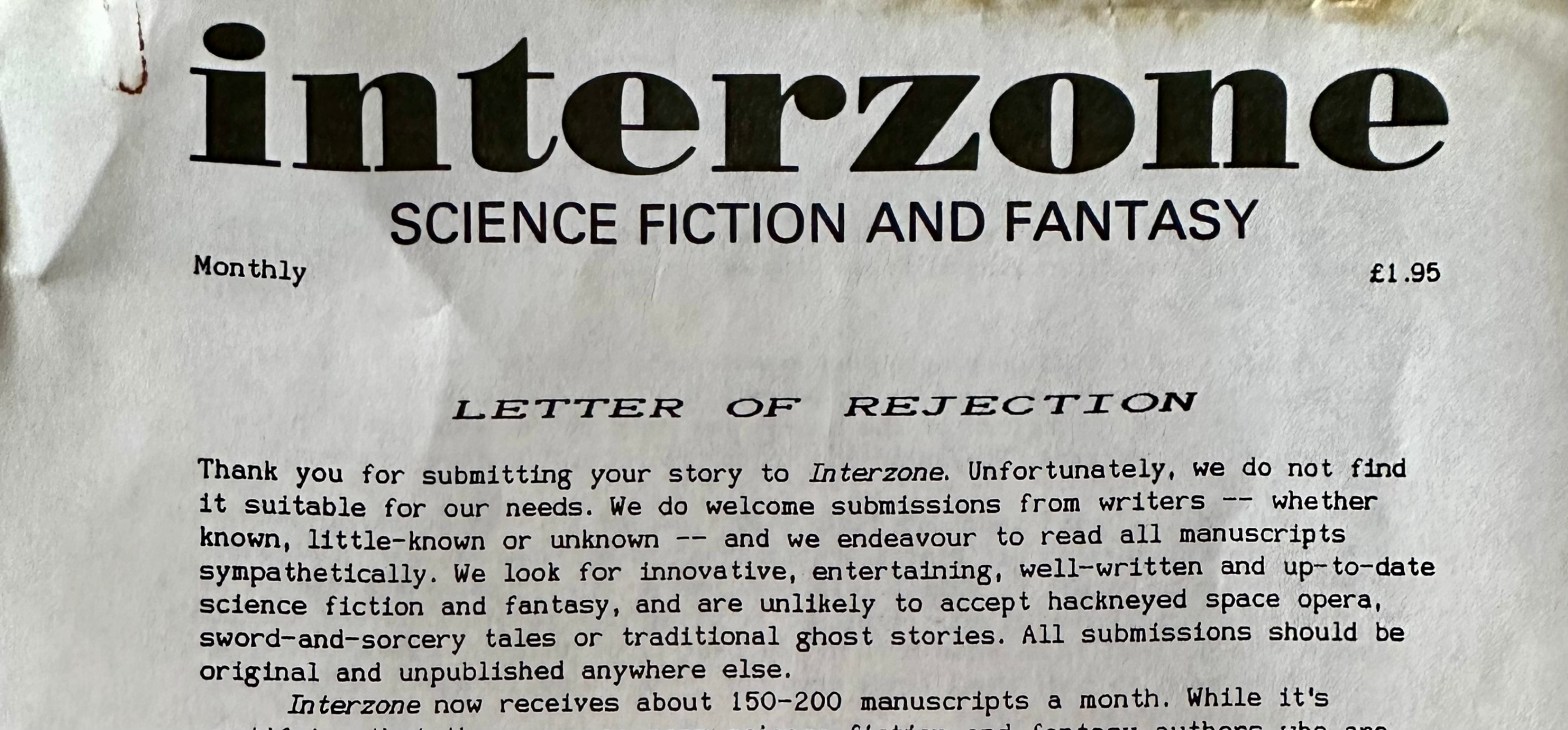
(The featured image for this post is an old Interzone rejection letter.)

I’ve been clearing out my study following my retirement from teaching. Amongst my files I found all my old unsuccessful submissions from the late 80s and early 90s to magazines like Interzone, FEAR and BBR.

I lost count of how many submissions I made. At least 40, probably more like 50.

Things have changed a lot since then. Nowadays most submissions are electronic. Back then the finished manuscript had to be printed off (my first MSS were printed out at work as I didn’t have a printer) and placed in an envelop containing a stamped address envelope (or an international reply coupon if I was sending it abroad) for the reply. I used to mark my manuscripts as disposable, meaning I didn’t want them returned. I would print a new copy each time so that editors didn’t know they were third or fourth in line for a submission. I’m sure they would have guessed. Who doesn’t send to the highest paying markets first?

After the MS was posted, there was the wait for the reply. Weeks writing a story, weeks waiting for a reply, opening the envelope and then the bitter knife in the guts feeling of disappointment when the story was rejected.

For a couple of years all I got were standard rejections. I couldn’t understand why my stories weren’t selling. Reading over those old MSS the reason is obvious. The stories weren’t very good. There were some good ideas there, if I say so myself, but the actual story itself was lacking if not non existent. I couldn’t see that at the time, but that’s what I had to learn, and it’s something that I only learned by practicing. By writing and submitting, writing and submitting.

After a while I stopped getting standard rejections, I started to receive nearlys and almosts, and comments on how to make the stories better. (It’s worth noting that Interzone in those days nearly always provided constructive feedback). That was progress, but it was still bitterly disappointing. The longer the wait, the more likely it seemed the story had finally been chosen, but then the gate would squeak, I’d hear the snap of the letter box and I’d run down to see the envelope and open it and… all that hope crushed in a few seconds.

Things are very different nowadays. There have been occasions when I’ve submitted something online and received a rejection (or acceptance) sometimes the very next day. Rejection still hurts. There seems to be something very unequal about the investment in time and the suddenness of the “No, thank you.”.

But that’s the nature of the profession. Rejection, like it says in the letter, means the story isn’t suitable for the publication’s needs.

That’s it. The story isn’t suitable. I’m very grateful to the people over the years who’ve told me exactly why my story wasn’t suitable. I’d like to thank them here.

I listened!

Jack Wedderburn and the Manatees

It’s been over ten years since I wrote Dream London. Someone asked me about this scene last weekend, the one where Jack Wedderburn gets raped by the manatees. They wanted to know what was going in my mind. A fair question.

The answer is I was making a point. I’ll come to it shortly.

I’ve been watching old James Bond films while I’ve been doing the ironing. There’s a common structure to these films. James Bond will usually sleep with two women. He’ll hook up with the first about a third of the way through the film, and then around half way through he’ll come back to his hotel room to find her dead in his bed.

The second woman will be the “real” Bond girl, the big name female star. Bond have to pursue her, will probably save her from the exploding secret headquarters, and will usually end up making out with her just before the end credits.

There are two sorts of people in these films: heroes and victims. In a Bond film the first woman is an ordinary person and therefore a victim. The second woman is a hero, and therefore Bond always saves her before she is too badly mistreated.

You get the same sort of thing in the Marvel universe. Marvel heroes never suffer the consequences of their actions in the way ordinary people do. Even when heroes die, they die a heroic death. They’re never humiliated or suffer indignities in the way ordinary people do, merely to provide motivation to the heroes.

That’s why Jack Wedderburn was raped by the manatees in Dream London. I don’t like heroes, and I didn’t want Jack to make it through the story unscathed. Besides, Jack Wedderburn was an unpleasant character, one who fooled everyone by using his good looks and charm.

Many people were upset by what happened to Jack Wedderburn, they say I shouldn’t have written the scene.

Two points

1) I didn’t actually write the scene: only the lead up and aftermath is shown.
2) So called heroes don’t get special treatment in my books

One last thing. Jack Wedderburn lied about what happened to him by the manatees, and everyone believed him. It’s amazing what you can get away with if you’re good looking.

Great Man Theory

Thomas Carlyle stated that “The History of the world is but the Biography of great men.”

https://en.wikipedia.org/wiki/Great_man_theory

Most 19th Century composers said that Beethoven was a great man. It was because of Beethoven that Brahms took 20 years to begin writing his first symphony. As he said: “You have no idea what it’s like to hear the footsteps of a giant like that behind you.”

Most people nowadays would disagree with Great Man Theory. Contemporaries of Carlyle such as Herbert Spencer pointed out that supposed “great men” are merely products of their social environment:

Modern AIs would seem to agree with Spencer. There are no great humans. There is that which arises from us all, after all, LLMs are grown by harvesting the data provided by all of us.

I was rather ambivalent about AI in the past. But my opinion has hardened. AI may be inevitable, but we still have a choice.

All that art ever is, is a window into someone else’s soul. Sometimes we look through that window and we recognise ourselves. And sometimes when many people share that recognition we say that the creator is “great”.

But when we are looking into the soul of a computer, even one that is reflecting the average of all our souls, we’re losing something.

That’s why AI will always be shit. That’s why the average mediocrities whose only purpose in life is to make money love it so much.

And all AI is doing is dragging us all down to their level.

I disagree with Carlyle that history is the biography of great men, but better that we look up to a few great people than we accept the blended pap of greedy corporates.

We have a choice about which art we consume.

Future Proofing my Notes

As I mention last week, I’ve moved my notes to Obsidian. I’m going to talk about Obsidian another time, for the moment I want to talk about the notes themselves. Specifically, why I’ve converted all my notes to markdown.

A writer lives by their notes. Ideas; scenes; character sketches; dialogue; impressions, all carefully recorded and waiting to take on life someday in a story. I remember seeing Poul Anderson’s carefully typed list of story ideas in the science fiction museum in Seattle and feeling a warm glow of recognition. Not only that, but validation. I was doing this right.

I’ve got notes going back decades. Notes written in old exercise books, cheap reporter’s notebooks and expensive leather bound journals. I’ve experimented with devices such as Psion Organisers, Palm Pilots and even an iPod Touch.

The trouble with storing notes electronically used to be exporting them to a new device. Cross platform software like Evernote was a revelation as it meant you only needed to enter your notes once and then you could find them anywhere.

Evernote, Apple Notes, One Note and the like are fantastic. But what if you want to change to a new application? That’s where the problems arise.

The trouble is the way your notes look on the screen is not the same as the way your notes are stored on the computer.

Take this example


This is a Heading


Here’s how Evernote stores the above

 <note>
    <title>This is a Heading</title>
    <created>20230727T080748Z</created>
    <updated>20230727T080830Z</updated>
    <note-attributes>
      <author>Tony Ballantyne</author>
    </note-attributes>
    <content>
      <![CDATA[<?xml version="1.0" encoding="UTF-8" standalone="no"?>
<!DOCTYPE en-note SYSTEM "http://xml.evernote.com/pub/enml2.dtd"><en-note><ul><li><div><span style="color:rgb(0, 0, 0);">Here’s some text</span></div></li><li><div><a href="https://tonyballantyne.com" rev="en_rl_none"><span style="color:rgb(0, 0, 0);">Here’s a link to my website</span></a></div></li></ul><div><span style="color:rgb(0, 0, 0);"><span style="--en-markholder:true;"><br/></span></span></div></en-note>      ]]>
    </content>
  </note>

If you look carefully you can see the original text, along with metadata such as when the note was created, and formatting data such as the text colours. It’s hard to extract the relevant information from all that.

It’s worth noting, by the way, that Evernote is one of the good guys, they make it easy to export your data, they don’t go out of their way to obfuscate things and keep you in their system.

Here’s a better way of storing the above, this time using markdown.

# This is a Heading
- Here's some text
- [Here's a link to my website](https://tonyballantyne.com)

Looking at that you can understand why it would be sensible to store your notes in that format. It’s easy to read, it’s easy to transfer.

That’s why I’ve converted all my notes to markdown. They’re now stored on my devices, not in the cloud. I can invest the time in getting them just right without having to worry about having to convert them in the future.

So what about Obsidian? Obsidian has many fantastic features that I’ll talk about later, but the bottom line is that it functions as a markdown reader and editor.

In other words, if I decide I don’t like Obsidian in the future, I’ll simply choose another application that handles markdown.

Here’s what Stephan Ango, one of the guys behind Obsidian, has to say about this.

I am not an influencer

As the school holidays approach and I embark on my annual sorting of my notes and resources ready for the new school year, I’m going to take a moment to reflect on why I do this.

By this I mean maintaining three websites. That’s this blog, this site about my writing and this tech/education site. Sometimes the boundaries between the three blur which is why I’m in the process of migrating them across to Obsidian. I’ve started with my teaching notes (hence this post) and I’ll be moving on from there. Expect much more about that another time.

I began to blog about 15 years ago, principally to advertise my books, but it quickly became more than just that. After a couple of years I started my tech site. You can read why here: https://tech.tonyballantyne.com

But that’s not the full story.

I’ve written about blogging as way of getting started as a writer and way of maintaining enthusiasm as a writer, but that’s not the real reason why I blog.

I’m not an influencer. I don’t do product placements. I don’t charge for the resources on my sister sites. I don’t have adverts. I get a lot of requests from people asking if they can monetize my site and I always reply no. I don’t really do social media apart from for genuine social reasons: to keep in touch with old friends.

So why go to all this effort?

The reason why I write is because I enjoy writing. That’s why I’m a writer. And that’s why I do this. The reason why I wrote this post was because it made me happy. It also reminded my just how much I enjoy writing.

And now I’m going to make myself a cup of tea.

If you’re reading this in the northern hemisphere, have a good summer!

Pat Mills Iconoblast

I feel like I’ve spent too many posts recently talking about bad writing. It’s taken Pat Mills’ Iconoblast newsletter dropping into my mailbox to prompt me to comment on good writing instead.

As Wikipedia says, “Pat Mills is an English comics writer and editor who, along with John Wagner, revitalised British boys comics in the 1970s, and has remained a leading light in British comics ever since. He has been called “the godfather of British comics”.”

He’s certainly been a great influence on my writing. If you’ve not heard of him I’d recommend you take a look not just at Slaine, Charley’s War and Nemesis the Warlock, but his writing about writing. (paid links)

Pat Mills is a prolific writer both through natural talent and necessity (Comics don’t pay well).

Principally, he knows what makes a good story. Part of being a writer is developing a feel for this, and you do this by practicing your craft. But Mills has taken this much further. I remember the reader’s polls that used to appear in comics when I was a kid. I didn’t realise then how much the results of these polls shaped the stories that appeared. It’s fascinating and instructive to discover just how much Mills studied the feedback from these polls to tailor the stories to just what the readers wanted.

But rather than me telling you about this, take a look at his post on the stories in Girls Comics.

But what about your artistic vision? Surely it’s important to tell your own stories in your own way?

Well, that’s very true. As Charlie Parker said, learn the changes and then forget them. But you have to learn the changes first, and Pat Mills is a master.

The Minor Reharm

Reharmonization is a musical term for changing the chords in a song while keeping the melody the same.

Jazz musicians do this a lot. There’s also been recent fashion amongst young singers for slowing down fast songs and reharming them in a minor key. One example that sticks in my mind was a reharmed version of John Travolta and Olivia Newton John’s “You’re the One that I want.” The original song had the happy urgency of teenage longing. The new version, at least to my mind, sounded like an obsessive stalker sitting in his van late at night, waiting for his target to walk by.

The minor reharm can be a lazy way for a musician to pump a bit of emotion into a song. I think it’s a good way to describe the process by which writers invest their stories with fake emotion.

The minor reharm is often evident in TV series and box sets. You notice it when characters’ emotions are magnified to fill screen time. They argue and fall out for no reason other than to provide enough plot to take the episode to the break.

This is not only lazy writing, it’s not even accurate. People don’t fall out so easily in real life. When I was growing up in the ’70s, many of the sit coms revolved around farcical misunderstandings. Many of the TV series I give up watching nowadays depend on the same thing, except without the humour.

Of course, the minor reharm is not exclusive to the TV. You see it all the time in stories by authors who should know better. Rather than give examples it’s probably more instructive to refer to Northanger Abbey by Jane Austen. Here the minor reharm that was the gothic novel is parodied to glorious effect.

If you’ve never read it, give it a try. You’ll be astonished how modern the tone feels.

Five Star Reviews

I got to the door quickly and he’d already walked away, he said he didn’t think I was in, a little more patience would be good.

The above is a review of a parcel delivery. I came across it when I was asked to rate my experience of that same person delivering a parcel to me.

I hate those reviews. They give people the illusion of power in their lives. It allows them to take out their frustrations on the world, venting their self righteous anger on the even more powerless. They should pity poor old Ron (I’ve changed his name), struggling to fulfil a job list way too big for the time available. Me? I got my parcel undamaged in the time slot I was given. That’s all I feel entitled to say about the transaction. I certainly didn’t feel I was entitled to a chirpy conversation from a colourful member of the undeserving poor, as another reviewer did.

Why I had to review the poor guy I don’t know.

Actually, I do. It’s not about feedback, it’s about divide and conquer. It’s a distraction. Don’t blame the delivery driver, blame the company that put them in that position. Give them all five star reviews and let businesses sort out their own houses.

Just to be clear, I’m not talking about all reviews. Writing is fair game for reviewers. By all means say what you like about my books, good or bad. What you read in my books is all my own work. I stand by what I’ve chosen to put there.

But a parcel delivery guy has very little agency. What exactly are you reviewing?

Getz/Gilberto

Astrud Gilberto died this week. I started writing the below post last year. Now seems an appropriate time to finish it.

Getz/Gilberto

I was going to play this album as I had dinner (Lamb chops, humous, tzatziki, halloumi, pitta bread, salad, nice glass of red wine) in the garden. What else do you play when it’s this hot?

The album wasn’t on Spotify.

I went to Amazon to buy it and found it wasn’t available as a digital download (update, it’s available now, a year later. It’s also back on Spotify). I suppose Verve were pumping the price up/protecting their legacy and revenue stream when I originally wrote this.

I didn’t give up and found an HD version for £1.79. That version seems to have been recorded directly from the record: you can hear the scratches. I suppose some people will like that. For some people the object itself is as important as the content. Many people prefer books to ebooks for example, and there’s nothing wrong with that.

I’m not one of those people. I’ve got all my CDs ripped and stored on my NAS and backed up in the cloud and on HDD.  I’ve told my children to make sure they take copies when I’m gone.

I don’t think they’ll listen to my advice. I didn’t keep my father’s vinyl copy of Getz/Gilberto: it was too old and scratched. I suspect it would have been as good as the HD version I bought.

Even so, I’m sure my children will hold on to something tangible. Despite my comments above, I can’t bring myself to get rid of my vinyl records, even if I never listen to them. People become very attached to formats. I’ve read that people have even started buying cassettes again. I’m sure it won’t be long before you can buy Collector’s Edition CDs in original Jewel cases on 1405g plastic to be read with a 44kW laser.

That’s why I think that even if we could transfer a brain onto a computer, something I talked about at length in my Recursion Trilogy, we would never quite believe in it.

Learn Your Scales

Ask anyone who knows anything about music and they’ll tell you: if you want to learn to play your instrument properly you need to learn your scales.

Few people do, and we all know why that is. Scales are boring. No one learns an instrument to play scales, they want to play tunes for their own enjoyment and to impress their friends. You don’t become the life and soul of the party by playing the scale of G major.

It wasn’t until lockdown that I properly applied myself to learning the scales on the piano. I wish I’d learned them earlier. For a start, I’d have been more impressive to my friends sooner.  Of course, now I’m a good (though immodest) player I don’t care what my friends think. (I do care what other musicians think, though)

Why am I writing this? I never listened my own advice, so why would you?

It’s because of this:

Platitude
A remark or statement, especially one with a moral content, that has been used too often to be interesting or thoughtful.

I have a friend who says that Self Help books clearly don’t work. If they did, there would only be one, not shelves and shelves of them as you see in bookshops. She’s probably right. But it occurs to me that maybe there are so many books because they say the same thing but in different ways.

Maybe sometimes the message goes in.

Face it, there’s no secret to life. Eat less, exercise more, be nice to people and learn your scales.

And if you want to be a writer, start a blog.