ibuffer changed my life

I wanted a quick way to delete all the buffers that can accumulate in an Emacs session. A quick search threw up this post by Martin Owen.

It turned out all I needed was ibuffer mode. ibuffer has a toggle command which selects all unselected buffers.

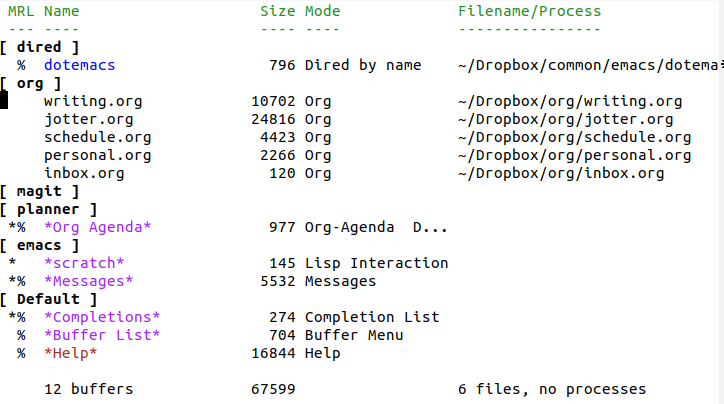
But that’s not all. ibuffer will group your buffers by type, just like in the featured image for this post. It also comes with a range of commands for filtering buffers. Here are my five favourite commands:

  1. t to toggle files selected
  2. / . to filter by extensions
  3. / p to remove top level filter
  4. * h Mark all help buffers
  5. * s Mark all *special* buffers

and here’s my set up: I’ve basically just adapted Martin’s.

(global-set-key (kbd "C-x C-b") 'ibuffer) ; instead of buffer-list
(setq ibuffer-expert t) ; stop yes no prompt on delete

 (setq ibuffer-saved-filter-groups
	  (quote (("default"
		   ("dired" (mode . dired-mode))
		   ("org" (mode . org-mode))
		    ("magit" (name . "^magit"))
		   ("planner" (or
				(name . "^\\*Calendar\\*$")
				(name . "^\\*Org Agenda\\*")))
		   ("emacs" (or
			     (name . "^\\*scratch\\*$")
			     (name . "^\\*Messages\\*$")))))))

(add-hook 'ibuffer-mode-hook
	  (lambda ()
	    (ibuffer-switch-to-saved-filter-groups "default")))

It took me about ten minutes to do all the above from start to finish. Ten minutes well spent, I say.

Midway

Written on the road between the past and the future, a writer explores his relationship with his dying father.

Literature, fantasy and science fiction come together in this unique and very personal piece.

Buy on Amazon (paid link)| Apple Books

| Barnes and Noble | Buy on Kobo

Ballantyne’s moving, quietly profound stories present flawed human beings confronting the vicissitudes of life with varying degrees of success. Superb.

The Guardian 16/10/2020

‘Sharp, touching, and very original, this collection uses stories of different genres to explore aspects of the same emotional landscape, creating a very personal and very satisfying whole.’

Chris Beckett, winner of the Arthur C Clarke Award

My New Writing Regime

I have a new writing regime.

For years I used to head in Manchester city centre to write in coffee shops and the Portico Library. Nothing unusual about that, many writers do the same.

But then lock down came and I found myself sat at my computer doing the day job for hours on end. Writing took a back seat: the last thing I wanted to do in the evening was to go back to the keyboard. I needed to find a new way to work.

I think I’ve found it.

Now, when it’s a writing day, I put my notebook and iPad into my backpack and set off walking. If I get an idea I record it on my phone using Speechnotes. When I’m ready to write I find somewhere to sit, be it a cafe, bench, pub or a convenient rock, and begin to write on my iPad. I repeat the process until I’ve done at least 500 words and then I go home.  The system seems to be working.

Not only that, it’s made me realise something.

I’ve now been a professional writer for twenty something years. During that time I was always in a hurry to get somewhere to write a story. It’s only recently occurred to me that when I read other people’s stories I stop and look at the scenery.

So that’s my new regime. I find I’m spending less time on the writing and more time on enjoying the scenery. Does it make me a better writer? I don’t know. I’m certainly a more relaxed one.

Lightweight .emacs

The last couple of years have seen a change in my Emacs setup. Work dictates that I have to use a number of different machines; in the past I’ve tried to give a consistent experience no matter which machine I was working on. Bookmarks, abbreviations, org-agendas were all stored on Dropbox, and an increasingly complicated set of code took into account paths for different operating systems and network setups. 

It came to a point where I seemed to be spending more time on my .emacs files than I was on actually doing anything.  I began to ask myself, was consistency that important?

The answer was no.

So I changed my approach.

I’ve streamlined my init file as much as possible. I now spend my time trying to find a way to use existing features as far as possible, If possible, I write lightweight code to solve a problem,  only installing packages as a last resort.  (take a look at my really simple scrivener mode for an example of this)

I still use packages, of course. I’m not going to stop using org mode or evil or magit, but I don’t need them on every computer. 

As far as my Emacs setup goes, I now only use Dropbox to enable the use of Orgzly and Beorg on my portable devices (I still use it to sync all my other files, of course)

Lastly, I’ve had a love hate relationship with Evernote over the years but I’ve been really impressed by the direction that it’s been going over the past 18 months.  All my records are now stored there, my agenda and editing is all done on Emacs (I sometimes forget that editing was its initial purpose).

Milanote

Milanote is a tool for organizing projects into kanban like boards. It’s targeted at creatives, and comes with a variety of templates, not only for writers but for fields as diverse as game design, interior design photography and software development.

You can write notes and todo lists, upload images & files and save things you find on the web, which is pretty typical for this sort of software. Where Milanote differs from other products mentioned on this site is the way you can organize things visually.

Crucially, you can export your boards as pdfs or pngs, or export them in doc, md or txt format.

There is a free version available with no time limit. The PRO version is $9.99 per month (monthly and annual plans)

Disclosure: Milanote shared a lifetime subscription with me in return for writing this post. I must admit, I’m a plain text sort of guy and always will be, but if you think in pictures and not in words, this may well be the tool for you.

Forks

Here is my pile of forks. The forks live on a shelf above my desk at work.

Every time I get a take away meal from the restaurant I take a metal fork with me. 

I always used to take my metal fork back to the restaurant when I finished my meal. This is because I am the sort of person who likes to keep things tidy. A place for everything and everything in its place. But it was also partly because it just seemed the right thing to do.

And then there was a notice in the staff bulletin saying that staff must return their cutlery to the canteen after their meals.  It listed the number of knives and forks in the canteen on a day to day basis and pointed out that the number was falling.  Staff were instructed to return their cutlery immediately.

Quite naturally, I began to hoard forks.

I know that not returning the forks is childish. I’m also aware that the pile of forks is upsetting me. I’d much prefer them to be back in their natural environment: basking in the cutlery tray. 

But most of all I’m really irritated at being instructed to do something I was planning to do anyway.

That’s why I have a pile of forks.

The Undecidable Blues

I wrote the following lyrics years ago, when I was doing my Maths degree. My friend, occasional collaborator and Dream London crimelord, John “Daddio” Clarke, has put them to music: listen here

The Undecidable Blues
by Tony Ballantyne

Woke up this morning, aware of my own inherent limitations
I said I woke up this morning, aware of my own inherent limitations
The fact that I can't prove them is one of those persistent aggravations

My baby makes these statements that are true, but unprovable
I said my baby makes these statements that are true, but unprovable
I ask her to explain herself but my baby is immovable

The way my baby's treating me don't demonstrate no consistency
You know the way my baby's treating me don't demonstrate no consistency
I say it's axiomatic: that my baby is a mystery

I said: "Baby won’t you tell me, you don't give me no clues
I’m riven by uncertainty, I don’t know how to choose"

I've got them Gödel's incompleteness theorem blues

John Daddio Clarke and the Cyprus Rodeo Blues Sisters sing The Undecidable Blues: listen here