My short story, Double Blind, appears in the anthology Solaris Rising 3, edited by Ian Whates.
The story is set in the same world as my short stories Third Person and The War Artist.
SF and Fantasy Writer
My short story, Double Blind, appears in the anthology Solaris Rising 3, edited by Ian Whates.
The story is set in the same world as my short stories Third Person and The War Artist.
The most boring talk I attended at Loncon3 was the one about Tax for Writers. It was also the most useful. HMRC were there to encourage writers to claim as much tax back as they could when filling in tax returns. The presenter (and okay, he wasn’t boring, he did a very good job) was at pains to point out this wouldn’t turn us into Starbucks or Amazon, it was simply the way the system works.
The best place to go to for help is here: http://www.hmrc.gov.uk/startingup/help-support.htm. I’ve been filling in tax returns for my writing for years now, but I still found some useful stuff there. I’d recommend any UK writer to take a look.
All the above is a huge misdirection, of course. Our overly complicated tax system is just a way to keep an excess of accountants in work, and to allow the rich and powerful to shirk their social responsibilities. If we were to simplify the tax system, a lot of very clever people would be freed to find useful employment, working for the betterment of humankind rather than simply to enrich themselves and their masters.
If you can figure out how to bring a simplified tax system about, I really hope you will do so. If not, you might as well try and get some money back out of the existing one.
My short story The Region of Jennifer appears as StarShipSofa Podcast no. 347. The story has been superbly narrated by Trendane Sparks. Follow the link for more of his work.
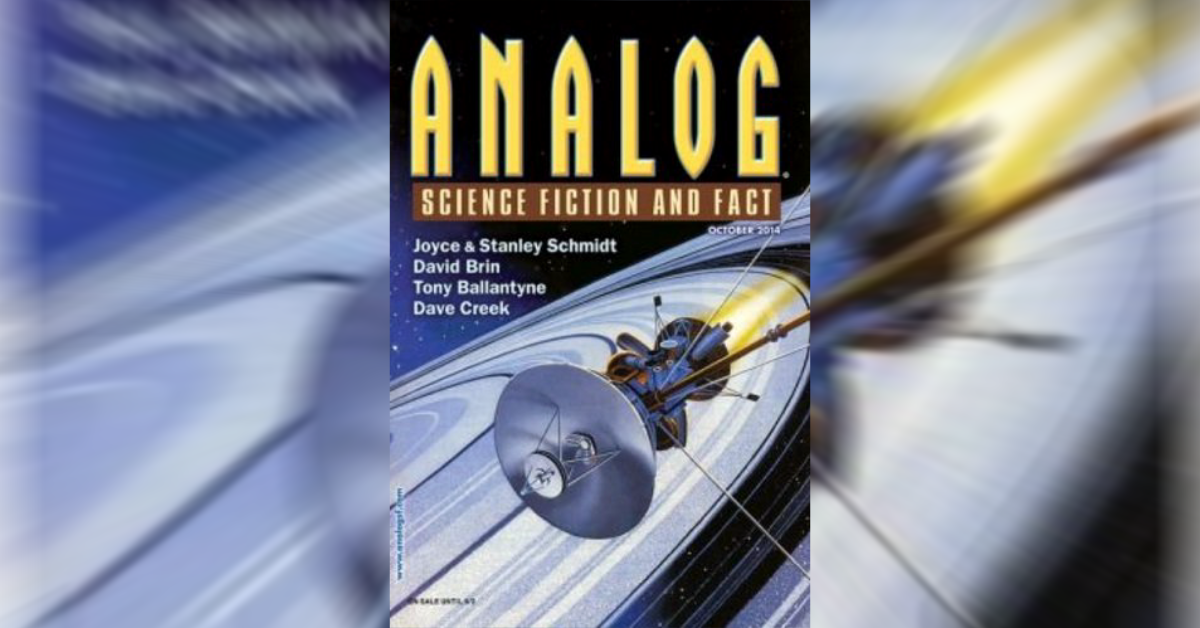
My short story, Threshold, appears in the October 2014 issue of Analog.
The story continues the Fair Exchange series that has been appearing in Analog over the past few years. It takes place in the Recursion universe around 12 years after the events depicted in the novels.
I’ll be attending Loncon 3, and I hope you are too.
Saturday 13:00 – 14:00, London Suite 5 (ExCeL)
Tony Ballantyne, Laura Lam
Come and chat!
I’m moderating the following panel:
Sunday 13.30 – 15:00
From the Minds of Iain M Banks’ Culture to Portal’s GLaDOS, artificial intelligences abound in sf, and not infrequently they turn on their creators. Whether as idealisation of reason or deadly threat – or both– why do AIs have such an enduring appeal? Where do fictional AIs
stand in relation to the real-world science? And to what extent has sf explored the ethical questions surrounding the creation of sentience to better serve humankind?
Madeline Ashby, Tony Ballantyne, Anthony Fucilla, Justina Robson, Tricia Sullivan
I’ll also be on the panel for the following:
What comic books from outside the UK have been influential upon the development of comic books here – artistically, politically, and thematically?
And how have British comic creators and stories in turn exerted their influence upon the comic book industries in other countries?
Is there a recognisable British comic book tradition? And how is it changing and adapting in an instant, connected world with a multitude of styles and visions?
Friday 18:00 – 19:00
The early twenty-first century commercial explosion of urban fantasy — first person, coexisting supernatural creatures, often noirish — was, at least initially, driven by the American market and American writers. Increasingly, however, writers such as Kate Griffin, Ben Aaronovitch and Paul Cornell are writing contemporary urban fantasy set in the UK and, in particular, in London. How has crossing the Atlantic changed this subgenre? How is it similar to or different from older forms of British urban fantasy?
“This House Believes that the European Union should not have been awarded the Nobel Peace Prize.”
I was delighted to be invited to the Portico Library in Manchester to adjudicate a debate evening with students from Parrenthorn High School, as part of the Portico Library’s Conflict and Community Programme.
The standard of debate was high, the students had clearly researched their topic and spoke persuasively. Even more impressive, they proved themselves capable of listening to opposing points and providing counter arguments.
I’ve written elsewhere about the raw deal teenagers today receive at the hands of the media. Anyone in doubt of the potential of teenagers should begin by listening to the pupils of Parrenthorn High School.
Thank you to the Portico Library for inviting me, the staff and pupils of Parrenthorn High School, and the Zochonis Charitable Trust for sponsoring the event.


I learned the craft of writing through short stories. When beginner writers ask me for advice, I always recommend they try the same. There are a lot of reasons for this: every tale completed means more practice at writing beginnings, middles and ends; you can experiment; you’re getting feedback more frequently… Best of all, you’re leaving each story behind and starting a new one. You’re always trying something new.
I don’t know how often I’ve said this. I do know that my advice is rarely taken. Fair enough, you choose which advice you take. but even so, I have wondered why more people don’t start with short stories…
And then, following a conversation the other day, it finally occurred to me why.
Because every short story completed opens up the possibility of another rejection.
Because rejection is painful.
Because writing a story means putting your heart and soul out there with the risk that no one is interested. Writing a story exposes you to the world. Devastating if the world isn’t interested.
It’s far safer to write a novel. The rejections are a long way in the future. You can mess around with a novel indefinitely, endlessly perfecting it, dreaming of the time that its picked up, that it becomes a best seller. One short story does not make you a writer, but with a successful novel you can miss out the wannabe stage and go straight to the top of the tree.
Good luck to you if that happens, and I’d be really interested to hear how you did it. But otherwise, my advice remains the same. Write short stories
My short story The Blue Magnolia appears as part of Far Fetched Fables No 9. The story is about 45 minutes in, though you’ll want to listen to the other stories too. It has been superbly narrated by Anthony Babbington – I’m going to be listening out for other work by him…
I overheard a conversation recently about the TV program Endeavour. Someone was complaining that the show had reached a point where the lead character was in danger.
“And we knew he wouldn’t die,” they complained, “because this show was a prequel. We know that Endeavour lives, he was seen as an older man in the TV show Morse.”
I’ve heard this sort of thing before, and it’s wrong. It misses the point. It’s not how stories work.
No one expects James Bond to die. No one ever expected Charlie Brown to ever kick the football. And surely no one expected Voldemort to be triumphant…
In most stories, the reader knows that the hero isn’t going to be killed, but that doesn’t matter. A journey is no less entertaining for knowing what the destination is going to be. Not every trip has to be a mystery tour.
There’s something almost reassuring in this, in following a story where you know what’s going to happen. This is what children in particular find pleasing in fairy stories and nursery tales, the repetition in the tale as Goldilocks tries the chairs, the porridge and then the beds and each time it’s the last choice that’s just right
A writer follows a curve and takes the reader with them. Some writers complain that people don’t want true innovation, that their stories are rejected because they’re too original. They may be right. But as I’ve written on this blog in the past, that’s the way the market works and the market is always right.
But there’s something else, too. Knowing when to repeat, knowing when to follow the conventions, that’s part of a writer’s craft. It makes peeling off into unknown territory so much more satisfying…