It’s beginning to look a lot like…


… Bad Christmas Movies

My family love bad Christmas movies.

I don’t mean bad Christmas movies like Love Actually where they have the time and budget to allow the cast to do their thing and then to edit the thing properly at the end. (Many things irritate me about this film, but I love the scene where Rowan Atkinson takes forever to wrap a Christmas present.)

Nor am I talking about bad bad Christmas movies where cast and crew are are just going through the motions.

No, I’m talking about good bad Christmas movies. The sort of movie which has all the ingredients, they just don’t have time and budget to put them together properly. The sort of film where the script talks about the evil Bolton Brothers who run an evil business, but the budget only runs to one of them showing up on screen.

What I love about these films is that they understand what the audience wants and they try to deliver it.

There’s a female lead who hasn’t had a relationship for some time.

She has a best friend who tells her to put herself out there and so she heads off to a small town (possibly her home town, possibly a town in New England or Scotland, occasionally a village near a castle in a small Kingdom in Europe)

The clock starts ticking, counting down to Christmas day.

The lead meets a Prince, a Lord or a Duke in disguise. If none are available she’ll settle for a handsome carpenter who is good with kids.

For some reason there will be a baking competition.

On Christmas Eve, it will start to snow.

And then she will realise she has met her man.

I have no problem with films that follow a structure. The first stories I placed were romances, sold to UK women’s magazines.

I learned a lot by writing them: if two people are going to fall in love in a romance, you have to make them attractive both to the reader and each other. Beginner writers, when confronted by something difficult (and getting your characters right is difficult) have a habit of dodging this by changing the structure.

Changing the structure can be fantastic, but not in this case.

I saw a film called Hot Frosty recently.

In it, a lonely woman builds a snowman who comes to life. He’s a good looking guy, totally ripped with great abs. The other women are jealous of this Hot Frosty.

And all I could think was, why don’t they build their own snowman? What if they did, and the town was suddenly filled with hot snowmen? What would the regular men do?

But this wasn’t a bad SF film. It was a bad Christmas movie. People watching this film (and I include myself in this) didn’t want internal logic. If they did they wouldn’t be watching a film where a snowman came to life.

If you’re looking for some ideas on what to write over the coming weeks, then I would recommend the following: write a straight love story. Or given the time of year, write a Christmas love story. Learn the structure and follow it. It’s excellent practice.

What do they teach these kids?

There used to be a question asked of trainee teachers: why do we teach Shakespeare and not Pinball?

It’s the sort of question that got a certain sort of politician angrily demanding that the lefties be kicked out from the teacher training colleges. The question annoyed me too when I first heard it (although when I was asked the question they said video games, not pinball).

But when I began to think about it, I realised that it was an excellent question. Possibly the most important question in education. It wasn’t so much about Shakespeare v Pinball, but rather about the value we place on different skills and knowledge. Why do we have the curriculum that we have?

The realistic answer, of course, is to make people employable.

One hundred years ago we taught people to add up columns of numbers. We were preparing clerks to work with ledgers. Nowadays students are taught how to use calculators or spreadsheets to solve problems. Different jobs, different education.

When I was at school the girls learned cooking and sewing, the boys woodwork and metalwork. Later on, girls could opt for what was called office skills: how to take shorthand and use a typewriter. My wife, studying 200 miles away in Wales, bucked the trend by taking A level physics and chemistry.

To put this in context, I was 9 when the Equal Pay Act came into force, meaning that women were paid the same as men for the same work. 15 years later, when I started teaching, it was taken for granted that girls and boys studied the same subjects.

When I started reading SF, just about the time of the Equal Pay act, I was led to believe that machines would do all the jobs in the future. SF promised humans a life of leisure. That prediction seems to have been half right. Nowadays, it seems, machines are indeed doing more and more jobs, but we humans seem to be working longer hours for less reward.

Which brings me to the news of the UK government’s curriculum review, announced yesterday.

The media made much of the fact that students would learn more about AI in the future. That makes sense.

But there was one rather heartening announcement that wasn’t really mentioned in the news reports: that changes to league tables will mean arts GCSEs “will be given equal status to humanities and languages, recognising their value in boosting confidence and broadening skills for a competitive job market.

Note that phrase, competitive job market. Like I said, education is all about making people employable.

But who cares? The arts have been slowly ground out of state schools over the past ten years. I think it’s a good thing that students will have the chance to start writing, painting and composing again. If the AIs are going to be doing all the jobs in the future, then at least students will have something interesting to fill their lives.

Maybe we can start to realise the second half of that 1970s vision of SF. Because I’m not sure it’s going to be that pleasant a future if we don’t…

Stevie Wonder

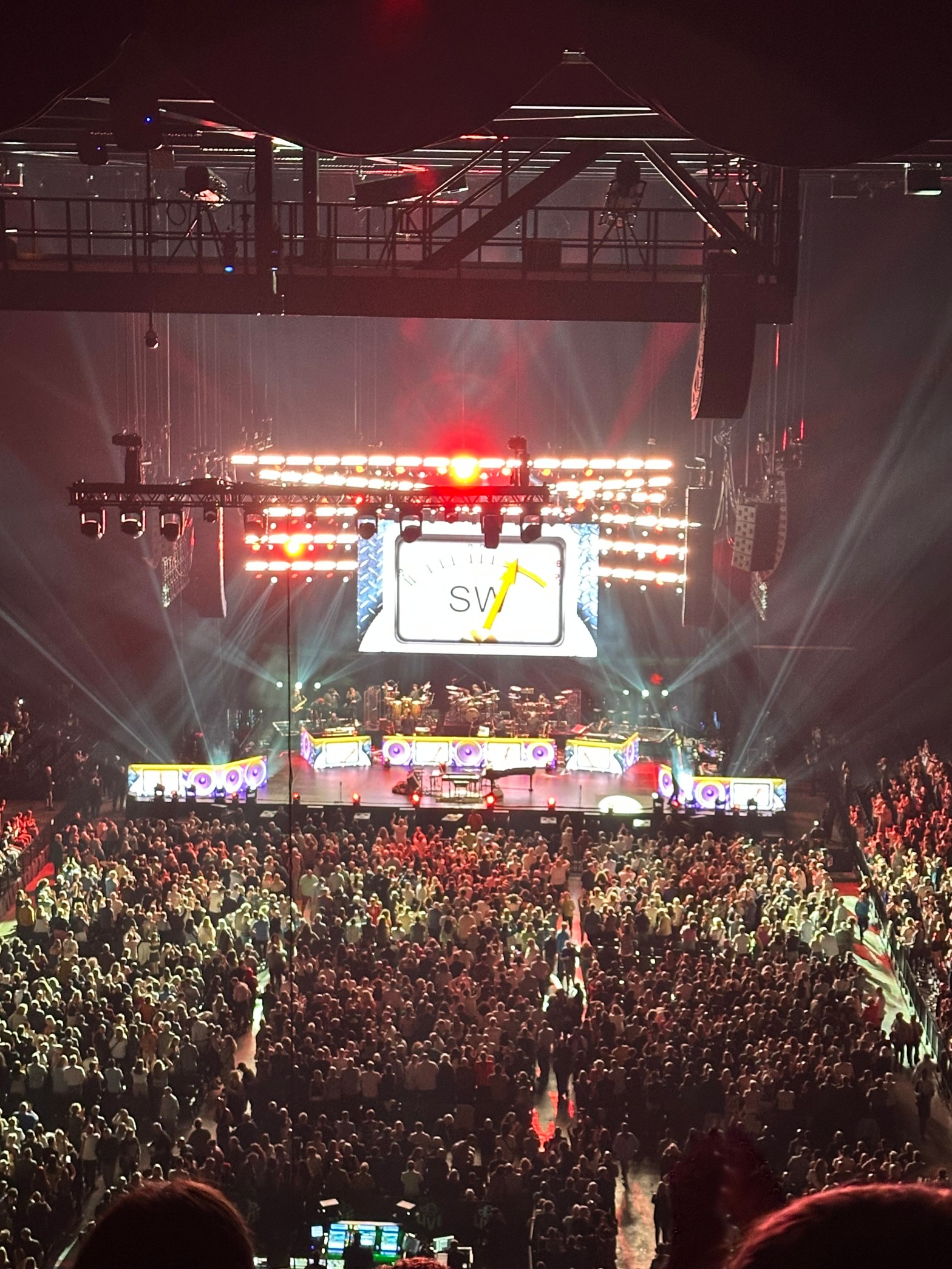
Last weekend I saw Stevie Wonder at the Co-op live arena in Manchester. A fantastic gig at no doubt the worst venue I’ve ever been to.

I was going to blog about Stevie Wonder, but there’s nothing much to say. After a shaky start his voice was still very strong, the band was, naturally, excellent, the hits kept on coming. I think he’s one of the major songwriters of the twentieth century and I’m not alone. One of the singers began his solo set by repeatedly saying “Mr Stevie Wonder. The Legend”. I understood what he meant. I was slightly awestruck to be in the same building as him. This man was sharing the same stage.

But this isn’t a piece of music criticism. It’s more an observation of the changing world. There was a great variety of people there that night, young and old. I myself went with my children who are big Stevie fans. There were undoubtedly a lot of music fans. But I don’t think that music is important to people nowadays as it was in the past.

That’s not to say that there aren’t lots of young people really into music nowadays. I regularly play in bands with young people whose musicianship far higher than I remember when I was younger. Teenagers nowadays have access to a far wider range of music through things like Spotify than was available to me as a child, and as result of this they have far more eclectic tastes.

But music doesn’t form such a big part of most teenagers identity as it once did. When I was at secondary school you liked Pop, or Northern Soul or Heavy Rock. It was a question you always asked when you met someone. What sort of music do you like? It was understood that it was part of your identity. I remember how one girl in my form would always be late to afternoon registration as she’d stayed home to listen for the number one record on the Thursday charts. I remember the excitement or disappointment when we heard that Duran Duran or Adam and the Ants had reached the top spot.

I don’t see that same level of tribal loyalty now, at least for music. That’s not a good or bad thing. That’s just the way it is.

I saw it at the Stevie Wonder concert. Many of the audience members spent most of their time shuttling between their seats, the bar and the toilet. That’s partly the result of the modern practice of seeing an audience as an opportunity to maximise its revenue stream, something the Co-op live has taken to an extreme (Did I mention how much I hated the place and the contempt they showed their customers?).

But it’s not just that. I’ve been to lots of gigs where I’ve left before the last song. But not for an artist I really cared about.

You have to wonder at the number of people who got up and left as the last song began on Saturday night. This was a gig where the tickets cost a minimum of £100. It was likely the first and last time people were going to see this artist, a legend in many people’s eyes.

Music is, of course, very personal. A song that some love can leave others cold. But this was the last song of a gig. It was Stevie Wonder playing Superstition. What on earth did they expect to see? Were they surprised? Were they disappointed. Or would they rather just get off early so they could have another drink?

Like Milhouse said: “You’ve changed man, it used to be all about the music.”

Why You Should Write Down Everything: The Power of GTD

My colleague recently noticed me updating my todo list.

“Have you really included walk the dog on your list?” he asked. “Even if you did forget, wouldn’t the dog remind you?”

The dog would remind, but that’s no reason for omitting the task.

I’ve followed GTD for years. One of the most useful bits of advice it gives is to capture everything, and I learned a long time ago this means EVERYTHING.

Yes, I wouldn’t forget to walk the dog, but walking the dog will take an hour of my time and this is time I can’t use for something else. Don’t get me wrong, I don’t want to use the time for anything else. I like walking. I like walking the dog. This is something I want to do.

It’s important to write everything down so I know how much time I have for things I want to do and things I have to do. That way I ensure I do both.

I wrote in some detail about my GTD process years ago. I’ve recently removed those posts from my website as part of the ongoing reorganisation.

The reason for removing the post is that Todoist explained it all far better than I did. If you’ve never seen GTD before I strongly suggest you follow this link. It might just change your life.

Speaking of Todoist, I’m planning a new section to discuss my current writing tools and how they’re evolving. Watch this space.

The Proprioception of Christmas

Johnny Mathis reminds me of my childhood.

My mother would play songs such as The Sounds of Christmas, It’s Beginning to Look A Lot Like Christmas and Christmas is a Feeling in Your Heart as we decorated the Christmas tree. His singing makes me think of bowls of satsumas on the sideboard, Terry’s Chocolate Oranges and soaking wet gloves from throwing snowballs.

Looking at those songs now, it occurs to me that – just like the advice given to beginning writers – the lyricists were trying to engage the senses with regards to Christmas. They’ve covered three of them.

But what about the others? I’m not just talking about the taste and smell of Christmas. It’s reckoned there are between 9 and 21 senses (Google it if you don’t believe me.)

So why not write a songs about an exteroceptive sense like flavour, a sense put together by the brain from taste and smell? It should be quite easy to write about the Flavours of Christmas.

It might be harder to write about interoceptive senses such as feeling your stomach gurgling. Harder, but not impossible.

Here’s a Christmas Challenge for my song writer friends.

Write The Proprioception of Christmas.

Proprioception refers to the way you can tell the position of your body. It’s proprioception that allows you to touch your nose with your eyes closed. If that doesn’t say Christmas I don’t know what does.

Entries in by the 24th December.

The best song wins a Chocolate Orange.

Inspiration Thursday

Looking for story inspiration?

I was walking through the cellar of my school recently when I came across a trolley full of half used containers of hand sanitiser. It occurred to me that this image would have meant something very different three years ago, before Covid 19.

And that got me thinking, what might it have meant three years ago?  Why would someone be throwing away so much hand sanitiser? What would have happened in a school in, say 2012, that meant they had over ordered hand sanitiser?

And that gave me an idea for a story. Maybe the image has inspired you.  Maybe not.

But what if the trolley wasn’t in a school, but a police station? Or a football stadium? Or on board a submarine?  What if the year was 1957, or 2140? What if the containers were empty, or had never been opened?

I have files of half completed stories based on chance encounters like this one. I never know when I’m going to meet the next image or person that will collide with an existing idea and cause it to burst into life.

That’s part of the fun of being a writer.

Worldcon 75

I’m delighted to say that I’ll be attending Worldcon 75 in Helsinki.

You can see my up to date program schedule on the con’s rather excellent website or read it below.

Look forward to seeing you there

Music and Magic

Wednesday, August 9  16:00 – 17:00

Tony Ballantyne, Leo Vladimirsky, Mrs Philippa Chapman

Music has been used as a tool for magic for a long time: the Finnish national epic Kalevala uses it extensively and Tolkien’s Middle-Earth was sung to existence! There is a clear connection between music and magic.

Evolution of the Image of the Robot

Friday, August 11  17:00 – 18:00

Tara Oakes, Tanja Sihvonen, Mary Turzillo, Tony Ballantyne

Robots are often made into the image of humans. In reality, however, robots have as many incarnations and images as there are robot creators. The panelists discuss how the image of the robot has changed and developed, both in fact and in fiction.

Signing

Saturday, August 12 14:00 – 15:00

Robot Morality

Sunday, August 13 13:00 – 14:00

Tara Oakes, Lilian Edwards, Tony Ballantyne, Su J. Sokol

With robot cars soon on our streets and with robots as caretakers questions of ethics and morals rise. How should a robot car choose to react in an accident (save passenger or save most lives)? What kinds of ethics and moral questions rise from using robots as caretakers of our children, elderly, disabled or ill. What about killer robots that are constructed by the armies of the world? Is it morally right to teach a robot to kill?


Manifesto

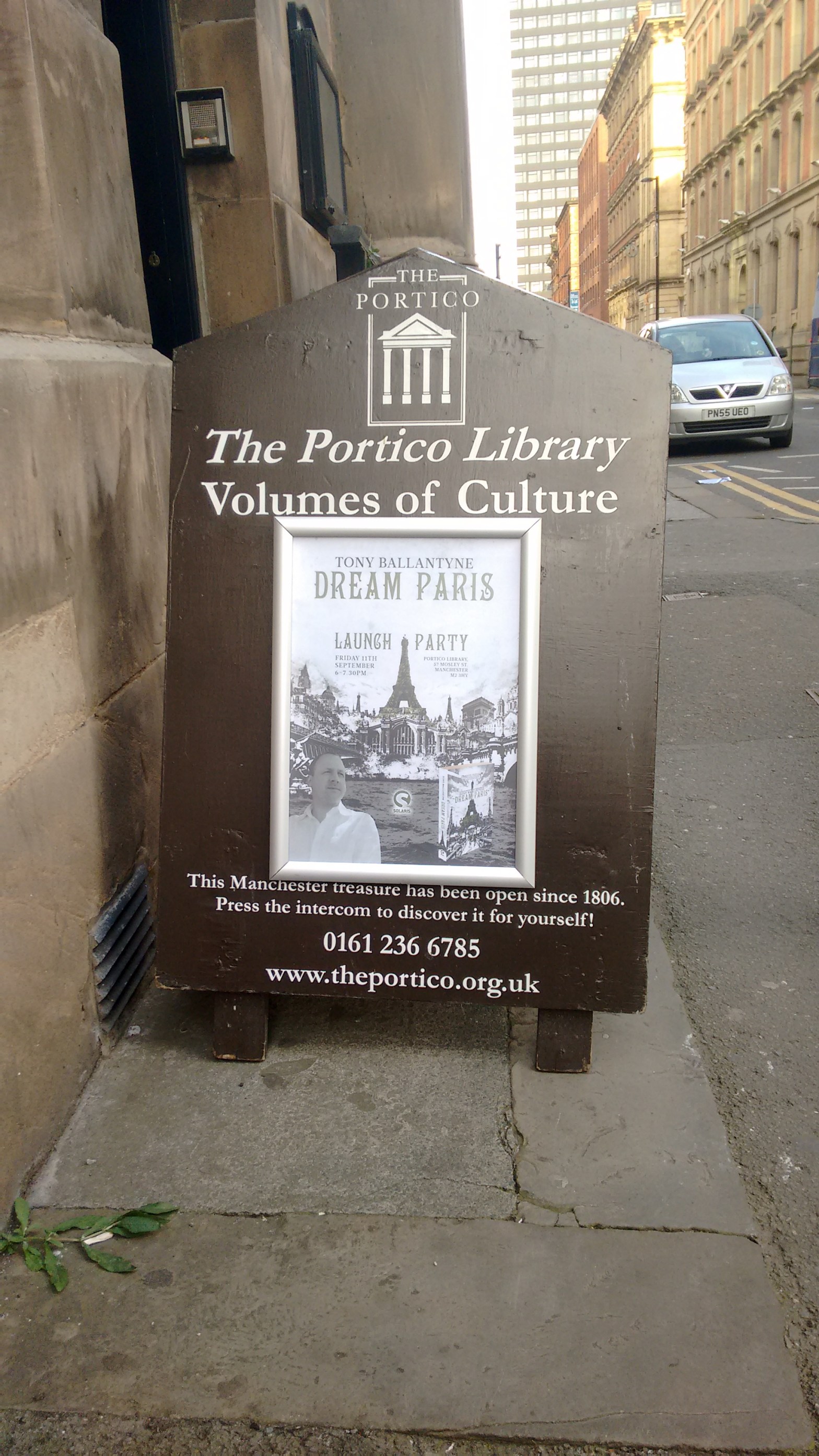
(I read the following at the launch party for Dream Paris, 11th Sept 2015)

It’s a common question asked of all authors: why did you write this book?

So when I finished Dream Paris, just like when I finished all my other books, I sat down and thought about what my answer would be when asked that question.

It was only than that it occurred to me how odd this was. I’d just spent 381 hours or 15 and a bit days (I timed myself, see my website) writing a novel over the course of a year, and I hadn’t once stopped to think why.

Why am I doing this? Why write at all?

There’s a very easy answer to this. That great writer about writing, Sol Stein said that a writer was someone who couldn’t not write. But perfect though that answer is, it doesn’t actually answer the question. Why write at all?

I spent a lot of time over the summer, wondering just that. I spend a lot of my time writing, my family put up with it, they’ve rearranged their lives to a certain extent to let me spend my time sitting at keyboard.

Why do I write? I could say it’s because I’m a story teller, but every human is a story teller. The first story we tell ourselves is the story of who we are. We make up the story of what sort of a person we are: happy or sad or popular or deserving or hard done by. We make up stories about other people, our friends and acquaintances, and our stories about them never match their stories of themselves. We put ourselves in their shoes so we can try and understand their motives and actions. This is what scientists call a theory of mind, some say this is the dawn of intelligence.

So I don’t think it’s enough to say that I’m a story teller, because everyone is.

I could point out that like many people in this room I’m a professional story teller, what’s called a teacher, and have been since I taught fencing on a children’s camp in America and discovered to my surprise that I enjoyed it. All teaching is story telling, teaching is taking the real world in all its splendid, unknowable complexity and reducing it to a story that a child can understand. Not only understand, but believe. And any teacher will tell you that the student doesn’t always believe what you’re saying.

So I’m a teacher and a writer. I don’t know which of those things come first, I know that they’re both linked. Incidentally, my wife often points out that those are two things nearly everyone thinks they can do until they try it…

Now, I don’t know if the above explains why I’m a writer. I know it leaves me thinking who wouldn’t want to be a writer?

But that still doesn’t explain why I write what I write.

There’s a certain cachet in being a writer, and whilst I’m delighted with this, it’s a sign of our society that someone who has written an impenetrable 80 000 word novel about the pain of being middle class is generally held in higher esteem than someone who gives up all their free time to run a Scout Troop or a Brownie Pack.

It’s also true that there is less cachet in writing SF. Indeed it’s not uncommon for people to ask me if I ever intend to write a ‘proper’ book. And yes, that is as rude as it sounds.

Well, I believe that SF is the only truly original form of literature of the past 100 years. SF encompasses everything from the mainstream but adds its own unique sensibility. I believe that SF is read by people who appreciate the beauty in Euler’s Identity just as readily as they appreciate the beauty in the St Matthew Passion, and if they don’t understand either of those things then they don’t scoff at them, they don’t say they are boring they are pretentious, they set off to learn about them. SF recognises that there is as much beauty in maths and science as there is in the arts, and that all these things make humans what they are. In my opinion, to try and explore the human condition without acknowledging the cold equations is to fail as a writer.

I believe what I just said to be true, and I could say that’s why I’m an SF writer, but it’s not.

The truth is, I’m an SF writer because when I write, I write SF. That’s the way that I think. SF isn’t about the robots and spaceships and rayguns – I rarely write about those things anyway – it’s about the way you look at the world, it’s the way that the stories are told. I can’t write a story without extrapolating, without asking what if, without acknowledging the fact that there is a cold, impersonal but ultimately wonderful universe out there.

I want to explain the world, I want to find wonder in the everyday. Ultimately, I think that the fact of the evolution of the horse is more wonderful than any unicorn and I can’t pretend otherwise. That really would be selling out.
This is why I write
This why I write what I write.
I can’t help it, I have no choice

Hiroshima

The picture shows the Peace Dome in Hiroshima.  The bomb exploded almost directly above the building, it was the only structure left standing in the area afterwards.

It’s very quiet around the dome, nobody has a lot to say.  They all look to a point above the building and imagine.

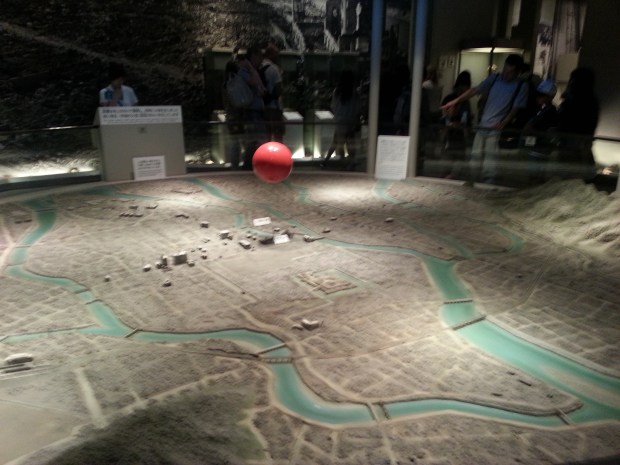
 I took the picture below in the Peace Museum, just around the corner from the dome.  The red ball hangs over the map: it represents the point of detonation.  There is a model of the dome beneath the ball.

The picture in the Peace Museum that upset me the most  was of two children playing with kittens.  Despite the fact they were in the middle of a war, despite the fact rations were tight and they expected to be firebombed at any time, the children were laughing and smiling.  They looked just like any kids anywhere, anytime.

The picture was taken three days before the bomb.