The Perfect Scene

Here’s one of my favourite passages in modern literature. In it, Sue Townsend describes Adrian Mole spending Sunday at his Grandma’s house. I suspect that many other people my age will recognise the scene from their own childhood. Nothing else I’ve read captures a sense of time and place so well.

Many writers have a temptation to throw unusual words or extravagant sentences at their ideas. This passage show that real genius is capable of simplicity:

Archers omnibus. Egg, bacon, fried bread, the People.

Roast beef, roast potatoes, mashed potatoes, cabbage, carrots, peas, Yorkshire pudding, gravy.

Apple crumble, custard, cup of tea, extra strong mints, News of the World.

Tinned salmon sandwiches, mandarin oranges and jelly, sultana cake, cup of tea.

Adrian Mole: The Wilderness Years by Sue Townsend

Sue Townsend

If anyone ever tells you that women aren’t as funny as men, say two words in reply: Sue Townsend.

Sue Townsend wrote the funniest book I’ve ever read: The Secret Diary of Adrian Mole, aged 13 3/4. I read it at just the right time of my life – aged around 15 or 16, when I was just a year or so older than Adrian Mole when he wrote his first diaries. When asked why she had written about a teenage boy and not a girl, Sue Townsend replied that she believed boys and girls were pretty much the same at that time of their life. She certainly described my childhood (and I sometimes fear she is describing part of my adulthood, too.)

Like many excellent writers, Sue Townsend knew that the best writing is often the simplest. One of her most inspired passages is to be found in The Wilderness Years, where she simply describes the food that Adrian eats one Sunday afternoon round his Grandma’s house. It’s nothing more than a list, but it sums up my childhood perfectly, sitting in front of the coke fire at my Grandmother’s house, reading the Sunday People and then watching something like Bullseye on the television.

Sue Townsend died on Thursday evening, aged 68. She left behind one of the most consistently funny and moving series of books ever written, books filled with a well realised air of righteous indignation about them. Sue Townsend was on the side of the forgotten people, the failures, the Adrian Moles of this world.

She will be missed.

The Region of Jennifer

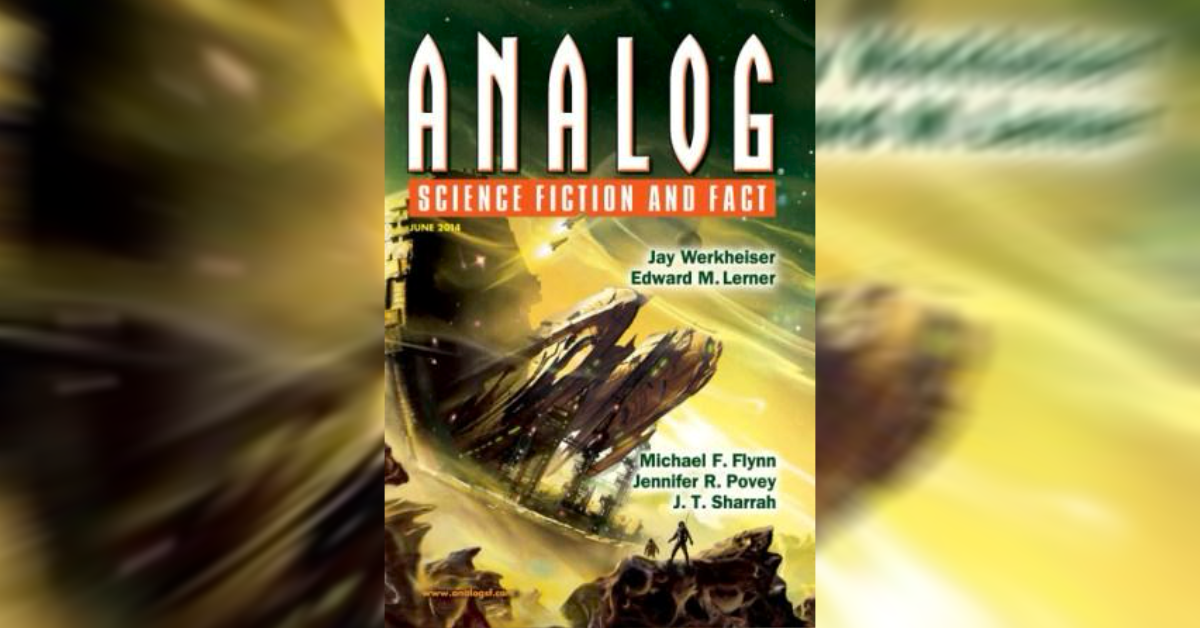
My short story, The Region of Jennifer, appears in the June 2014 issue of Analog

This is the first of a series of stories I’ve been working on set in the Recursion universe. The action takes place 8 years after the events in Divergence and deals with some of the questions raised by the Big Share Out that occurred at the end of Divergence.

I’ve had the idea for this series for some time, from around the time I finished writing Divergence, in fact, however I found myself distracted by Robots and Dream Worlds in the meantime.

But I was missing writing Hard SF, and I had reached the point where I just couldn’t not get the ideas down on the page, and The Region of Jennifer was the first result.

Watch this space, there are more stories in the Fair Exchange series to come…

Nobody Really Knows

Earlier this week I was listening to a radio program about the discovery of waves of gravitational energy that confirmed inflation just after the big bang. The presenter was inviting listeners to ring in and ask questions of a scientist, the scientist was doing a rather good job of explaining things clearly.

I thought it rather heartening that those taking part in the discussion were taking this opportunity to try and understand what was going on.

I should have known better. A caller rang in and announced that it was all very well hearing the scientist speak, but nobody really knows how the universe started. For all their talk, for all their experiments, those scientists didn’t really know what had happened.

I suppose that’s true. Nobody really knows anything. But that’s not very helpful.

Nobody really knows anything. It’s the really that’s the loaded word. I don’t really know what’s happening when my back is turned, I don’t really know what other people think of me, I don’t really know that I’m not part of some Truman Show style hoax and everyone is watching me on television.

But what’s the point of that sort of thinking? If I accept it, I might as well accept that I’ll never know anything.

Many people like to say no one really knows. It excuses them having to think. It has the added effect of pulling your hard won experience and knowledge down to their level. It makes their ignorance the equal of your ignorance.

I don’t see why I should accept that.

Did anyone else read Danny Dunn?

I’ve just finished answering a set of questions about writing SF, the results of which will appear in a magazine article. One of the questions asked was What’s the first SF you remember reading?

I couldn’t give a definitive answer but there are two series that stand out in my mind from my childhood. The  first is the Space series of children’s SF anthologies, edited by Richard Davis in the 1970’s and early ’80s, the second is the Danny Dunn series by Jay Williams and Raymond Abrashkin.

Did anyone else read those books? I haven’t read them for years, probably not since I became a teenager, and I’m not sure I would want to read one again.  It might spoil the memories.

But I loved the books at the time. Danny Dunn liked science and maths, so did the adults around him. His mother was housekeeper to Professor Bullfinch, a man who encouraged Danny’s love of science and taught him new things.  The science was pretty authentic (or so I remember) and I used to devour it.  The professor invented some of the objects which started Danny off on adventures.

For me, the best thing about the stories was that Danny Dunn (and his friends Irene and Joe) would win through by using their intelligence.  The resolution wasn’t achieved by guns, or superpowers, or magic, it was always achieved by thinking, by learning new facts and applying them. I wouldn’t say the books got me interested in studying Maths, but it definitely made me realise just how cool maths and science were. And if you’re laughing at this last sentence, then understand this, it showed me that there were other people who found those subjects cool.

I wonder what happened to Danny Dunn?

He’s probably a grandfather by now. I’d like to think that his kids are working at CERN or somewhere like that. I hope they didn’t end up working in quantum finance.

Danny Dunn, boy accountant. It doesn’t bear thinking about.

Six Tips on Narrative Voice

  • Writing in the First Person is harder than it looks: the narrator defines the sort of story you write. Compare the way the intelligent Katiniss Everdeen tells her story in The Hunger Games with that of the much less aware Riddley Walker in the novel of the same name.
  • There are very few stories written in the Second Person, something which makes those few attempted stand out and say something. Unfortunately, the thing they are usually saying is that the writer has just been on a course.  Best avoided.
  • Stories written in the Third Person offer the most flexibility, and are the best choice for the beginner writer. Of these…
  • The Third Person subjective is the easiest: here you can describe individual characters’ thoughts and emotions from the inside.
  • Third Person objective is harder: here you describe the characters from the outside, you’re not privy to their thoughts – rather like watching a film.
  • Third Person omniscient is the easiest but seems very old fashioned and lacking in skill. Most importantly, Editors don’t like it!

See Also

Thoughts on Cosmopolitan Predators!

Aethernet Magazine Issue #12 was published on Saturday, and with it the last episode of Cosmopolitan Predators!

What was the experience of writing a piece of serial fiction like? I’ve already already posted on this blog about writing serial fiction as well as the experience of working to deadlines. The various writers who contributed to Aethernet Magazine have also written about their experiences. I think it’s fair to say that none of us expected writing serial fiction to be quite so different, nor so difficult. But was it worth it?

Definitely! Writing serial fiction was enjoyable, exhilarating and frustrating. Every writer should always be pushing themselves, be trying something new, doing whatever it takes to keep improving. To borrow an excellent piece of advice from the musical world, “never put down your instrument until you’ve done something new with it.”

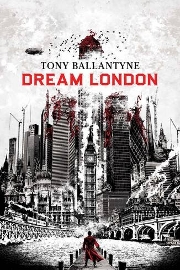
I’m now working on Dream Paris, the follow up to Dream London. I’ve set myself a target of 10 000 words a month (a bit more than the typical 7 – 8 000 words of each episode of Cosmopolitan Predators!) and I intend to deliver a complete episode to my first reader, Barbara Ballantyne, on the first of each month. Okay, I won’t be under quite the same constraints as when writing Cosmopolitan Predators! as I will have the luxury of going back and changing things. Will Dream Paris be a better book for being written this way? Well, I’m very pleased with how things are going so far, but then the final say on the book is not really up to me. For the moment though, I’m trying something new, and that’s what I love to do…

Six Books Every Writer Should Read

  1. Understanding Comics: The Invisible Art by Scott McCloud
  2. The Art of Fiction by David Lodge
  3. Solutions for Novelists: Secrets of a Master Editor by Sol Stein
  4. The Turkey City Lexicon (You can find it here)
  5. A Dance to the Music of Time: vol.1: Spring by Anthony Powell
  6. The book which inspired you to become a writer. Ask yourself, what makes it so good?

I also now recommend a seventh book: The Pointless Rules of English.  Read more about it here on my blog.

See Also

A Techy Whinge

A computer needs an operating system. You buy a PC and about 90% of the time it comes with Windows installed (about 8% of the remaining are Apple OS).1  A significant part of the cost of the PC goes on the operating system. Not a problem, Microsoft spends a lot of money developing their software, they deserve to paid for their work (just like I hope to paid for my writing).

The problem arises when you try and choose another operating system. What if you don’t want Windows?

Okay, I don’t do politics on this blog. If you want to know my politics, read my books. Better yet, buy me a pint at a convention and I’ll bore you with them as long as the beer keeps coming.

However, I’m taking a brief break from that rule this week. This might seem a boring techy whinge, and I suppose it is, but it’s important.

I’ve installed Ubuntu Linux, my preferred operating system, on three Windows 8 machines this week. It’s been a tremendous pain, something that was once a very easy job has become a nuisance because Windows does not want to let go of the machine. This is not just a Linux issue, my technicians at work are having trouble installing Windows 7 on new Windows 8 machines.

A lot of people have been rude about Microsoft in the past, sometimes unfairly in my opinion. But I’m about to join their ranks.

Why shouldn’t I install whatever operating system I choose on a PC? I bought the machine, it belongs to me and not to Microsoft, no matter what the pre-installed software seems to think. That’s like the estate agent saying I’m not allowed to choose the carpets or wallpaper for my new house. Or the bank saying that I have to have PPI when I take out a loan (and that didn’t work out so well for the banks here in the UK… )

I feel that we’re at crossroads. So many people are asking me to install Linux on their machines because they’re fed up of the dog’s dinner that is Windows 8. However, the process of installation of another OS hasn’t been this difficult in years. That’s why I’ve logged my experience so far here on my tech blog for anyone who might find it useful.

As I said earlier, this may seem like a boring techy whinge, but there are other issues at stake. For example, here in the UK, Microsoft allows schools to use Office 365 for free. Okay, Microsoft benefits by getting kids used to its way of doing things, but education benefits because even if Office 365 were not that good (and it’s excellent), schools are free to spend the money saved on other things.

Good for Microsoft.  Or so I thought. A few weeks ago at BETT (an educational trade fair) I was told that schools in Malaysia had to pay for Office 365.

Let’s just think about that. Countries who probably need the money more for their children’s education don’t get the free software.

Free, open source software has the potential to make people’s lives better. It helps to level the playing field when it comes to education. That’s just one, minor reason why I use Linux, and one reason why you should. If you’re using it, you’re helping to develop the software so that other people can use it.

That’s one of the reasons why I blog occasionally about Linux. That’s why I’ll be making an effort to transfer more Linux notes across to my tech blog Tony Ballantyne Tech in the coming weeks.

I use Ubuntu Linux, there are many other flavours available. Why not give it a try? If you know someone who uses it, ask them what to do, they’d probably be delighted, if not downright evangelical about its benefits.

In the meantime, you can find out more about Ubuntu here.