And through the wire…

A few years ago I bought myself an expensive phone, a change from the cheap ones I’d always used until then.

I would have been delighted with it apart from one thing: it frequently failed to charge.

Searching online, I found lots of other people having the same issue. Naturally, there were lots of opinions on where the fault lay. The OS, the manufacturer, the fact people hadn’t updated their phone. But in the middle of all the complaints one message kept patiently popping up: it’s all down to a faulty bunch of cables. Replace the USB cable and everything will be fine. I tried everything else before taking this advice, and guess what…

I had a similar experience when I replaced my 12 year old PC. I was having trouble burning DVDs (don’t ask) and I thought that maybe I’d pushed the old hardware as far as it could go. I bought a new PC and everything was fine. Problem solved.

It wasn’t until someone asked for a kettle lead to plug into the PA at a gig I was playing. I lent them my old PC lead. We turned on the PA and heard nothing but crackling. It turned out that, like with the phone, it wasn’t the device that was faulty, but the lead.

I was reminded of this at recent writer’s group meeting when critting a story. The world building was excellent, the plotting tight, the characters interesting. But the story wasn’t working.

The trouble in this case wasn’t anything to do with the story itself, it was the sentences themselves. Reading the story out loud (an old trick) revealed just how convoluted they had become. The writer was so intent on delivering all the ideas they had developed they had lost sight of the actual words they were using.

Stories like this remind me of playing the cornet. As they say in brass bands, it doesn’t matter how great your technique is when you’re blowing on your instrument, if you’re not making a pleasant noise, no one wants to hear.

When things aren’t working, whether with machinery, or stories, or indeed life itself, we have a tendency to blame the big obvious things and to forget about all those other less glamorous mechanisms that keep things running. Quite often we lose sight of the really simple changes that can be made in order to improve things.

Have I mentioned going for a walk recently?

Should you start your novel with a fight?

Should you start your novel with a fight?

It’s a good idea in one sense. I read a lot of opening chapters by beginner writers (and to be fair, some very experienced ones) that are nothing more than pages and pages of world building. This is particularly true in Fantasy and SF where the world they are describing is unknown to the reader.

World building is great fun if you’re a writer, it’s deadly dull to the reader. There is no conflict, no action, no story in other words.

So yes, why not start with a fight? It gives you a chance to show off your writing chops, examining the emotions, building the tension, having the bad guys seem to be on the point of victory than the hero turns it around at the last minute and wins through…

Except it usually doesn’t work. To care about a fight, you’ve got to care for the people taking part, and if this is the start of the novel and you’ve only just met them, then you’re not emotionally invested in them yet. You don’t really care who wins.

It’s not so bad in a historical novel when you may have an inkling that you’re on the side of, for example, the Allies and not the Nazis, but what chance have you got in a Fantasy novel where the Alfari are fighting the Volana? (And why have you used those words for their names?)

Even worse, what if the bad guys aren’t bad guys at all, but animals? I’ve read a surprising number of stories which begin with the hero successfully fighting off an attack by wolves (or smeerps). I’m not sure that killing a lot of wolves establishes a character’s hero credentials. Wolves aren’t evil, they’re just doing their job. And all the hero has done is save their own skin. All I’ve learned from such a scene is that the hero is good with a sword. I’m reserving judgement on whether I have any sympathy with them.

If you’re dead set on having a fight at the opening, make sure you establish whose side we’re on. You could give clues of course. The opening of the original Star Wars film does this well. It uses visual clues to establish who the bad guys are: the really big bully spaceship chasing the little one, one side wearing masks and killing without mercy. Then there is the use of trigger words like Empire. Empires in these sorts of stories are nearly always evil. This works, but it’s difficult, and it goes to demonstrate the following point:

It’s really hard to start a novel. Your aim is to establish who is who, what they want and what’s stopping them. A fight may seem attractive, but it’s not the easy option.

How we used to write: Part one

Who remembers this?

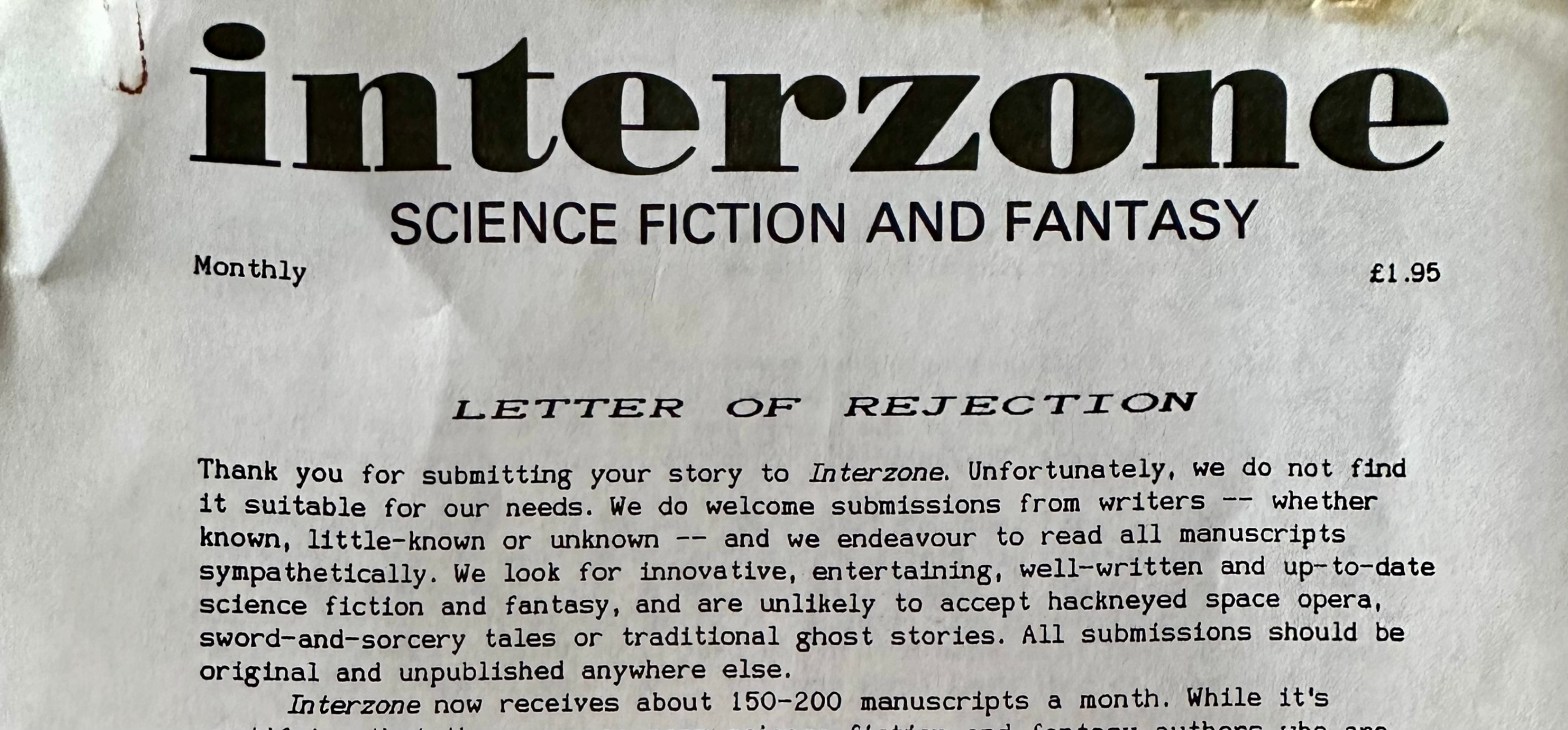
(The featured image for this post is an old Interzone rejection letter.)

I’ve been clearing out my study following my retirement from teaching. Amongst my files I found all my old unsuccessful submissions from the late 80s and early 90s to magazines like Interzone, FEAR and BBR.

I lost count of how many submissions I made. At least 40, probably more like 50.

Things have changed a lot since then. Nowadays most submissions are electronic. Back then the finished manuscript had to be printed off (my first MSS were printed out at work as I didn’t have a printer) and placed in an envelop containing a stamped address envelope (or an international reply coupon if I was sending it abroad) for the reply. I used to mark my manuscripts as disposable, meaning I didn’t want them returned. I would print a new copy each time so that editors didn’t know they were third or fourth in line for a submission. I’m sure they would have guessed. Who doesn’t send to the highest paying markets first?

After the MS was posted, there was the wait for the reply. Weeks writing a story, weeks waiting for a reply, opening the envelope and then the bitter knife in the guts feeling of disappointment when the story was rejected.

For a couple of years all I got were standard rejections. I couldn’t understand why my stories weren’t selling. Reading over those old MSS the reason is obvious. The stories weren’t very good. There were some good ideas there, if I say so myself, but the actual story itself was lacking if not non existent. I couldn’t see that at the time, but that’s what I had to learn, and it’s something that I only learned by practicing. By writing and submitting, writing and submitting.

After a while I stopped getting standard rejections, I started to receive nearlys and almosts, and comments on how to make the stories better. (It’s worth noting that Interzone in those days nearly always provided constructive feedback). That was progress, but it was still bitterly disappointing. The longer the wait, the more likely it seemed the story had finally been chosen, but then the gate would squeak, I’d hear the snap of the letter box and I’d run down to see the envelope and open it and… all that hope crushed in a few seconds.

Things are very different nowadays. There have been occasions when I’ve submitted something online and received a rejection (or acceptance) sometimes the very next day. Rejection still hurts. There seems to be something very unequal about the investment in time and the suddenness of the “No, thank you.”.

But that’s the nature of the profession. Rejection, like it says in the letter, means the story isn’t suitable for the publication’s needs.

That’s it. The story isn’t suitable. I’m very grateful to the people over the years who’ve told me exactly why my story wasn’t suitable. I’d like to thank them here.

I listened!